






Tesla drivers do this because every 2 plugs share a cabinet so charge rate is cut in half if both are used. You will see the plugs/stalls labelled 1A, 1B, 2A, 2B, etc.I also avoid SCs because while I can almost always charge if there’s an open plug, the habit of T drivers to park every-other-space means unless the station has more than 12 plugs, there’s often not an open plug even with 50% of the plugs technically not in use.
We own EVs. Ask Us Anything.
- Thread starter SpaceEVDriver
- Start date
-
 From all of us at Scout Motors, welcome to the Scout Community! We created this community to provide Scout vehicle owners, enthusiasts, and curiosity seekers with a place to engage in discussion, suggestions, stories, and connections. Supportive communities are sometimes hard to find, but we're determined to turn this into one.
Additionally, Scout Motors wants to hear your feedback and speak directly to the rabid community of owners as unique as America. We'll use the Scout Community to deliver news and information on events and launch updates directly to the group. Although the start of production is anticipated in 2026, many new developments and milestones will occur in the interim. We plan to share them with you on this site and look for your feedback and suggestions.
How will the Scout Community be run? Think of it this way: this place is your favorite local hangout. We want you to enjoy the atmosphere, talk to people who share similar interests, request and receive advice, and generally have an enjoyable time. The Scout Community should be a highlight of your day. We want you to tell stories, share photos, spread your knowledge, and tell us how Scout can deliver great products and experiences. Along the way, Scout Motors will share our journey to production with you.
Scout is all about respect. We respect our heritage. We respect the land and outdoors. We respect each other. Every person should feel safe, included, and welcomed in the Scout Community. Being kind and courteous to the other forum members is non-negotiable. Friendly debates are welcomed and often produce great outcomes, but we don't want things to get too rowdy. Please take a moment to consider what you post, especially if you think it may insult others. We'll do our best to encourage friendly discourse and to keep the discussions flowing.
So, welcome to the Scout Community! We encourage you to check back regularly as we plan to engage our members, share teasers, and participate in discussions. The world needs Scouts™. Let's get going.
We are Scout Motors.
You are using an out of date browser. It may not display this or other websites correctly.
You should upgrade or use an alternative browser.
You should upgrade or use an alternative browser.


I know why they do it.Tesla drivers do this because every 2 plugs share a cabinet so charge rate is cut in half if both are used. You will see the plugs/stalls labelled 1A, 1B, 2A, 2B, etc.
It doesn’t matter if the plug works if I can’t plug it into my vehicle.
The fact is that the design and the behavior that design engenders in its users creates one of the reasons I consider those stations to be unreliable as a place to charge. Unless there are more than a dozen plugs, it’s likely I won’t be able to charge at a SC when I want to charge. Thus, in most of my travels, I cannot rely on SCs being reliable charging stops. I’ll stop if it’s the only choice, but it’s very rare that SCs are the only choice.

Good luck with your family member! And thanks for the info, I am easing my way into this world and it's nice to have this forum with infoThanks. Things are looking up. Probably going to be doing the shorter round trip for the foreseeable future, but hoping not to be doing the longer round trip anymore.
Yes, front center or front passenger side makes the most sense to me. The only reason T uses rear driver side was because of the garage at the house EM happened to be renting around the time they were making that decision. Now everyone is stuck backing in to chargeThat explains a lot. Thanks!
In that case, it would seem that front passenger would be better if the cable could reach the front. That would allow for diagonal curbside parking hookup as well. That would also be better for those towing trailers. Of course, I might not have considered some other situation.


I've looked through several of the pages but admittedly not all, so if this question was asked already, I apologize. What would you say is the added cost to your electric bill, in dollars, percent, or however you can best describe? Obviously this is a loaded question and dependent on lots of other factors, but I'm curious what that hit looks like each month/year for charging an EV.
With all due respect, your view is in the minority. Tesla SCs have the best uptime and availability stats of any charging network by a WIDE margin.I know why they do it.
It doesn’t matter if the plug works if I can’t plug it into my vehicle.
The fact is that the design and the behavior that design engenders in its users creates one of the reasons I consider those stations to be unreliable as a place to charge. Unless there are more than a dozen plugs, it’s likely I won’t be able to charge at a SC when I want to charge. Thus, in most of my travels, I cannot rely on SCs being reliable charging stops. I’ll stop if it’s the only choice, but it’s very rare that SCs are the only choice.
Can they be cumbersome for some vehicles based on their charge port location? Yes. Tesla SCs were originally designed only for Teslas. The V4 SCs have 10' cables which solves the problem.
Please don't scare people. Tesla takes their SC network very seriously. They have been known to show up with truck-mounted generators to get people on their way if a site is down. Let me know when EA even picks up the phone when a site is down.....
Bottom line to everyone else, your Scout will automatically route you to compatible chargers when on the road. Just like gas stations, you may have a preference for one brand over another, but all will flow electrons. Yes you will need to carry a CCS adapter in order to use older chargers. Lectron sells them for $100 https://ev-lectron.com/products/lec...ast-charge-your-tesla-with-ccs-chargers-black. I carry mine with me and use it when I need it. I know this stuff seems overwhelming right now but it's pretty straightforward.
It completely depends on your local electric rates (tariffs). Most people don't pay much attention to them. Some providers charge you more per kWh the more you use (usage tiers). In that case your bill may spike quite a lot as the EV will put you into a higher tier. My utility, PSO (owned by AEP) has summer and winter rates (most people here use natural gas for heating so electricity use drops a lot in the winter). In the winter, the rate actually goes down the more you use. In the summer, it's the opposite. But they have a Time of Use (TOU) rate that makes power super cheap off peak ($0.05/kWh) and more expensive on peak ($0.25/kWh). On peak is M-F, 2:00pm-7:00pm. So you just need to avoid using a lot of electricity during those 5 hours each day. We have programmable thermostats so we have them cool the house down to 72 degrees by 2:00pm and then bump the thermostat to 78F until 7:00pm when it goes back to our usual 75F. Even in the heat of the summer the AC almost never kicks on until 7:00pm.I've looked through several of the pages but admittedly not all, so if this question was asked already, I apologize. What would you say is the added cost to your electric bill, in dollars, percent, or however you can best describe? Obviously this is a loaded question and dependent on lots of other factors, but I'm curious what that hit looks like each month/year for charging an EV.
In the winter my "blended" rate (literally total bill divided by kWh) is $0.10/kWh and in the summer it's $0.12/kWh.
I realize this is highly variable but we have a 3,200 sq ft house that is all electric (geothermal HVAC, heat pump water heater, electric cooking, electric dryer, etc) with 2 EVs and we pay ~$380/month in the depths of winter and $480/month in the peak of summer. Oh, we also have a 25,000 gallon pool as part of that. I drive ~15,000 miles/year and my wife about 10,000. This is in NE Oklahoma so winters are fairly mild but summers are serious.
Last edited:

So many factors…I've looked through several of the pages but admittedly not all, so if this question was asked already, I apologize. What would you say is the added cost to your electric bill, in dollars, percent, or however you can best describe? Obviously this is a loaded question and dependent on lots of other factors, but I'm curious what that hit looks like each month/year for charging an EV.
For me, it’s difficult to say with certainty because the weather has been weird, we’ve added some other devices, I run a compute business from home with wildly varying compute demands from week to week, we have solar panels and a backup battery, etc., etc., etc.
The easiest way for me to say is to estimate cost per mile of the BEV and compare that with the cost per mile of the gas vehicle it replaced.
tl;dr:
I estimate that we’re saving about $3800/year (plus/minus about $1500) in energy costs compared with driving our two most recent gas vehicles. Averaging that over 12 months is about $320/month savings. This also assumes $3.50/gallon gas, which is way low compared with today’s gas prices. If you increase gas prices to the average in our area, the estimate is about 50% too low (if gas prices stay what they are today, we’ll save more like $5700/year).
----
We are fairly strict about trying to charge during super-off-peak time (10:00 to 15:00). When we’re successful at doing that for run-around-town driving, we pay $0.03495/kWh. With the Mustang getting around 4 miles/kWh and the Lightning getting around 2.5 miles/kWh, that’s $0.008/mile for the Mustang and $0.014/mile for the Lightning.
If we only did around-town driving, that would be:
16,000 miles/year in the Lightning means $224/year energy cost for the Lightning.
14,500 miles/year in the Mustang means $116/year energy cost for the Mustang.
However, we do road trips for about half of our total miles, more than half in the Lightning and less than half in the Mustang. If I use an average of $0.48/kWh cost for those trips:
Lightning (10,000 miles/year road trips, 6,000 miles/year around-town):
$0.48/kWh / 2.3 miles/kWh = $0.21/mile road trips and $0.014/mile around town...
$0.21 * 10,000 + $0.014 * 6000 = $2184/year for energy.
Mustang (4500 miles road trips and 10,000 miles around town):
$0.48/kWh / 3.7 miles/kWh = $0.13/mile road trips
$0.13 * 4500 + 0.014*10000 = $725/year for energy.
The Tacoma we had prior only got 8-16 miles/gallon, depending on if I was really babying it at 45 mph or if I was towing or driving around town. The average was about 12 mpg.
For a 16,000 mile/year driving habit, with gas at around $3.50/gallon, the annual cost of fuel was about $4700.
Our Golf Alltrack was not very impressive with only about 25 mpg, at best. For 14500 miles/year, average of $3.50/gallon, that estimate is $2030/year in fuel costs.
Yeah I realize it's such a loaded question due to like you guys said, all the different variables. I'm mostly trying to get an idea and set expectations at this point, so all the information you guys have given thus far is very helpful and I appreciate it. Thanks.So many factors…
For me, it’s difficult to say with certainty because the weather has been weird, we’ve added some other devices, I run a compute business from home with wildly varying compute demands from week to week, we have solar panels and a backup battery, etc., etc., etc.
The easiest way for me to say is to estimate cost per mile of the BEV and compare that with the cost per mile of the gas vehicle it replaced.
tl;dr:
I estimate that we’re saving about $3800/year (plus/minus about $1500) in energy costs compared with driving our two most recent gas vehicles. Averaging that over 12 months is about $320/month savings. This also assumes $3.50/gallon gas, which is way low compared with today’s gas prices. If you increase gas prices to the average in our area, the estimate is about 50% too low (if gas prices stay what they are today, we’ll save more like $5700/year).
----
We are fairly strict about trying to charge during super-off-peak time (10:00 to 15:00). When we’re successful at doing that for run-around-town driving, we pay $0.03495/kWh. With the Mustang getting around 4 miles/kWh and the Lightning getting around 2.5 miles/kWh, that’s $0.008/mile for the Mustang and $0.014/mile for the Lightning.
If we only did around-town driving, that would be:
16,000 miles/year in the Lightning means $224/year energy cost for the Lightning.
14,500 miles/year in the Mustang means $116/year energy cost for the Mustang.
However, we do road trips for about half of our total miles, more than half in the Lightning and less than half in the Mustang. If I use an average of $0.48/kWh cost for those trips:
Lightning (10,000 miles/year road trips, 6,000 miles/year around-town):
$0.48/kWh / 2.3 miles/kWh = $0.21/mile road trips and $0.014/mile around town...
$0.21 * 10,000 + $0.014 * 6000 = $2184/year for energy.
Mustang (4500 miles road trips and 10,000 miles around town):
$0.48/kWh / 3.7 miles/kWh = $0.13/mile road trips
$0.13 * 4500 + 0.014*10000 = $725/year for energy.
The Tacoma we had prior only got 8-16 miles/gallon, depending on if I was really babying it at 45 mph or if I was towing or driving around town. The average was about 12 mpg.
For a 16,000 mile/year driving habit, with gas at around $3.50/gallon, the annual cost of fuel was about $4700.
Our Golf Alltrack was not very impressive with only about 25 mpg, at best. For 14500 miles/year, average of $3.50/gallon, that estimate is $2030/year in fuel costs.


I've looked through several of the pages but admittedly not all, so if this question was asked already, I apologize. What would you say is the added cost to your electric bill, in dollars, percent, or however you can best describe? Obviously this is a loaded question and dependent on lots of other factors, but I'm curious what that hit looks like each month/year for charging an EV.
Its pretty easy to calculate the ballpark basic costs of an EV, once you know what you're looking for, just like it is for a gas car.
For a gas car its:
(Miles per year / mpg of the car) x cost of gas per gallon.
For an electric car its:
(Miles per year / miles per kwh efficiency of the gar) x cost of electricity per kwh.
Then you just add that amount to your electric bill for the year.
The confusing part is the "miles per kwh efficiency of the car". But thats pretty easy to find for any given vehicle (mine displays it in the driver display for every drive, just like how my gas ones show me the instant mpg). You can math it out, or look it up, but its pretty straightforward.
For me, it looks like this:
(15000 / 2.9) x $0.1065 = $550 a year in electricity.
Again, this is ballpark. It doesn't count for you charging at other places with different electric rates. Or account for time of use things as mentioned above, or even the charging efficiency difference (there is some wasted energy when charging, from conversion losses, but its fairly low with 240v L2 charging, like a few percent).
Also, a lot of smart/connected L2 chargers you get for your house, have apps/data you can use to look at JUST the EV chargers consumption/costs. So that is another easy option. I can post a screenshot from my phone later.
Here are a few examples from the emporia charger I have.
You can see it in a report for the month. You can see the days of the week we charged, and how much that cost us.
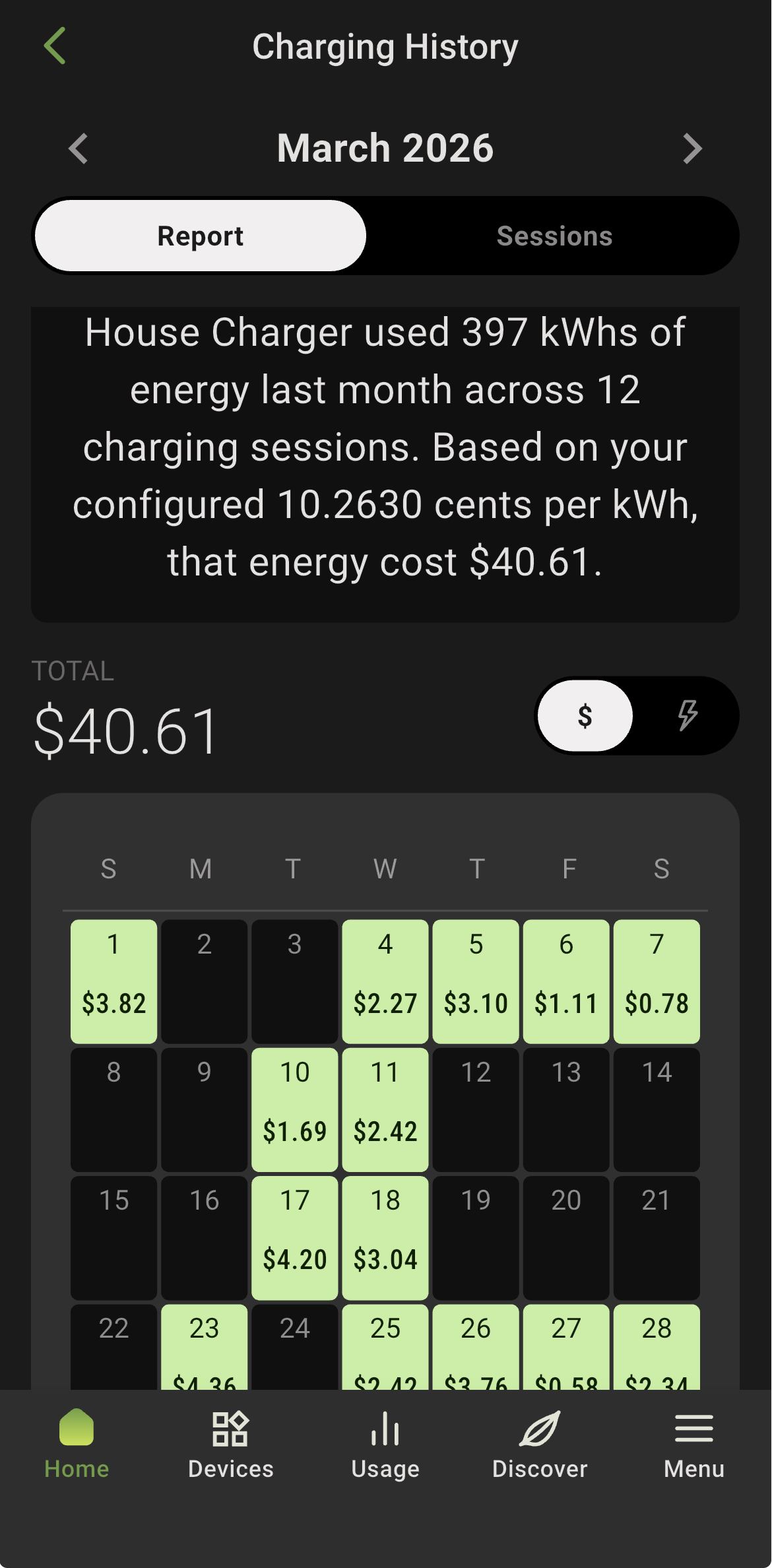
You can check historical usage (you can actually do this down the minute, or out to all time)
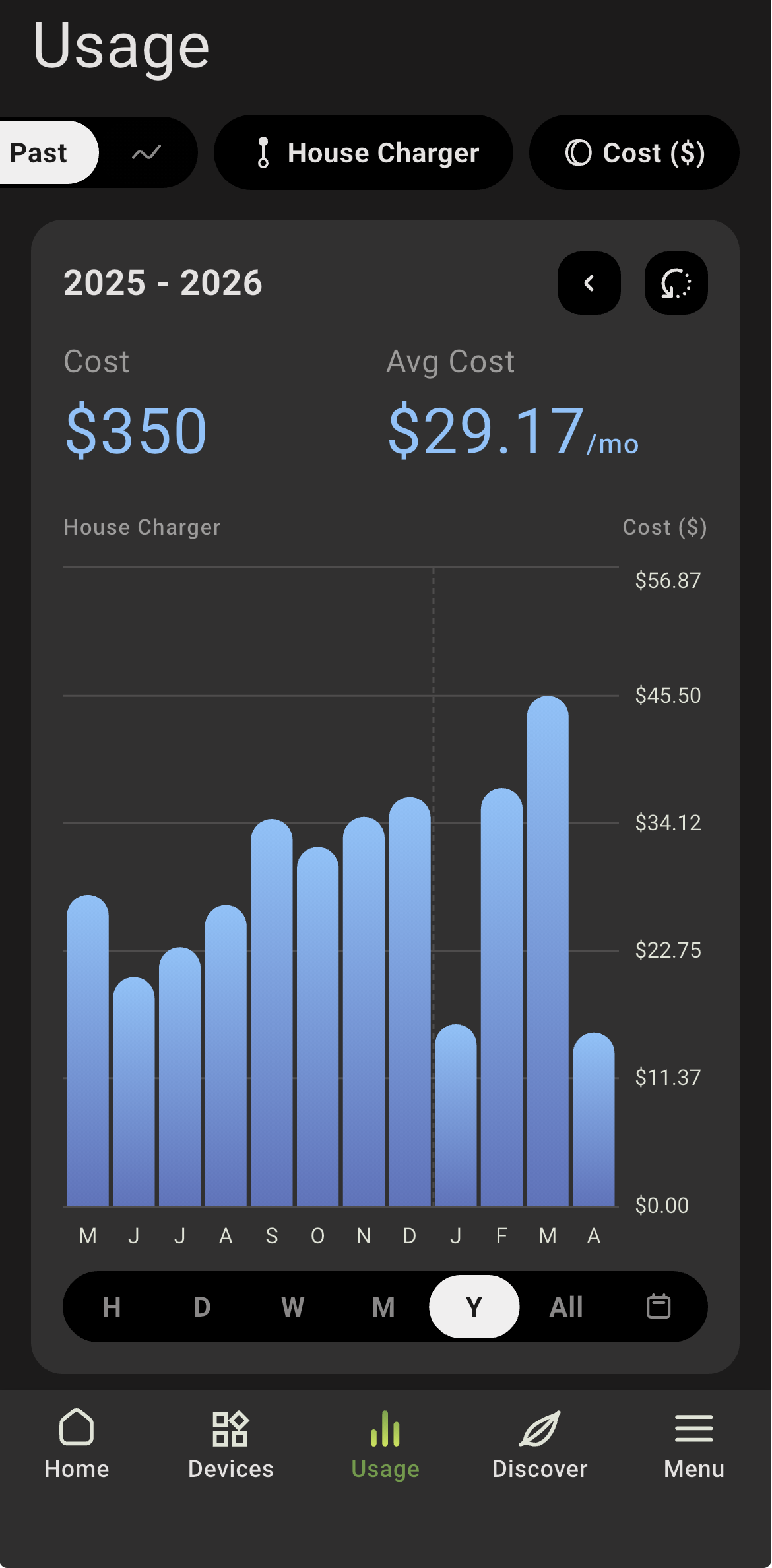
You can change the units from cost, to KWH, or a bunch of other things.
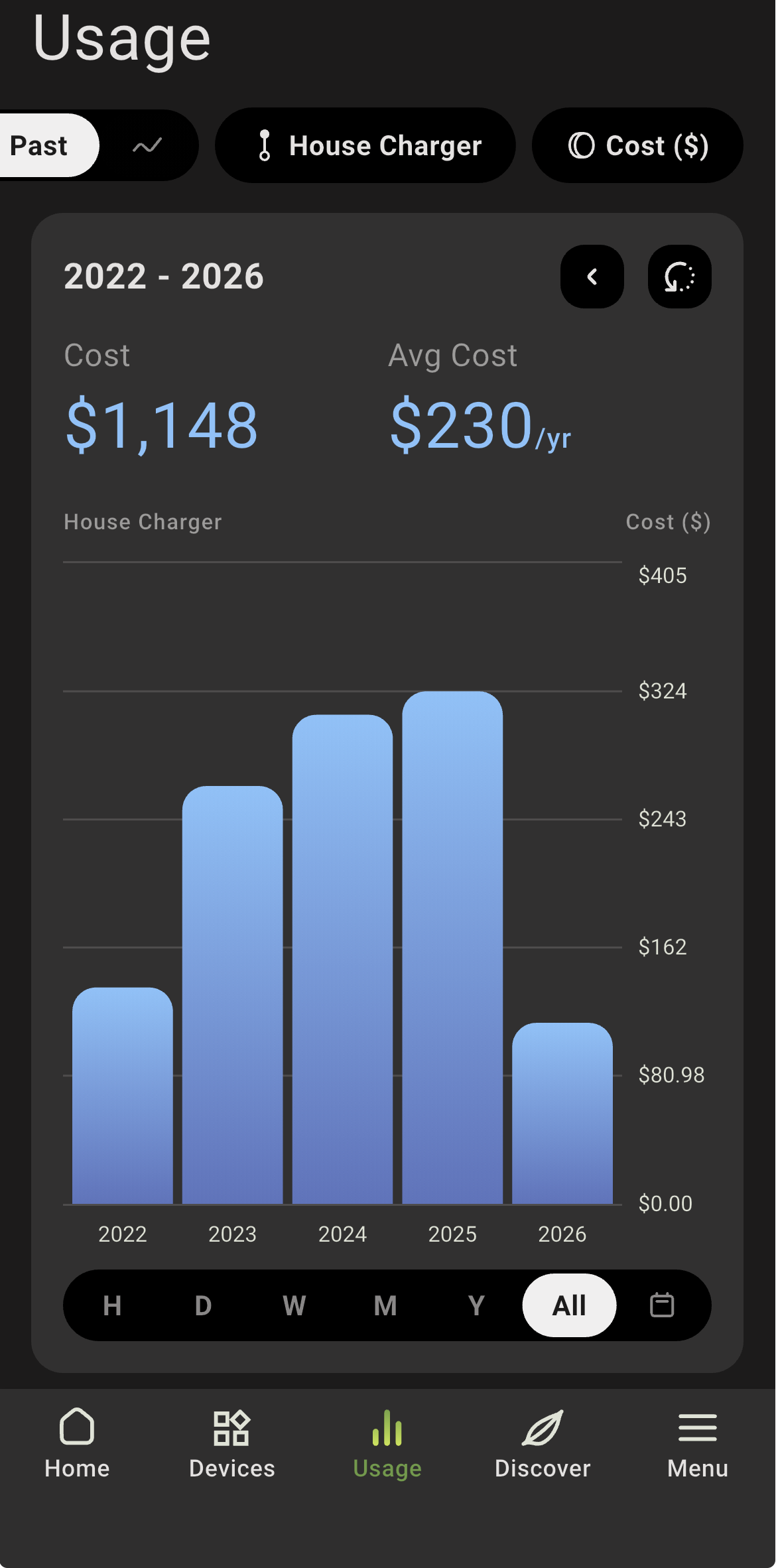
Anyway, just showing off what some of the options are .
.
You can see it in a report for the month. You can see the days of the week we charged, and how much that cost us.
You can check historical usage (you can actually do this down the minute, or out to all time)
You can change the units from cost, to KWH, or a bunch of other things.
Anyway, just showing off what some of the options are
.
I've only had my BEV for about a month. So, for what it's worth, here's my rough estimate for that month.
600 miles / month (local driving mostly < 55 mph)
3 miles / kwh ==> .33 kwh / mile
$0.13 / kwh (utility rate)
90 percent charging efficiency (assumption) ==> 1.11 correction factor
600 miles x .33 kwh / mile x $0.13 / kwh x 1.11 ~ $28.60 / month
The difference in my power bill compared to the same month last year ~ $38 more this year
Actually, since my previous daily driver got 15 mpg, the cost is SO SIGNIFICANTLY LESS that I couldn't care less what it adds to my power bill. I would have used an equivalent of about 40 gallons for that 600 miles, so you can calculate what that would have cost you at the pump today (I haven't had to look ).
).
600 miles / month (local driving mostly < 55 mph)
3 miles / kwh ==> .33 kwh / mile
$0.13 / kwh (utility rate)
90 percent charging efficiency (assumption) ==> 1.11 correction factor
600 miles x .33 kwh / mile x $0.13 / kwh x 1.11 ~ $28.60 / month
The difference in my power bill compared to the same month last year ~ $38 more this year
Actually, since my previous daily driver got 15 mpg, the cost is SO SIGNIFICANTLY LESS that I couldn't care less what it adds to my power bill. I would have used an equivalent of about 40 gallons for that 600 miles, so you can calculate what that would have cost you at the pump today (I haven't had to look
).
I like the information your Emporia gives. If you had a time of day utility rate, would you be able to input that?Here are a few examples from the emporia charger I have.
You can see it in a report for the month. You can see the days of the week we charged, and how much that cost us.
View attachment 14895
You can check historical usage (you can actually do this down the minute, or out to all time)
View attachment 14896
You can change the units from cost, to KWH, or a bunch of other things.
View attachment 14897
Anyway, just showing off what some of the options are
I've only had my BEV for about a month. So, for what it's worth, here's my rough estimate for that month.
600 miles / month (local driving mostly < 55 mph)
3 miles / kwh ==> .33 kwh / mile
$0.13 / kwh (utility rate)
90 percent charging efficiency (assumption) ==> 1.11 correction factor
600 miles x .33 kwh / mile x $0.13 / kwh x 1.11 ~ $28.60 / month
The difference in my power bill compared to the same month last year ~ $38 more this year
Actually, since my previous daily driver got 15 mpg, the cost is SO SIGNIFICANTLY LESS that I couldn't care less what it adds to my power bill. I would have used an equivalent of about 40 gallons for that 600 miles, so you can calculate what that would have cost you at the pump today (I haven't had to look
If you have low electricity rates at home, you really can save a lot of money vs a 15-20mpg SUV.
You saw above how if I charged at home 100% of the time (which has been true so far), it will cost me about $550 a year.
A 20mpg SUV with my current gas prices ($5.50/gal), would be $4125 a year. Which means I'm saving over $3500 a year in gas.

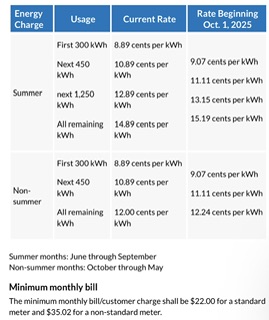
Here are the current rates in Columbia, MO (far right column)
My last fill up in the the Toy H. Was 13.8 gallons for 208 miles.
MPG 15.1
Cost: $48.28 @ 3.499/gallon
Fuel cost/mile: $0.254 (it was a little less because there was a grocery discount)
Assuming 2miles/kWh for the Terra…
$0.1111/kWh divided by 2 = $0.056 “fuel” cost per mile.
A 78% reduction
So that 208 miles would have cost me $11.65.
THIS IS VERY HARD TO IGNORE…..

My last fill up in the the Toy H. Was 13.8 gallons for 208 miles.
MPG 15.1
Cost: $48.28 @ 3.499/gallon
Fuel cost/mile: $0.254 (it was a little less because there was a grocery discount)
Assuming 2miles/kWh for the Terra…
$0.1111/kWh divided by 2 = $0.056 “fuel” cost per mile.
A 78% reduction
So that 208 miles would have cost me $11.65.
THIS IS VERY HARD TO IGNORE…..
I like the information your Emporia gives. If you had a time of day utility rate, would you be able to input that?
I believe so?
I haven't had to do that yet, as they don't really have time of use here (its in testing... but very not worth it yet. Its like 2-3x more expensive during peak, and $0.01 less during off peak (yes, one penny cheaper).
It lets you put in your electricity rates, or even lookup your plan for you (which I just tried, and it found mine).
It also has a charging schedule feature, with an option to "charge when cheapest" (smart saver), where you can define a whole bunch of stuff. I'm sure you could look into it more/find more info in reviews if needed.

Don't forget. If you have solar, you could eventually be MAKING money. If you have free charging at work, your math can be totally skewed. And if you split expenses with your wife and she's the one that pays the electric bill (and you own the EV), well, that's good math too. ;-)


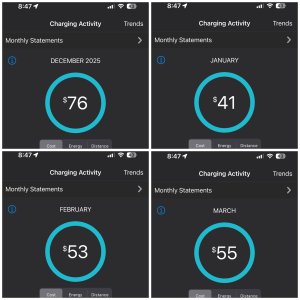
This what I paid for my bolt, driving 120-150+ Miles a day 5-6 days a week with extra travel in December for festivitiesI've looked through several of the pages but admittedly not all, so if this question was asked already, I apologize. What would you say is the added cost to your electric bill, in dollars, percent, or however you can best describe? Obviously this is a loaded question and dependent on lots of other factors, but I'm curious what that hit looks like each month/year for charging an EV.
Attachments

There's no such thing as Level 4.
There's AC Level 1, AC Level 2, and DC Fast Charging, sometimes mis-identified as Level 3.
The ai slop generated from repeated misinformation in forums and by certain brand marketing claims will make it seem like brand-T has more chargers than everyone else, but there's a meaningful difference between more than any other single brand and more than all the other brands combined. Brand-T does not have more than all other brands combined.
As an example:
The registered Superchargers in the federal database includes chargers that aren’t available to non-brand-T vehicles. Brand-T claims all superchargers whenever it claims a count of charging stations, even though many of those aren’t available to the general public. For example, there are 163 Superchargers registered in Texas (out of a total of 762 DCFC stations in Texas). But the brand-T website for finding where to charge your non-Brand-T vehicle only lists 110 available chargers. About 33% of the Superchargers in Texas are not available to non-brand-T vehicles.
If you’re a brand loyalist and only want to use one brand of charging station, that’s your choice. But if you want as much freedom to charge as possible, don’t fall for the misleading marketing. Use a brand-neutral search tool, and check for chargers in that brand-neutral search tool. Plugshare is, IMO, the most useful brand-neutral search tool.
is this information incorrect??
Key Aspects of Level 4 Charging
- Speed: Designed to charge EVs significantly faster than current 150-250 kW chargers, with 350 kW to 400 kW+ capabilities.
- Technology: These chargers use 3-phase 480V input and offer Direct Current (DC) power directly to the battery, often aimed at 800V architectures (like the Hyundai Ioniq 5/6, Porsche Taycan).
- Infrastructure: While not yet widespread, they are intended for highway corridors to simulate gasoline refueling times.
- Usage: They often feature liquid-cooled cables to handle the intense heat generated by high-power electricity transfer.
Kia Victoria +4
While Level 3 (DC Fast Chargers) typically operate between 50 kW and 250 kW, Level 4 is defined by power outputs of 350 kW and higher.
eInfochips +2
Note on Tesla V4 Superchargers: Many current Tesla V4 units are being installed with V3 backend hardware, limiting speeds to 250kW, though the dispensers are capable of higher, according to some 14 and 13 in Reddit conversations.
What Is a Level 4 EV Charger?
Level 4 EV charging is the fastest type of electric vehicle charging. It can deliver up to 1 MW of power, which can charge an electric vehicle's battery in as little as 15 minutes. Level 4 chargers are typically used by commercial fleets and at public charging stations. They are not yet widely available, but they are expected to become more common in the coming years as the demand for electric vehicles grows.
What Is a Level 4 EV Charger? | Power Midwest
www.powermidwest.com

Are you and I the same person?Don't forget. If you have solar, you could eventually be MAKING money. If you have free charging at work, your math can be totally skewed. And if you split expenses with your wife and she's the one that pays the electric bill (and you own the EV), well, that's good math too. ;-)
I just got my first EV, an AWD Hyundai Ioniq 5, a few months ago. Just before I leased it, I learned that the parking garage at my work has 25 free 110V x 12A chargers and I can get one of those spots almost all the time if I show up by 7:55am. Obviously this will change over time, but free charging at work covers most of my needs as in a 10 hourish workday I come out about 5% ahead on battery state of charge after accounting for the charge used to get to and from work.
And when I charge at home, I use 220V x 24A and my wife pays that bill. So I just set it to charge overnight at the super off peak hours and haven't worried about it so far since I do it so rarely.
Final observation, which hopefully Scout Motors will do something similar. My Hyundai came with a charging cable is nice little zip up storage bag. It has 4 adapters 110V x 8A, 110V x 12A, 220V x 16A, 220V x 24A. I have only ever used the 110V x 12A and 220V x 24A. The other two adapters just sit in the car. From looking at a Hyundai Ioniq forum, this is apparently the "Ampure Go 2 Portable charger"
Similar threads

- Replies
- 233
- Views
- 11K
- Replies
- 74
- Views
- 4K

- Replies
- 141
- Views
- 17K


- Replies
- 12
- Views
- 1K

