We own EVs. Ask Us Anything.

  • From all of us at Scout Motors, welcome to the Scout Community! We created this community to provide Scout vehicle owners, enthusiasts, and curiosity seekers with a place to engage in discussion, suggestions, stories, and connections. Supportive communities are sometimes hard to find, but we're determined to turn this into one.

    Additionally, Scout Motors wants to hear your feedback and speak directly to the rabid community of owners as unique as America. We'll use the Scout Community to deliver news and information on events and launch updates directly to the group. Although the start of production is anticipated in 2026, many new developments and milestones will occur in the interim. We plan to share them with you on this site and look for your feedback and suggestions.

    How will the Scout Community be run? Think of it this way: this place is your favorite local hangout. We want you to enjoy the atmosphere, talk to people who share similar interests, request and receive advice, and generally have an enjoyable time. The Scout Community should be a highlight of your day. We want you to tell stories, share photos, spread your knowledge, and tell us how Scout can deliver great products and experiences. Along the way, Scout Motors will share our journey to production with you.

    Scout is all about respect. We respect our heritage. We respect the land and outdoors. We respect each other. Every person should feel safe, included, and welcomed in the Scout Community. Being kind and courteous to the other forum members is non-negotiable. Friendly debates are welcomed and often produce great outcomes, but we don't want things to get too rowdy. Please take a moment to consider what you post, especially if you think it may insult others. We'll do our best to encourage friendly discourse and to keep the discussions flowing.

    So, welcome to the Scout Community! We encourage you to check back regularly as we plan to engage our members, share teasers, and participate in discussions. The world needs Scouts™. Let's get going.


    We are Scout Motors.

I learned that the parking garage at my work has 25 free 110V x 12A chargers and I can get one of those spots almost all the time if I show up by 7:55am.

Can't do that with gas.

when I charge at home, I use 220V x 24A and my wife pays that bill. So I just set it to charge overnight at the super off peak hours and haven't worried about it so far since I do it so rarely.
Can't do that with gas.

A lot of people will try to find ways to make EV charging equivalent to gas by ONLY thinking about DCFC, but that isn't how people charge regularly. You can also become even more independent and self-reliant with solar. If anyone has a runway of being in one place for more than 6 or 7 years, they should seriously consider solar immediately, if they own an EV and own a house.
 
If anyone has a runway of being in one place for more than 6 or 7 years, they should seriously consider solar immediately, if they own an EV and own a house.

Rooftop solar is on our to do list. Not only because of EVs, but also all of our appliances we converted to electric as they needed to be replaced so the only thing that uses natural gas or propane is the BBQ and the hot water heater. For the BBQ, I can eventually convert to an electric wood pellet grill or smoker like from Traeger.

So, tankless hot water heaters, any suggestions :). That is the last appliance to figure out how to get rid of gas.
 
Rooftop solar is on our to do list. Not only because of EVs, but also all of our appliances we converted to electric as they needed to be replaced so the only thing that uses natural gas or propane is the BBQ and the hot water heater. For the BBQ, I can eventually convert to an electric wood pellet grill or smoker like from Traeger.

So, tankless hot water heaters, any suggestions :). That is the last appliance to figure out how to get rid of gas.
A heat pump water heater is a better option, especially if you go with a battery backup. The power use is distributed throughout the day, which is more easily fed by solar and battery than a tankless. We have a tankless and it draws 19 kW, which is too much for our battery backup to feed, so we draw some from the grid for that use, even if we have the overall energy to cover heating the water.
 
A heat pump water heater is a better option, especially if you go with a battery backup. The power use is distributed throughout the day, which is more easily fed by solar and battery than a tankless. We have a tankless and it draws 19 kW, which is too much for our battery backup to feed, so we draw some from the grid for that use, even if we have the overall energy to cover heating the water.
Thanks. We went tankless when that was considered better for natural gas water heaters because you only heat the water when ready to use it and we thus don't keep a 50 gallon tank of water at temperature to use it at most a few times a day. Sounds like that logic breaks down when you switch back to electric, alas, we no longer have the space for the tank unless we undo some of the changes we made when we got rid of the old style giant tank gas water heater.
Anyway, I do appreciate the advice and will look into in conjunction with solar. We do have battery backup at our cabin that came with a 20 year old solar array that at peak only puts out 1.4kW. So we need to replace and size up that solar also.
 
Rooftop solar is on our to do list. Not only because of EVs, but also all of our appliances we converted to electric as they needed to be replaced so the only thing that uses natural gas or propane is the BBQ and the hot water heater. For the BBQ, I can eventually convert to an electric wood pellet grill or smoker like from Traeger.

So, tankless hot water heaters, any suggestions :). That is the last appliance to figure out how to get rid of gas.
I highly recommend a hybrid water heater. I have an unconditioned basement and during the humid Summer it keeps the large basement moderately cool. It would work the same for an enclosed garage. They are not cheap but I found that it reduced my power bill significantly. It has different energy savings modes. In the winter, the basement doesn't seem to get very cold while running in "heat pump" mode, but when sub-freezing outside for long periods, I will sometimes switch it to all electric (no heat pump).

Other than a standard water heater 240V/30A circuit, you will need to have the ability to drain the condensate. You can also buy a small condensate pump if you have to send the condensate uphill. It also does take up space due to the tank size.

I have a tankless water heater also, but rarely use it because I feel like the hybrid is much more efficient. The further north you live however, hybrid may not be the right choice. I would suggest some research before purchasing.
 
I highly recommend a hybrid water heater. I have an unconditioned basement and during the humid Summer it keeps the large basement moderately cool. It would work the same for an enclosed garage. They are not cheap but I found that it reduced my power bill significantly. It has different energy savings modes. In the winter, the basement doesn't seem to get very cold while running in "heat pump" mode, but when sub-freezing outside for long periods, I will sometimes switch it to all electric (no heat pump).

Other than a standard water heater 240V/30A circuit, you will need to have the ability to drain the condensate. You can also buy a small condensate pump if you have to send the condensate uphill. It also does take up space due to the tank size.

I have a tankless water heater also, but rarely use it because I feel like the hybrid is much more efficient. The further north you live however, hybrid may not be the right choice. I would suggest some research before purchasing.
Thanks. I'm about as south as you can get and still be along the California coast, aka San Diego. And we are familiar with condensate pumps, we needed one for the tankless water heater, I forget why.
 
is this information incorrect??

Key Aspects of Level 4 Charging
  • Speed: Designed to charge EVs significantly faster than current 150-250 kW chargers, with 350 kW to 400 kW+ capabilities.
  • Technology: These chargers use 3-phase 480V input and offer Direct Current (DC) power directly to the battery, often aimed at 800V architectures (like the Hyundai Ioniq 5/6, Porsche Taycan).
  • Infrastructure: While not yet widespread, they are intended for highway corridors to simulate gasoline refueling times.
  • Usage: They often feature liquid-cooled cables to handle the intense heat generated by high-power electricity transfer.
    Kia Victoria +4
Difference Between Level 3 and Level 4
While Level 3 (DC Fast Chargers) typically operate between 50 kW and 250 kW, Level 4 is defined by power outputs of 350 kW and higher.
eInfochips +2
Note on Tesla V4 Superchargers: Many current Tesla V4 units are being installed with V3 backend hardware, limiting speeds to 250kW, though the dispensers are capable of higher, according to some 14 and 13 in Reddit conversations.


What Is a Level 4 EV Charger?

Level 4 EV charging is the fastest type of electric vehicle charging. It can deliver up to 1 MW of power, which can charge an electric vehicle's battery in as little as 15 minutes. Level 4 chargers are typically used by commercial fleets and at public charging stations. They are not yet widely available, but they are expected to become more common in the coming years as the demand for electric vehicles grows.


Looks like AImay have been used to derive this information. I believe the AI is getting hung up on Tesla’s nomenclature for how they named their charging stalls (v1, v2, v3 etc).

Here is the US DOT info on the current charging levels and standards.

I’ve seen 1MW charging referred to as flash charging but not level 4 and at this time I’m not certain there has been an official level assigned nor an SAE standard created for megawatt charging.
 
Thanks. I'm about as south as you can get and still be along the California coast, aka San Diego. And we are familiar with condensate pumps, we needed one for the tankless water heater, I forget why.
Then if you can make room for the tank, I would go this route without hesitating. I believe the efficiency would even be better than a natural gas tankless. We are empty-nesters so hot water demand is low, but when we have guests I'll sometimes switch to "High Demand" mode just in case. This can be done with an app on your phone.

Look for any tax incentives or power utility incentives as well. Google Gemini can be your friend. ;)

The natural gas tankless exhaust creates water condensate. That's why you needed the condensate pump.
 
  • Like
Reactions: J Alynn and maynard
Can't do that with gas.

Can't do that with gas.


A lot of people will try to find ways to make EV charging equivalent to gas by ONLY thinking about DCFC, but that isn't how people charge regularly. You can also become even more independent and self-reliant with solar. If anyone has a runway of being in one place for more than 6 or 7 years, they should seriously consider solar immediately, if they own an EV and own a house.

In my post about costs, I used the power utility rate. The reality is that most of my charging is done via solar. I didn't use the real number simply because it would have added an extra layer of complication to the answer. Most of our local driving is entirely free due to charging via solar and battery backup overnight.
 
Rooftop solar is on our to do list. Not only because of EVs, but also all of our appliances we converted to electric as they needed to be replaced so the only thing that uses natural gas or propane is the BBQ and the hot water heater. For the BBQ, I can eventually convert to an electric wood pellet grill or smoker like from Traeger.

So, tankless hot water heaters, any suggestions :). That is the last appliance to figure out how to get rid of gas.
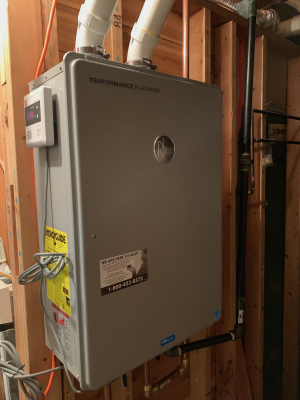
I installed a Rheem - love it...
 

Attachments

  • IMG_2316.png
    IMG_2316.png
    4.5 MB · Views: 3
Its pretty easy to calculate the ballpark basic costs of an EV, once you know what you're looking for, just like it is for a gas car.

For a gas car its:

(Miles per year / mpg of the car) x cost of gas per gallon.

For an electric car its:

(Miles per year / miles per kwh efficiency of the gar) x cost of electricity per kwh.

Then you just add that amount to your electric bill for the year.
Just a cautionary note, you really need to look at your electricity rate tariff. With my state/utility, there are rate tiers. The price is X/kWh up to so many kWh per month. In the summer, each kWh above that is a higher price. So if the EV pushed you into a higher price tier the cost may be higher per kWh than what you are paying now. In the winter, the price actually goes DOWN the more that you use.

Here is the default residential rate tariff for my utility:
On-Peak Season
$0.088792 per kWh for the first 1,350 kWh
$0.114186 per kWh for all additional kWh

Off-Peak Season
$0.079241 per kWh for the first 475 kWh
$0.052529 per kWh for the next 775 kWh
$0.035221 per kWh for all additional kWh

Now your utility may just have a flat rate no matter how much you use. In that case then yes, just calculate your usage based on mileage and multiply by your kWh rate.

is this information incorrect??

Key Aspects of Level 4 Charging
Yes, it is incorrect. Please stop using AI. Seriously. There is no such thing as Level 4 charging. The AI is confusing Tesla's Supercharger VERSIONs with the charging LEVEL.

As @SpaceEVDriver said, there is only Level 1 (120V AC), Level 2 (240V AC), and DCFC (DC Fast Charging). Many people call DCFC Level 3 as shorthand to show that it is faster than Level 1 and Level 2.

All Tesla Superchargers are DCFC chargers. They have increased the power over time and noted that as V1, V2, etc. They are up to V4 today.
 
<SNIP>

Here is the default residential rate tariff for my utility:
On-Peak Season
$0.088792 per kWh for the first 1,350 kWh
$0.114186 per kWh for all additional kWh

Off-Peak Season
$0.079241 per kWh for the first 475 kWh
$0.052529 per kWh for the next 775 kWh
$0.035221 per kWh for all additional kWh

<Snip>
Boy, this sure beats my rate tiers—and I thought I had it pretty good. I don’t think I’ve ever exceeded 950kwh even in the summer months with the AC running “a lot”.
 
  • Like
Reactions: J Alynn and maynard
Looks like AImay have been used to derive this information. I believe the AI is getting hung up on Tesla’s nomenclature for how they named their charging stalls (v1, v2, v3 etc).

Here is the US DOT info on the current charging levels and standards.

I’ve seen 1MW charging referred to as flash charging but not level 4 and at this time I’m not certain there has been an official level assigned nor an SAE standard created for megawatt charging.
The SAE defines Level 1 AC, Level 2 AC, Level 3 AC (which was considered but never implemented), Level 1 DCFC (80 A maximum) and Level 2 DCFC (500 Amp maximum as updated in the 2024 revisions).

The IEC defines four Modes with Mode 4 being DCFC.

Every few years these two bodies amend the standards and sometimes extend DCFC to higher output voltages and amperages. As of 2024, the DCFC standard allows up to 1000 VDC and 500 Amps for 500 kW DC power output.

The megawatt charging standard is separate and is intended for commercial vehicles. It is also not called "Level 4."

As you note, there's a lot of ai nonsense out there. The ai slop will trip up and confuse anyone who isn't serious about reading the actual standards or engaging with good faith intentions to learn in conversations with people who know what they're talking about. Generative ai cannot keep up with changing standards simply because those updates are around the interwebs for less time, are therefore discussed less often than the older standards, and thus are less likely to show up in the training corpus of the ai's LLM. The ai results are worse than useless because they’re simply a statistical slot machine spitting out a string of high-occurrance tokens rather than sensible, reliable knowledge.
 
Rooftop solar is on our to do list. Not only because of EVs, but also all of our appliances we converted to electric as they needed to be replaced so the only thing that uses natural gas or propane is the BBQ and the hot water heater. For the BBQ, I can eventually convert to an electric wood pellet grill or smoker like from Traeger.

So, tankless hot water heaters, any suggestions :). That is the last appliance to figure out how to get rid of gas.
Tankless water heaters with electric are a bit pricey and if you have solar panels and capacity that is the only way to go. I just priced one on a new home we are building at work and the power requirements drawing from electric company were absolutely crazy. They ended up going dual 50 gallon electric water tanks and set up one on a timer to pre-warm. Don’t know the final spec but was a creative solution.
 
  • Like
Reactions: maynard
Tankless water heaters with electric are a bit pricey and if you have solar panels and capacity that is the only way to go. I just priced one on a new home we are building at work and the power requirements drawing from electric company were absolutely crazy. They ended up going dual 50 gallon electric water tanks and set up one on a timer to pre-warm. Don’t know the final spec but was a creative solution.
After having a tankless water heater on solar+battery power, I would go with an all-electric heat pump tanked water heater.

But this is because I installed an 80 Amp tankless.

If I could do it over again, I’d either get an all-electric heat pump tanked or a smaller (40 or 50 Amp) tankless. I don’t like the fact that it doesn’t matter how much battery storage I have, it’s nearly impossible to provide enough amperage to cover all of the tankless power draw. So every morning we draw a little bit from the grid even though we have the energy stored and the solar power available. Since I’m not paid on a 1:1 basis for the power I sell to the utility, it would save me money to “waste” solar/battery energy keeping a tank of water hot.
 
  • Like
Reactions: maynard