We own EVs. Ask Us Anything.

  • From all of us at Scout Motors, welcome to the Scout Community! We created this community to provide Scout vehicle owners, enthusiasts, and curiosity seekers with a place to engage in discussion, suggestions, stories, and connections. Supportive communities are sometimes hard to find, but we're determined to turn this into one.

    Additionally, Scout Motors wants to hear your feedback and speak directly to the rabid community of owners as unique as America. We'll use the Scout Community to deliver news and information on events and launch updates directly to the group. Although the start of production is anticipated in 2026, many new developments and milestones will occur in the interim. We plan to share them with you on this site and look for your feedback and suggestions.

    How will the Scout Community be run? Think of it this way: this place is your favorite local hangout. We want you to enjoy the atmosphere, talk to people who share similar interests, request and receive advice, and generally have an enjoyable time. The Scout Community should be a highlight of your day. We want you to tell stories, share photos, spread your knowledge, and tell us how Scout can deliver great products and experiences. Along the way, Scout Motors will share our journey to production with you.

    Scout is all about respect. We respect our heritage. We respect the land and outdoors. We respect each other. Every person should feel safe, included, and welcomed in the Scout Community. Being kind and courteous to the other forum members is non-negotiable. Friendly debates are welcomed and often produce great outcomes, but we don't want things to get too rowdy. Please take a moment to consider what you post, especially if you think it may insult others. We'll do our best to encourage friendly discourse and to keep the discussions flowing.

    So, welcome to the Scout Community! We encourage you to check back regularly as we plan to engage our members, share teasers, and participate in discussions. The world needs Scouts™. Let's get going.


    We are Scout Motors.

Do you mean Tesla Superchargers compared to other DC Fast Chargers or do you mean any DCFC (L3) Vs Destination Chargers (L2)
unfortunately I am just quoting what was said. The only additional info is "he's a charger snob" and has a Tesla. So I'm guessing he literally means only the actual branded Superchargers
 
“Supercharger” is a brand name for DC Fast Charger. About half of Superchargers are available to cars that aren’t brand-T. The others are only available to brand-T.

DC Fast Chargers (abbreviated DCFC) is a category of charging stations that includes Superchargers, but is not limited to those.

Most DCFCs use a plug called CCS1.
All Superchargers have a plug called NACS. Some have a built-in adapter for NACS to CCS1.

If someone is limiting themselves to Superchargers, then they’re limiting themselves to fewer than 1/3 of all DCFCs that are available in North America.

  • There are about 17,576 DCFC stations with about 78,584 plugs available to the public in the US and Canada.
    • Of those, there are about 14,123 CCS1 stations and 38,173 plugs using CCS1.
    • And about 4,734 stations and 42,875 plugs using NACS.
    • Of those with NACS, there are about 3,334 brand-T Supercharger stations and 39,993 plugs.
      • But, again, not all Superchargers are available to every EV. About 800 of the Supercharger stations (8,029 plugs) are Version 2 and don’t use the CCS1 protocol internally so are not available to non-brand-T vehicles. Some Version 3 are also not available to non-brand-T EVs.
he probably is just considering branded Superchargers so I can tell him there are "generic equivalents" available but whether he will count them or not who knows
 
So when I put in my trip in either the Scout UX or a charger app will it filter out chargers that are not compatible?
Also, because Scout is planning to use the NACS port, you will need two adapters to use most charging stations in the US and Canada. You’ll need an adapter for DC charging and a separate adapter for AC charging. This is basically going to be the reality for the next decade or two despite the supposed transition to NACS as the main standard. Until all the chargers have transitioned, we’ll all have to carry adapters and use the proper one in the proper context.
 
he probably is just considering branded Superchargers so I can tell him there are "generic equivalents" available but whether he will count them or not who knows
Sounds like he wants to feel superior, so I’m fine with not having to compete with him for charger stalls.

Also, the CCS1 plug standard supports faster charging than the NACS standard (as currently approved by the standards bodies—they both can support even higher charging speeds in the future). So, I suppose if an inferior charging speed make someone feel better, they’re welcome to it.
 
What's the oldest EV you own? how many miles, % use left of pack?
10+ year old vehicles.. anyone have 15 year old ? 2011 they seem to hit mass market right?

what do you expect the value to be at 20-30 years? performance of battery? disposal fees? replacement costs?

does anyone expect these to last? When you buy it do you imagine giving it to your grandkid?

or is this an iphone 6?

feels like most EV buyers are lease types... in 3 years not my problem.. i'll get the new one.
 
Also, because Scout is planning to use the NACS port, you will need two adapters to use most charging stations in the US and Canada. You’ll need an adapter for DC charging and a separate adapter for AC charging. This is basically going to be the reality for the next decade or two despite the supposed transition to NACS as the main standard. Until all the chargers have transitioned, we’ll all have to carry adapters and use the proper one in the proper context.
Well when I get my Scout be prepared for me to ask for recommendations.
 
Is Install of a level 2 at home a need, or want? Can you plug it in to a regular outlet?
You can use a regular outlet. But it charges more slowly on 120 volts than 240 volts.

Assume a vehicle gets 2.5 miles/kWh, which is okay for a truck at around-town and pretty decent for a truck at highway speeds. These will be the typical charge rates, times, and etc for an AC (Level 1 or Level 2) charger.

Level of chargerVoltageAmperage to the vehicle (Amps)Charge rate (kW)Miles recharged per hour, assuming 2.5 miles/kWh efficiencyHours to recharge 40 miles, assuming 2.5 miles/kWhMiles recharged per hour, assuming 4 miles/kWh efficiencyHours to recharge 40 miles, assuming 4 miles/kWh.
Level 1120 121.43.6 115.86.9
Level 2240204.8128.3192.1
Level 2240307.2185.6291.4
Level 2240409.6244.238~1
Level 224048 (typical maximum)11.5293.546~1
Level 224080 (maximum, not available to the Scout)19.2482.1770.5

My sister has a Mustang Mach-E and lives in an apartment. She is not allowed to install a Level 2 charger, so she uses Level 1. She drives a little over 40 miles a day for work, school, errands, etc. With the ~4 miles/kWh average efficiency she gets, the above chart is too conservative. Every night, she uses the Level 1 to recharge more energy on her battery than she uses each day. By the weekend, she has about 100% charge. If she ever needs more charge for some extra driving, she will go to one of the dozens Level 2 chargers around her work, school, shopping, etc. Usually just half an hour on a 40 Amp (9.6 kW) Level 2 charger will recover enough to catch her up.

You can fill in the chart for an assumed efficiency.
 
You can use a regular outlet. But it charges more slowly on 120 volts than 240 volts.

Assume a vehicle gets 2.5 miles/kWh, which is okay for a truck at around-town and pretty decent for a truck at highway speeds. These will be the typical charge rates, times, and etc for an AC (Level 1 or Level 2) charger.

Level of chargerVoltageAmperage to the vehicle (Amps)Charge rate (kW)Miles recharged per hour, assuming 2.5 miles/kWh efficiencyHours to recharge 40 miles, assuming 2.5 miles/kWhMiles recharged per hour, assuming 4 miles/kWh efficiencyHours to recharge 40 miles, assuming 4 miles/kWh.
Level 1120121.43.6115.86.9
Level 2240204.8128.3192.1
Level 2240307.2185.6291.4
Level 2240409.6244.238~1
Level 224048 (typical maximum)11.5293.546~1
Level 224080 (maximum, not available to the Scout)19.2482.1770.5

My sister has a Mustang Mach-E and lives in an apartment. She is not allowed to install a Level 2 charger, so she uses Level 1. She drives a little over 40 miles a day for work, school, errands, etc. With the ~4 miles/kWh average efficiency she gets, the above chart is too conservative. Every night, she uses the Level 1 to recharge more energy on her battery than she uses each day. By the weekend, she has about 100% charge. If she ever needs more charge for some extra driving, she will go to one of the dozens Level 2 chargers around her work, school, shopping, etc. Usually just half an hour on a 40 Amp (9.6 kW) Level 2 charger will recover enough to catch her up.

You can fill in the chart for an assumed efficiency.
Thanks, I was thinking I will likely end up doing something similar to the charge a little each night and top off when out and about.
 
Thanks, I was thinking I will likely end up doing something similar to the charge a little each night and top off when out and about.
We did this with one Level 1 EVSE and two EVs for about 18 months.

It’s not perfect, but it worked for us for until I got my act in gear and installed the Level 2 charger(s).

That said, the past month has been very hectic for us. We have had a family member in the hospital (ICU, hospital, PT/OT/ST rehab, etc) quite a distance away. We were driving one or both EVs 250-300 miles round trip a few times a week, 125-150 miles round trip even more times a week. Level 2 charging allowed us to charge up every night. Two Level 2 EVSEs allowed us to charge two EVs from 30% or less to 100% every day we did this trip. This meant we didn’t have to use DC charging except a few times.
 
We did this with one Level 1 EVSE and two EVs for about 18 months.

It’s not perfect, but it worked for us for until I got my act in gear and installed the Level 2 charger(s).

That said, the past month has been very hectic for us. We have had a family member in the hospital (ICU, hospital, PT/OT/ST rehab, etc) quite a distance away. We were driving one or both EVs 250-300 miles round trip a few times a week, 125-150 miles round trip even more times a week. Level 2 charging allowed us to charge up every night. Two Level 2 EVSEs allowed us to charge two EVs from 30% or less to 100% every day we did this trip. This meant we didn’t have to use DC charging except a few times.
Oh my goodness, I hope your family member is better.
 
I guess which chargers are available depends on where you are. Just googled it for Texas. More than 1/2 the DC fast charging stalls in Texas are Tesla. If you break it down, Tesla has 10x the number of stalls of the next largest provider. The only thing really missing is Level 4 chargers (plenty of Tesla v4 cabinets - but without the back end, they are not Level 4 chargers)- but those are rare regardless of company at the moment. Kind of the Chicken or the Egg. No real need to rush to replace the Level 3 chargers till there are enough vehicles that can use the Level 4... But we have another 2 years, so that could change too.

Will mention I wasted way too much time trying to search for the information, and some sites were not all that updated. One location I knew about - site said they were all Level 2 chargers. But they had the grand opening of a new store next to it last year - will all Level 3 chargers (and the Level 2 ones are gone). Likewise the new location had 8 Level 4 chargers (not Tesla) that were not showing up - but the review I saw of them on Youtube showed them only putting out 140kw/h - guess they did not like the vehicle the poster was using.
 
  • Like
Reactions: J Alynn and maynard
Depending on the source, Tesla seems to have to the most reliable network, compared to say EA, I’ve yet to see the local superchargers to be offline, but same can be said for the L3s at the Electric company parking lot (those have been there longer), I can say the same for the Mercedes branded ChargePoint DCFCs at bucees, but most L2s here (blink) are offline, and 40% of the times I’ve visited an EA DCFC 2 or more have been offline.

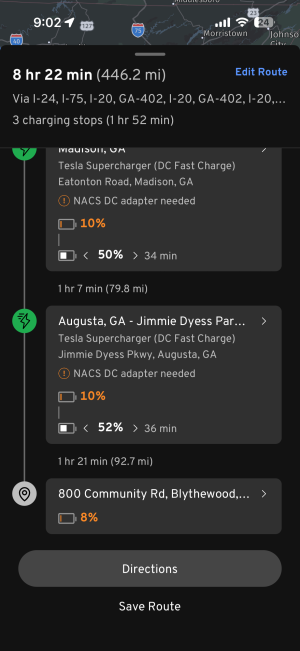
The the initial point, we were looking to see how feasible the event on the 20th would be, so I checked the route on Google, not a single SuperCharger appeared, then I did a route in the Chevy app and all three stops were SCs
 

Attachments

  • IMG_8016.png
    IMG_8016.png
    311.8 KB · Views: 2
  • Like
  • Wow
Reactions: J Alynn and maynard
Man, I have many questions. I have finally gotten over the fear of range anxiety after I realized that I have similar range in my 2022 bronco. Let's be real, even in an ice vehicle you still have to plan your routes to make sure you can get gas. Anyways, as someone who does drive an ice vehicle my reason for the change is simple. I am tired of gas prices and honestly feel like it's time to make a change. unfortunately, I was dumb and well overpaid for my bronco (thanks hype train XD) that is not to say I don't love my bronco. But if I do things right, I should have it paid off by 2028-2029 and I pre-ordered the full EV and that won't be out for a little while longer.

I am aware this is kind of lengthy, but I felt a little background was important. I'd really love to know how I should prepare. what are some things I should get. how should I expect it to drive like. etc. etc. lay it all out for me!
 
You can use a regular outlet. But it charges more slowly on 120 volts than 240 volts.

Assume a vehicle gets 2.5 miles/kWh, which is okay for a truck at around-town and pretty decent for a truck at highway speeds. These will be the typical charge rates, times, and etc for an AC (Level 1 or Level 2) charger.

Level of chargerVoltageAmperage to the vehicle (Amps)Charge rate (kW)Miles recharged per hour, assuming 2.5 miles/kWh efficiencyHours to recharge 40 miles, assuming 2.5 miles/kWhMiles recharged per hour, assuming 4 miles/kWh efficiencyHours to recharge 40 miles, assuming 4 miles/kWh.
Level 1120121.43.6115.86.9
Level 2240204.8128.3192.1
Level 2240307.2185.6291.4
Level 2240409.6244.238~1
Level 224048 (typical maximum)11.5293.546~1
Level 224080 (maximum, not available to the Scout)19.2482.1770.5

My sister has a Mustang Mach-E and lives in an apartment. She is not allowed to install a Level 2 charger, so she uses Level 1. She drives a little over 40 miles a day for work, school, errands, etc. With the ~4 miles/kWh average efficiency she gets, the above chart is too conservative. Every night, she uses the Level 1 to recharge more energy on her battery than she uses each day. By the weekend, she has about 100% charge. If she ever needs more charge for some extra driving, she will go to one of the dozens Level 2 chargers around her work, school, shopping, etc. Usually just half an hour on a 40 Amp (9.6 kW) Level 2 charger will recover enough to catch her up.

You can fill in the chart for an assumed efficiency.
Excellent chart, thank you. But… all the level 2 figures don’t seem to match between columns 5 & 6. Or am I missing something?
 
Also, because Scout is planning to use the NACS port, you will need two adapters to use most charging stations in the US and Canada. You’ll need an adapter for DC charging and a separate adapter for AC charging. This is basically going to be the reality for the next decade or two despite the supposed transition to NACS as the main standard. Until all the chargers have transitioned, we’ll all have to carry adapters and use the proper one in the proper context.
One thing to add here... There are chargers that also have adapters that are "built in". For example, Tesla has DCFC stations with Magic Docks: https://www.tesla.com/support/charging/supercharging-other-evs#magic-dock

My advice would be to look at your typical driving patterns, run a few of your common routes through ABRP now, determine which brands of chargers are found in your area, and just download the most common apps (PLUS PlugShare and ABRP) before you get your EV. Its actually quite simple. If you are out and about before your first road trip, stop and charge before you feel the pressure of a long road trip. People at chargers usually help each other out if they have questions.

And lastly, most new vehicles have such good route planning and SW built-into the infotainment system that it can be completely brainless. Just follow the directions on your screen and you will route to the appropriate charger on your trip (your truck may even just start preconditioning at exactly the right time before reaching your destination). Just make sure to select that you want fast-charging or what type of chargers you want to see on your screen. Usually, that is selectable.
 
Depending on the source, Tesla seems to have to the most reliable network, compared to say EA, I’ve yet to see the local superchargers to be offline, but same can be said for the L3s at the Electric company parking lot (those have been there longer), I can say the same for the Mercedes branded ChargePoint DCFCs at bucees, but most L2s here (blink) are offline, and 40% of the times I’ve visited an EA DCFC 2 or more have been offline.

The the initial point, we were looking to see how feasible the event on the 20th would be, so I checked the route on Google, not a single SuperCharger appeared, then I did a route in the Chevy app and all three stops were SCs
Just in case...
I don't know if you're actually planning this drive, but it appears you are coming into Columbia on I-20. There is a SuperCharger in Lexington, SC just as you approach Columbia here that may not show on any navigation apps that you're using.

 
  • Like
Reactions: J Alynn and maynard
There's no such thing as Level 4.
There's AC Level 1, AC Level 2, and DC Fast Charging, sometimes mis-identified as Level 3.

The ai slop generated from repeated misinformation in forums and by certain brand marketing claims will make it seem like brand-T has more chargers than everyone else, but there's a meaningful difference between more than any other single brand and more than all the other brands combined. Brand-T does not have more than all other brands combined.

As an example:
The registered Superchargers in the federal database includes chargers that aren’t available to non-brand-T vehicles. Brand-T claims all superchargers whenever it claims a count of charging stations, even though many of those aren’t available to the general public. For example, there are 163 Superchargers registered in Texas (out of a total of 762 DCFC stations in Texas). But the brand-T website for finding where to charge your non-Brand-T vehicle only lists 110 available chargers. About 33% of the Superchargers in Texas are not available to non-brand-T vehicles.


If you’re a brand loyalist and only want to use one brand of charging station, that’s your choice. But if you want as much freedom to charge as possible, don’t fall for the misleading marketing. Use a brand-neutral search tool, and check for chargers in that brand-neutral search tool. Plugshare is, IMO, the most useful brand-neutral search tool.