We own EVs. Ask Us Anything.

  • From all of us at Scout Motors, welcome to the Scout Community! We created this community to provide Scout vehicle owners, enthusiasts, and curiosity seekers with a place to engage in discussion, suggestions, stories, and connections. Supportive communities are sometimes hard to find, but we're determined to turn this into one.

    Additionally, Scout Motors wants to hear your feedback and speak directly to the rabid community of owners as unique as America. We'll use the Scout Community to deliver news and information on events and launch updates directly to the group. Although the start of production is anticipated in 2026, many new developments and milestones will occur in the interim. We plan to share them with you on this site and look for your feedback and suggestions.

    How will the Scout Community be run? Think of it this way: this place is your favorite local hangout. We want you to enjoy the atmosphere, talk to people who share similar interests, request and receive advice, and generally have an enjoyable time. The Scout Community should be a highlight of your day. We want you to tell stories, share photos, spread your knowledge, and tell us how Scout can deliver great products and experiences. Along the way, Scout Motors will share our journey to production with you.

    Scout is all about respect. We respect our heritage. We respect the land and outdoors. We respect each other. Every person should feel safe, included, and welcomed in the Scout Community. Being kind and courteous to the other forum members is non-negotiable. Friendly debates are welcomed and often produce great outcomes, but we don't want things to get too rowdy. Please take a moment to consider what you post, especially if you think it may insult others. We'll do our best to encourage friendly discourse and to keep the discussions flowing.

    So, welcome to the Scout Community! We encourage you to check back regularly as we plan to engage our members, share teasers, and participate in discussions. The world needs Scouts™. Let's get going.


    We are Scout Motors.

Question for the electricity experts and ‘nerds’. Since we had really bad storms this weekend and power outages, how does one design an optimal electric chainsaw that could be run via the Scouts. I realize cords aren’t the most desirable on a chainsaw but was thinking other than rotating 6 batteries charging on the tailgate plugged into the vehicle, there has to be a way to have a chainsaw easily run consistently while cutting large trees. Our local Lowe’s sold out of chainsaws and the Home Depot came close. Anyone have any great ideas?
Oh no. Why do you need a chainsaw? What happened?
 
  • Like
Reactions: maynard
Oh no. Why do you need a chainsaw? What happened?
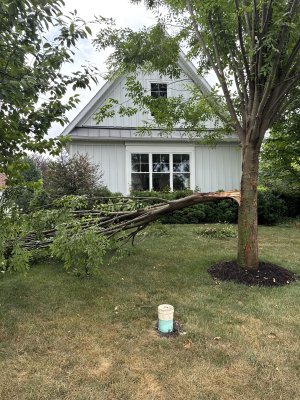
Bad storms. Ours was minimal-hundreds of trees in the county came down, cars and house crushed, lots of downed power lines so minimal work and still have power so can’t complain-but had me wondering about options that could spoil up an electric chainsaw. Just our township had 40 roads closed still today and storm was Saturday night.
 

Attachments

  • IMG_0164.jpeg
    IMG_0164.jpeg
    3.7 MB · Views: 14
Bad storms. Ours was minimal-hundreds of trees in the county came down, cars and house crushed, lots of downed power lines so minimal work and still have power so can’t complain-but had me wondering about options that could spoil up an electric chainsaw. Just our township had 40 roads closed still today and storm was Saturday night.
Wow - glad you guys are safe…
 
  • Like
Reactions: J Alynn
Bad storms. Ours was minimal-hundreds of trees in the county came down, cars and house crushed, lots of downed power lines so minimal work and still have power so can’t complain-but had me wondering about options that could spoil up an electric chainsaw. Just our township had 40 roads closed still today and storm was Saturday night.
Oh my goodness. So glad you are okay!
 
  • Like
Reactions: maynard and J Alynn
Question for the electricity experts and ‘nerds’. Since we had really bad storms this weekend and power outages, how does one design an optimal electric chainsaw that could be run via the Scouts. I realize cords aren’t the most desirable on a chainsaw but was thinking other than rotating 6 batteries charging on the tailgate plugged into the vehicle, there has to be a way to have a chainsaw easily run consistently while cutting large trees. Our local Lowe’s sold out of chainsaws and the Home Depot came close. Anyone have any great ideas?

I’ve been a Stihl and Husqvarna saw owner for nearly 50 years. I have not needed to cut more than a few branches and a couple of small trees in the past five or so years. I have a suspicion that my partner will ask that we install a wood stove for the ambiance sometime in the next year or two.

If that happens, I’ll sell my Stihl MS 391 and get an MSA 300 and a couple of spare batteries. The charging specs on the Stihl batteries are that they’ll return to 80% within 10 minutes, and I believe that’s accurate. The regular sized battery will run the saw for 20-30 minutes at close to 100% duty cycle. A backpack battery could last an hour or more. Half an hour is about all I would get out of a tank of gas anyway, and the lubrication will need to be refilled by then too. With three batteries at 100% at the start of my day, I’m unlikely to run out of charge if they’re recharging from the truck while I’m working. And the lower NVH from the electric would make it a much easier day.

I have a 12” DeWalt electric chainsaw that I use for limbing and etc. It’s almost dangerously easy to use. And I can get at least 30-45 minutes out of a single battery while I’m up in a tree. Since I have a pile of DeWalt tools and batteries, it’s my go-to chainsaw for anything other than felling a large tree.

I usually run a 20” bar on my 391. Stihl claims it can handle a 25” bar, but it bogs down and isn’t any fun at that size.

The MSA 300 (electrict) is rated for a 20” bar. Given the much higher torque at 0 RPM an electric motor has, I suspect it’s fully capable of bucking up a 40-inch diameter tree easily, and larger if you know what you’re doing. I’m itching for an excuse to swap to electric.
 
  • Love
  • Like
Reactions: J Alynn and maynard
I’ve been a Stihl and Husqvarna saw owner for nearly 50 years. I have not needed to cut more than a few branches and a couple of small trees in the past five or so years. I have a suspicion that my partner will ask that we install a wood stove for the ambiance sometime in the next year or two.

If that happens, I’ll sell my Stihl MS 391 and get an MSA 300 and a couple of spare batteries. The charging specs on the Stihl batteries are that they’ll return to 80% within 10 minutes, and I believe that’s accurate. The regular sized battery will run the saw for 20-30 minutes at close to 100% duty cycle. A backpack battery could last an hour or more. Half an hour is about all I would get out of a tank of gas anyway, and the lubrication will need to be refilled by then too. With three batteries at 100% at the start of my day, I’m unlikely to run out of charge if they’re recharging from the truck while I’m working. And the lower NVH from the electric would make it a much easier day.

I have a 12” DeWalt electric chainsaw that I use for limbing and etc. It’s almost dangerously easy to use. And I can get at least 30-45 minutes out of a single battery while I’m up in a tree. Since I have a pile of DeWalt tools and batteries, it’s my go-to chainsaw for anything other than felling a large tree.

I usually run a 20” bar on my 391. Stihl claims it can handle a 25” bar, but it bogs down and isn’t any fun at that size.

The MSA 300 (electrict) is rated for a 20” bar. Given the much higher torque at 0 RPM an electric motor has, I suspect it’s fully capable of bucking up a 40-inch diameter tree easily, and larger if you know what you’re doing. I’m itching for an excuse to swap to electric.
Never realized the batteries would last that long. Misperception as I assumed gas would give more power than a battery due to assumed battery rundown. Thanks for your insight as usual
 
I run 8", 10" and 16" Milwaukee saws for limbing, downed trees, etc. Power is definitely not a problem, nor is battery life. I can easily drop two 10"-12"x60' trees, limb everything off and cut all of it up into 20" firewood chunks on a single 12Ah Forge battery. I need to recharge before the battery does, haha. Gotta be careful with that instant torque though. Definitely recommended for regular homeowner or farm use, but I'd stick with gas if you do it for a living. Like an EV, those bigger batteries aren't light.
 
Last edited:
I run 8", 10" and 16" Milwaukee saws for limbing, downed trees, etc. Power is definitely not a problem, nor is battery life. I can easily drop two 10"-12"x60' trees, limb everything off and cut all of it up into 20" firewood chunks on a single 12Ah Forge battery. I need to recharge before the battery does, haha. Gotta be careful with that instant torque though. Definitely recommended for regular homeowner or farm use, but I'd stick with gas if you do it for a living. Like an EV, those bigger batteries aren't light.
I’m still using 3.5 Ah and 5 Ah batteries in my DeWalt; your 12Ah sounds fantastic.

The Stihl has the option for a backpack battery with 28 Ah (40 Volts). It weighs 7 kg (15 pounds). That’s not super light. But my 2.5 gallon steel gas can weighs about 5 pounds more when it’s full and isn’t anywhere near as convenient as a backpack.
 
  • Like
Reactions: maynard
I’m still using 3.5 Ah and 5 Ah batteries in my DeWalt; your 12Ah sounds fantastic.

The Stihl has the option for a backpack battery with 28 Ah (40 Volts). It weighs 7 kg (15 pounds). That’s not super light. But my 2.5 gallon steel gas can weighs about 5 pounds more when it’s full and isn’t anywhere near as convenient as a backpack.
Think of the backpack as ballast, much like a tractor. Allows you to do more work, farther from your body! :ROFLMAO:
 
Same principle for why I find it easier to carry two 5-gallon diesel cans at the same time instead of only one, right?
I think it’s a similar principle, yes. I spent a time doing powerlifting and geeking out with the coach about physics, but biomechanics are still something I have only—at best—a surface-level understanding of.

Making a bunch of implied assumptions that arms work as beams, we can guesstimate the difference in torque on the shoulders...
My arms are about 1 meter long when bent appropriately for holding a chainsaw.

My Stihl 391 has a mass of about 9 kg when full of fuel and with a 20” guidebar and chain.
That’s a torque of about 88 Nm (65 ft-lb) on my shoulders when I’m cutting.

A Stihl MSA 300 has a mass of about 5.7 kg without the battery, but with chain oil.
I’m not sure about the backpack adapter mass, but let’s say it’s a full kg (I think it’s likely much less since it’s just a few contacts in plastic).
The torque on my shoulders would be about 65-66 Nm (48 ft-lb).

With a 1.8 kg battery on the saw, it would be 7.5 kg and 73.5 Nm (54 ft-lb) torque on the shoulders.

With the backpack, the torque on the shoulders would be reduced by about 13% compared with the same saw with a battery in the saw.
Compared with the MS 391, the torque would be reduced by about 35%.

I’ll take it.
 
I’ve been a Stihl and Husqvarna saw owner for nearly 50 years. I have not needed to cut more than a few branches and a couple of small trees in the past five or so years. I have a suspicion that my partner will ask that we install a wood stove for the ambiance sometime in the next year or two.

If that happens, I’ll sell my Stihl MS 391 and get an MSA 300 and a couple of spare batteries. The charging specs on the Stihl batteries are that they’ll return to 80% within 10 minutes, and I believe that’s accurate. The regular sized battery will run the saw for 20-30 minutes at close to 100% duty cycle. A backpack battery could last an hour or more. Half an hour is about all I would get out of a tank of gas anyway, and the lubrication will need to be refilled by then too. With three batteries at 100% at the start of my day, I’m unlikely to run out of charge if they’re recharging from the truck while I’m working. And the lower NVH from the electric would make it a much easier day.

I have a 12” DeWalt electric chainsaw that I use for limbing and etc. It’s almost dangerously easy to use. And I can get at least 30-45 minutes out of a single battery while I’m up in a tree. Since I have a pile of DeWalt tools and batteries, it’s my go-to chainsaw for anything other than felling a large tree.

I usually run a 20” bar on my 391. Stihl claims it can handle a 25” bar, but it bogs down and isn’t any fun at that size.

The MSA 300 (electrict) is rated for a 20” bar. Given the much higher torque at 0 RPM an electric motor has, I suspect it’s fully capable of bucking up a 40-inch diameter tree easily, and larger if you know what you’re doing. I’m itching for an excuse to swap to electric.
I've got dewalt tools, and have been considering a chainsaw.

Which one do you have/use? I see there are a bunch of models.

My issue is that most of the trees on my property are tiny. Well, I guess not "tiny" anymore, but still in the ~1-3in diameter range, and then the larger ones are in the 2-4ft range (PNW...). So my needs are not great, but it wouldn't be bad to have around for wind storms.

I have looked at the "mini" handheld chainsaws as well for limbing, but I've actually got a thing for manual tools when I can. And I've got a heavy machete pattern (24in blade vs the standard 18in, forward weighted ) that is phenomenal at limbing small trees (I can lop branches up to about 1-1.5in in one swing). I've even used it for felling small-medium sized trees (~6-8in diameter). But the small single hand chainsaws have some advantage for ease of use for others.
 
I've got dewalt tools, and have been considering a chainsaw.

Which one do you have/use? I see there are a bunch of models.

My issue is that most of the trees on my property are tiny. Well, I guess not "tiny" anymore, but still in the ~1-3in diameter range, and then the larger ones are in the 2-4ft range (PNW...). So my needs are not great, but it wouldn't be bad to have around for wind storms.

I have looked at the "mini" handheld chainsaws as well for limbing, but I've actually got a thing for manual tools when I can. And I've got a heavy machete pattern (24in blade vs the standard 18in, forward weighted ) that is phenomenal at limbing small trees (I can lop branches up to about 1-1.5in in one swing). I've even used it for felling small-medium sized trees (~6-8in diameter). But the small single hand chainsaws have some advantage for ease of use for others.

While I'm running the Milwaukee equivalent (M18 Hatchet), the DeWalt pruning chainsaw looks to serve a similar purpose. Small, portable and cuts through smaller stuff in a flash. Great for average storm debris when we lose larger branches. I rarely get a bigger saw out nowadays.
 
I've got dewalt tools, and have been considering a chainsaw.

Which one do you have/use? I see there are a bunch of models.

My issue is that most of the trees on my property are tiny. Well, I guess not "tiny" anymore, but still in the ~1-3in diameter range, and then the larger ones are in the 2-4ft range (PNW...). So my needs are not great, but it wouldn't be bad to have around for wind storms.

I have looked at the "mini" handheld chainsaws as well for limbing, but I've actually got a thing for manual tools when I can. And I've got a heavy machete pattern (24in blade vs the standard 18in, forward weighted ) that is phenomenal at limbing small trees (I can lop branches up to about 1-1.5in in one swing). I've even used it for felling small-medium sized trees (~6-8in diameter). But the small single hand chainsaws have some advantage for ease of use for others.
I have the DCCS620, which I think has been replaced by the DCCS621. The 620 was the only one available when I was shopping some 7-8 years ago. Now they have a wide range of saws. If I were to get another small saw within the DeWalt ecosystem, I would look at the 60V top handle DCCS673X1; IMO the top handle is better for pruning and other uses on a tree that’s standing.

But if I were to buy another saw, it would likely be from a chainsaw manufacturer rather than a cordless tool manufacturer. The DeWalt batteries are not my favorite—I’ve had several fail on me outside of warranty, but well within a reasonable cycle lifetime. And the larger DeWalt saws are quite a bit heavier than they should be (their 20” saw when fully assembled is almost 15 kg; that’s almost the weight of a huge Stihl MS 462 with a 36” bar and chain).
 
Stihl guy here (long-time MS311 owner).

Came in quite handy for a rando tornado that blew through our backyard once and took out a bunch of Pines. Works great for cutting firewood from blowdowns. Would def replace with electric based on my needs now, but hard to kill this thing.

1783450789047.png
 
We've had a 16" 60V DeWalt saw for a few years now and it is one of the best purchases I have ever made. Why? Because my wife will use it. She won't go near a gas saw due to having trouble starting it, the noise, and the smell. But with the DeWalt she has no issues and is self-sufficient. We have 2 batteries (one that came w/ the saw and one that came with our weedeater) and we quit before the saw does. I think the 16" is a good size as you can take down bigger stuff but it's still small enough that it doesn't wear you out running it.

But I guess to the OP's question, there are only 2 choices - batteries or cords. I think if you had 3 x 3Ah batteries with 2 chargers plugged into the Scout you would have no trouble keeping a saw running all day.
 
We've had a 16" 60V DeWalt saw for a few years now and it is one of the best purchases I have ever made. Why? Because my wife will use it. She won't go near a gas saw due to having trouble starting it, the noise, and the smell. But with the DeWalt she has no issues and is self-sufficient. We have 2 batteries (one that came w/ the saw and one that came with our weedeater) and we quit before the saw does. I think the 16" is a good size as you can take down bigger stuff but it's still small enough that it doesn't wear you out running it.

But I guess to the OP's question, there are only 2 choices - batteries or cords. I think if you had 3 x 3Ah batteries with 2 chargers plugged into the Scout you would have no trouble keeping a saw running all day.
GREAT point about the wife thing! My wife won't use the Stihl weedeater, but she'll use the Milwaukee one. She also likes the handheld blower and keeps the driveway and deck clean too, things that were historically my responsibility.
 
I run 8", 10" and 16" Milwaukee saws for limbing, downed trees, etc. Power is definitely not a problem, nor is battery life. I can easily drop two 10"-12"x60' trees, limb everything off and cut all of it up into 20" firewood chunks on a single 12Ah Forge battery. I need to recharge before the battery does, haha. Gotta be careful with that instant torque though. Definitely recommended for regular homeowner or farm use, but I'd stick with gas if you do it for a living. Like an EV, those bigger batteries aren't light.
More reassurance-appreciate it!
 
  • Like
Reactions: maynard