



So, the more I consider the Terra BEV (and my location in the Northeast) the more I am drawn to a Heat Pump as a required component for my next EV truck. I honestly don't think it would eliminate any DCFC charging stops that I would normally need to take on my winter trips, but it could potentially very positively impact the efficiency of the truck overall (and reduce charging costs & time). I own a Launch R1T without a Heat Pump, so I have no experience with an EV that has one. Rivian dropped heat pumps into the Gen II R1 vehicles, so they must have come to the conclusion that they could gain better efficiency overall (and in particular where we get real winter).
Then I started thinking about battery chemistry. I have a NMC large pack battery, and Scout is planning on using NMC (I think) for the Pure BEV. Then I realized that this has not yet been confirmed. For Gen II Rivian R1 vehicles, Rivian swapped battery chemistry to LFP and added a heat pump. I wonder if Scout will just follow suit or if there is a chance we see NMC with a heat pump in the pure BEV trucks?
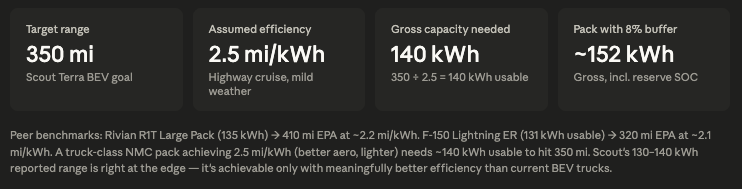
That got me wondering about the efficiency differences with each battery pack and how a heat pump will effect each. These are the "assumptions" I am using for the battery capacity, range and estimated efficiency at 2.5 mi/kWh:
This was the output for cold weather range projections:
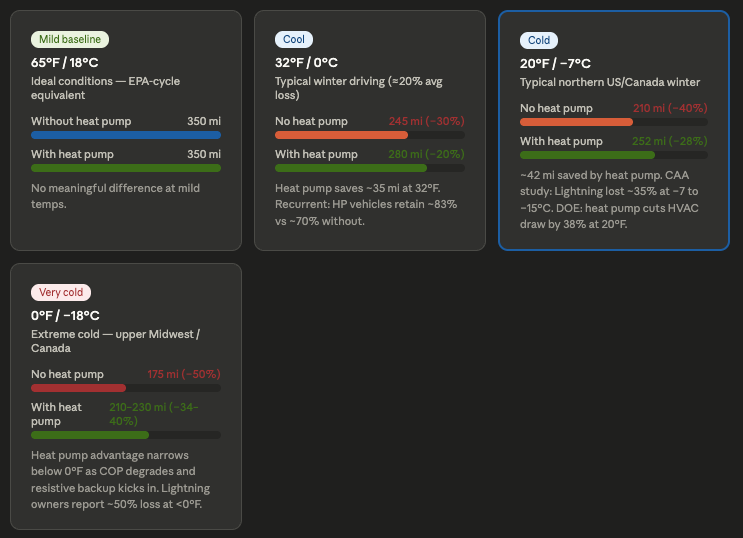
Now, here's a look with temperature impacts on range across 4 different temperature bands... The one I am really most interested in myself is the band at 20 degrees, which is a pretty good average winter temp for the Northeast over the span of my winter driving where DCFC charging will come into play on longer road trips:
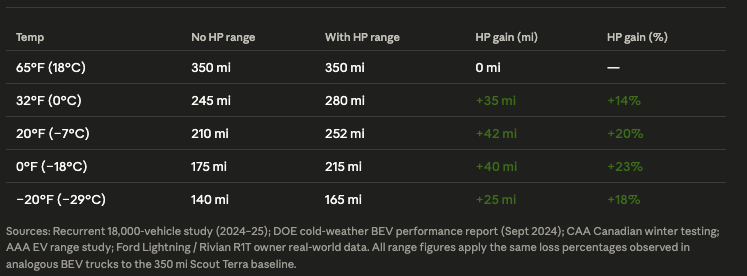
I guess my conclusion is that a 20% gain WITH a Heat Pump on NMC is really good. But, this lead me to a comparison of NMC vs. LFP:
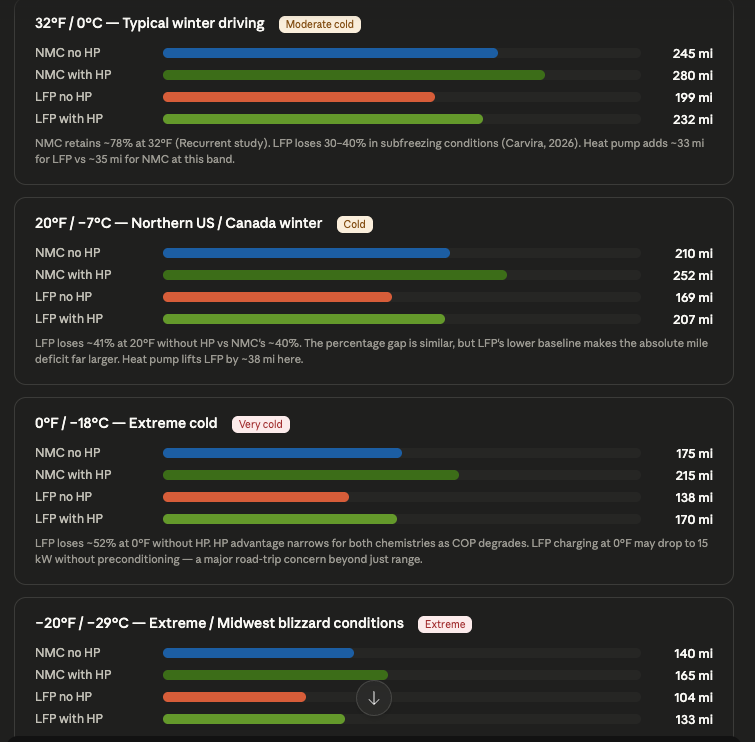
This data tends to verify that NMC with a Heat Pump would be optimal for my own use case, and for those in the Northern tier. I'm guessing this will all come down to cost and capability, and what Scout's addressable market looks like for those seeking better winter performance. Obviously a lot of decisions surrounding battery size, chemistry, heat pump or no heat pump, efficiency, etc. all still need to be finalized before ANY of this data can be validated, but this is an interesting consideration for winter performance for sure.
Then I started thinking about battery chemistry. I have a NMC large pack battery, and Scout is planning on using NMC (I think) for the Pure BEV. Then I realized that this has not yet been confirmed. For Gen II Rivian R1 vehicles, Rivian swapped battery chemistry to LFP and added a heat pump. I wonder if Scout will just follow suit or if there is a chance we see NMC with a heat pump in the pure BEV trucks?
That got me wondering about the efficiency differences with each battery pack and how a heat pump will effect each. These are the "assumptions" I am using for the battery capacity, range and estimated efficiency at 2.5 mi/kWh:
This was the output for cold weather range projections:
Now, here's a look with temperature impacts on range across 4 different temperature bands... The one I am really most interested in myself is the band at 20 degrees, which is a pretty good average winter temp for the Northeast over the span of my winter driving where DCFC charging will come into play on longer road trips:
I guess my conclusion is that a 20% gain WITH a Heat Pump on NMC is really good. But, this lead me to a comparison of NMC vs. LFP:
This data tends to verify that NMC with a Heat Pump would be optimal for my own use case, and for those in the Northern tier. I'm guessing this will all come down to cost and capability, and what Scout's addressable market looks like for those seeking better winter performance. Obviously a lot of decisions surrounding battery size, chemistry, heat pump or no heat pump, efficiency, etc. all still need to be finalized before ANY of this data can be validated, but this is an interesting consideration for winter performance for sure.