

Heat Pump / Pure BEV / Winter Performance (and Battery Chemistry)

  • From all of us at Scout Motors, welcome to the Scout Community! We created this community to provide Scout vehicle owners, enthusiasts, and curiosity seekers with a place to engage in discussion, suggestions, stories, and connections. Supportive communities are sometimes hard to find, but we're determined to turn this into one.

    Additionally, Scout Motors wants to hear your feedback and speak directly to the rabid community of owners as unique as America. We'll use the Scout Community to deliver news and information on events and launch updates directly to the group. Although the start of production is anticipated in 2026, many new developments and milestones will occur in the interim. We plan to share them with you on this site and look for your feedback and suggestions.

    How will the Scout Community be run? Think of it this way: this place is your favorite local hangout. We want you to enjoy the atmosphere, talk to people who share similar interests, request and receive advice, and generally have an enjoyable time. The Scout Community should be a highlight of your day. We want you to tell stories, share photos, spread your knowledge, and tell us how Scout can deliver great products and experiences. Along the way, Scout Motors will share our journey to production with you.

    Scout is all about respect. We respect our heritage. We respect the land and outdoors. We respect each other. Every person should feel safe, included, and welcomed in the Scout Community. Being kind and courteous to the other forum members is non-negotiable. Friendly debates are welcomed and often produce great outcomes, but we don't want things to get too rowdy. Please take a moment to consider what you post, especially if you think it may insult others. We'll do our best to encourage friendly discourse and to keep the discussions flowing.

    So, welcome to the Scout Community! We encourage you to check back regularly as we plan to engage our members, share teasers, and participate in discussions. The world needs Scouts™. Let's get going.


    We are Scout Motors.

R1TVT

Scout Community Veteran
1st Year Member
Dec 21, 2022
1,661
5,400
New England
So, the more I consider the Terra BEV (and my location in the Northeast) the more I am drawn to a Heat Pump as a required component for my next EV truck. I honestly don't think it would eliminate any DCFC charging stops that I would normally need to take on my winter trips, but it could potentially very positively impact the efficiency of the truck overall (and reduce charging costs & time). I own a Launch R1T without a Heat Pump, so I have no experience with an EV that has one. Rivian dropped heat pumps into the Gen II R1 vehicles, so they must have come to the conclusion that they could gain better efficiency overall (and in particular where we get real winter).

Then I started thinking about battery chemistry. I have a NMC large pack battery, and Scout is planning on using NMC (I think) for the Pure BEV. Then I realized that this has not yet been confirmed. For Gen II Rivian R1 vehicles, Rivian swapped battery chemistry to LFP and added a heat pump. I wonder if Scout will just follow suit or if there is a chance we see NMC with a heat pump in the pure BEV trucks?

That got me wondering about the efficiency differences with each battery pack and how a heat pump will effect each. These are the "assumptions" I am using for the battery capacity, range and estimated efficiency at 2.5 mi/kWh:
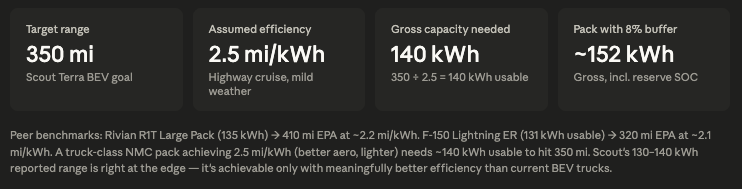
Screenshot 2026-04-10 at 9.47.01 AM.png


This was the output for cold weather range projections:
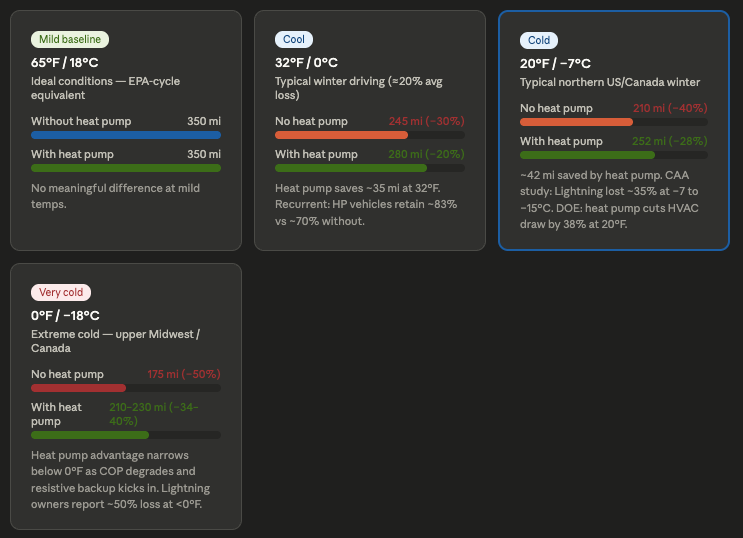
Screenshot 2026-04-10 at 10.21.45 AM.png


Now, here's a look with temperature impacts on range across 4 different temperature bands... The one I am really most interested in myself is the band at 20 degrees, which is a pretty good average winter temp for the Northeast over the span of my winter driving where DCFC charging will come into play on longer road trips:
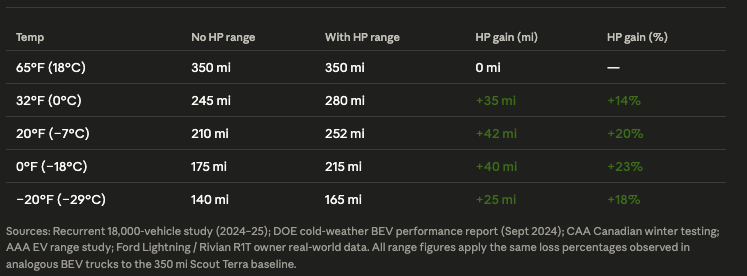
Screenshot 2026-04-10 at 10.25.09 AM.png


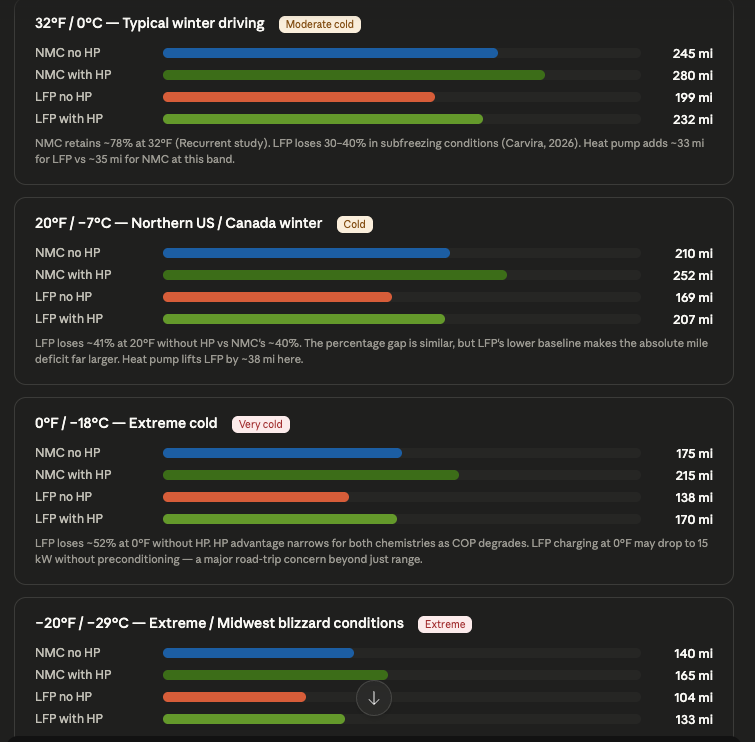
I guess my conclusion is that a 20% gain WITH a Heat Pump on NMC is really good. But, this lead me to a comparison of NMC vs. LFP:

Screenshot 2026-04-10 at 10.33.09 AM.png


This data tends to verify that NMC with a Heat Pump would be optimal for my own use case, and for those in the Northern tier. I'm guessing this will all come down to cost and capability, and what Scout's addressable market looks like for those seeking better winter performance. Obviously a lot of decisions surrounding battery size, chemistry, heat pump or no heat pump, efficiency, etc. all still need to be finalized before ANY of this data can be validated, but this is an interesting consideration for winter performance for sure.
 
I think you are close with your estimates at top, though I’m personally convinced the Terra highway efficiency will be less. If the actual range were around 300 miles I could live with that.
 
What tool are you using for this analysis?

I agree with your broad conclusion.

If I were in charge of Scout’s thermal management engineering, I would also play around with models for small, directed radiant (resistive) heat in much the same way another manufacturer is doing. I can’t remember which brand.
 
  • Like
Reactions: maynard and cyure
What tool are you using for this analysis?

I agree with your broad conclusion.

If I were in charge of Scout’s thermal management engineering, I would also play around with models for small, directed radiant (resistive) heat in much the same way another manufacturer is doing. I can’t remember which brand.
Sorry - thought I mentioned that it was Claude... Didn't spend much time overthinking my prompts, but did ask to unbias results by looking at real-world examples (lightning, R1T, etc) when considering data parameters for the analysis.

Yes, resistive would be the alternative I suppose, but I think Heat Pump might win out based on the bands and energy. Likely not on cost, complexity and additional maintenance though? I'm learning...
 
Sorry - thought I mentioned that it was Claude... Didn't spend much time overthinking my prompts, but did ask to unbias results by looking at real-world examples (lightning, R1T, etc) when considering data parameters for the analysis.

Yes, resistive would be the alternative I suppose, but I think Heat Pump might win out based on the bands and energy. Likely not on cost, complexity and additional maintenance though? I'm learning...

The winning part of heat pumps is efficiency. They can heat the entire cabin’s air mass for 1/5 (or less) the energy cost of a resistive heater.

The winning part of resistive is only if it’s not intended to heat the entire cabin’s air mass, but rather direct heat to specific locations (seat heaters, steering wheel heaters, footwell heaters). If you’re only trying to heat a small area 1/100th the volume of the cabin’s air mass, you can spend a lot less energy.
 
That leads to the next question... If you are an OEM adding a heat pump to an EV (maybe looking at current EV's on the market that already have them - Gen II R1's being one example), do they also have a separate resistance heating component for components like seats & steering wheels?

I believe Rivian eliminated Resistance heating altogether based on this, but will need to verify:

"A fully redesigned heat pump climate system delivers enhanced efficiency, especially in cold weather. Core to the design is our new heat pump thermal system, enabling the cabin to heat more quickly and remain quieter, all while consuming less energy."
 
  • Like
Reactions: maynard
That leads to the next question... If you are an OEM adding a heat pump to an EV (maybe looking at current EV's on the market that already have them - Gen II R1's being one example), do they also have a separate resistance heating component for components like seats & steering wheels?

I have a 2024 Hyundai Ioniq 5. It has a heat pump for cabin heating. It has resistance heating for the front seats and steering wheel (with separate temperature controls).
 
  • Like
Reactions: R1TVT and maynard
Then I started thinking about battery chemistry. I have a NMC large pack battery, and Scout is planning on using NMC (I think) for the Pure BEV. Then I realized that this has not yet been confirmed. For Gen II Rivian R1 vehicles, Rivian swapped battery chemistry to LFP and added a heat pump. I wonder if Scout will just follow suit or if there is a chance we see NMC with a heat pump in the pure BEV trucks?

I don't see anything official on the Scout Motors FAQ about what battery chemistry they are using, but Scott mentioned the battery chemistry during his interview with Jay Jeno. Here is a quote from an Inside EVs article about it:

In an interview on the YouTube channel Jay Leno’s Garage, Scout Motors’ President and CEO Scott Keogh shared some new insights into the revival of the iconic American off-road brand. He said the fully-electric and extended-range electric vehicle (EREV) versions of Scout's future models will use different battery chemistries.

The fully electric models of the Terra truck and Traveler SUV will feature nickel-manganese-cobalt (NMC) battery packs estimated to deliver 350 miles of range. The EREVs, which will feature a back-up gas-powered generator to charge the battery when running low on energy, will get a smaller lithium-iron-phosphate (LFP) battery pack.
 
  • Like
Reactions: maynard
I would never buy an EV without a heat pump. If you want to go down a rabbit hole, dig around on Tesla's octo-valve. It allows them to scavenge heat from the motors, inverters, battery pack, even the coolant pumps themselves and send it where it's needed. I was concerned that this would be a maintenance nightmare but I'm 4 years and 70k miles in and not a drip. Yes, 4 years isn't that long but I expected it to have failed already. It truly is genius in its ability to move heat around vs having to create it.

The car still has resistive strips for the seat and steering wheel heaters.

I am surprised that Rivian moved to all LFP. Even on the quad motors? I would not think they could get the performance needed for that beast out of LFP. LFP safe discharge rates are much lower than NMC. Tesla uses NMC on all of their high performance models and LFP on the base models.
 
That leads to the next question... If you are an OEM adding a heat pump to an EV (maybe looking at current EV's on the market that already have them - Gen II R1's being one example), do they also have a separate resistance heating component for components like seats & steering wheels?

I believe Rivian eliminated Resistance heating altogether based on this, but will need to verify:

"A fully redesigned heat pump climate system delivers enhanced efficiency, especially in cold weather. Core to the design is our new heat pump thermal system, enabling the cabin to heat more quickly and remain quieter, all while consuming less energy."
I don't know of any manufacturer who has heated seats or steering wheel that isn't resistive heat. The potential problems with any other method are...a lot.
 
I don't know of any manufacturer who has heated seats or steering wheel that isn't resistive heat. The potential problems with any other method are...a lot.
Got it. Looks like that is also the case with Rivian after some digging around:

"the heat pump is the new primary heating method in Gen 2, with resistive heating retained. This is the same approach most other EV makers (Tesla, Kia, etc.) use with their heat pump systems."
 
Maybe I misread the posts here?

Rivian Gen2 uses LFP for the Standard battery pack but NCA for its large and max packs.

NCA is an interesting choice over NMC. It's more expensive and more prone to thermal runaway, but also more energy dense and has better discharge performance. I seem to recall than Gen1 used an NMC chemistry.

I don't imagine Scout will choose NCA given the cost, but they may.
 
  • Like
Reactions: J Alynn and maynard