


For the Traveler, I'd love to see the spare tire carrier have an option to help raise and lower the spare. I don't care if it's slow and rudimentary, like the cable systems under the bed of many trucks, but there are plenty of people that can't easily lift a 90-lb+ spare onto the carrier.
What is one feature you hope Scout will include that has not yet been shown?
- Thread starter merrelljohnson
- Start date
-
 From all of us at Scout Motors, welcome to the Scout Community! We created this community to provide Scout vehicle owners, enthusiasts, and curiosity seekers with a place to engage in discussion, suggestions, stories, and connections. Supportive communities are sometimes hard to find, but we're determined to turn this into one.
Additionally, Scout Motors wants to hear your feedback and speak directly to the rabid community of owners as unique as America. We'll use the Scout Community to deliver news and information on events and launch updates directly to the group. Although the start of production is anticipated in 2026, many new developments and milestones will occur in the interim. We plan to share them with you on this site and look for your feedback and suggestions.
How will the Scout Community be run? Think of it this way: this place is your favorite local hangout. We want you to enjoy the atmosphere, talk to people who share similar interests, request and receive advice, and generally have an enjoyable time. The Scout Community should be a highlight of your day. We want you to tell stories, share photos, spread your knowledge, and tell us how Scout can deliver great products and experiences. Along the way, Scout Motors will share our journey to production with you.
Scout is all about respect. We respect our heritage. We respect the land and outdoors. We respect each other. Every person should feel safe, included, and welcomed in the Scout Community. Being kind and courteous to the other forum members is non-negotiable. Friendly debates are welcomed and often produce great outcomes, but we don't want things to get too rowdy. Please take a moment to consider what you post, especially if you think it may insult others. We'll do our best to encourage friendly discourse and to keep the discussions flowing.
So, welcome to the Scout Community! We encourage you to check back regularly as we plan to engage our members, share teasers, and participate in discussions. The world needs Scouts™. Let's get going.
We are Scout Motors.
You are using an out of date browser. It may not display this or other websites correctly.
You should upgrade or use an alternative browser.
You should upgrade or use an alternative browser.


Do you mean just for the tire or the whole carrier?For the Traveler, I'd love to see the spare tire carrier have an option to help raise and lower the spare. I don't care if it's slow and rudimentary, like the cable systems under the bed of many trucks, but there are plenty of people that can't easily lift a 90-lb+ spare onto the carrier.
Just the spare wheel/tire dropping out of the carrier if that makes the most sense. If you want to take the carrier off, you'll need a helping hand or three.Do you mean just for the tire or the whole carrier?
Did a 5-tire rotation on my FJ recently and realized that I'm getting too old for that crap.

I only do 4 tire rotation on my Wrangler. The spare needs to stay clean and pretty.Just the spare wheel/tire dropping out of the carrier if that makes the most sense. If you want to take the carrier off, you'll need a helping hand or three.
Did a 5-tire rotation on my FJ recently and realized that I'm getting too old for that crap.


Just the tire. I like the carrier, but it appears it’s for the off-road option. All others will get an inflator kit.Do you mean just for the tire or the whole carrier?


And imagine if you are coming dressed from work then even worse to deal with a dirt covered tireJust the spare wheel/tire dropping out of the carrier if that makes the most sense. If you want to take the carrier off, you'll need a helping hand or three.
Did a 5-tire rotation on my FJ recently and realized that I'm getting too old for that crap.

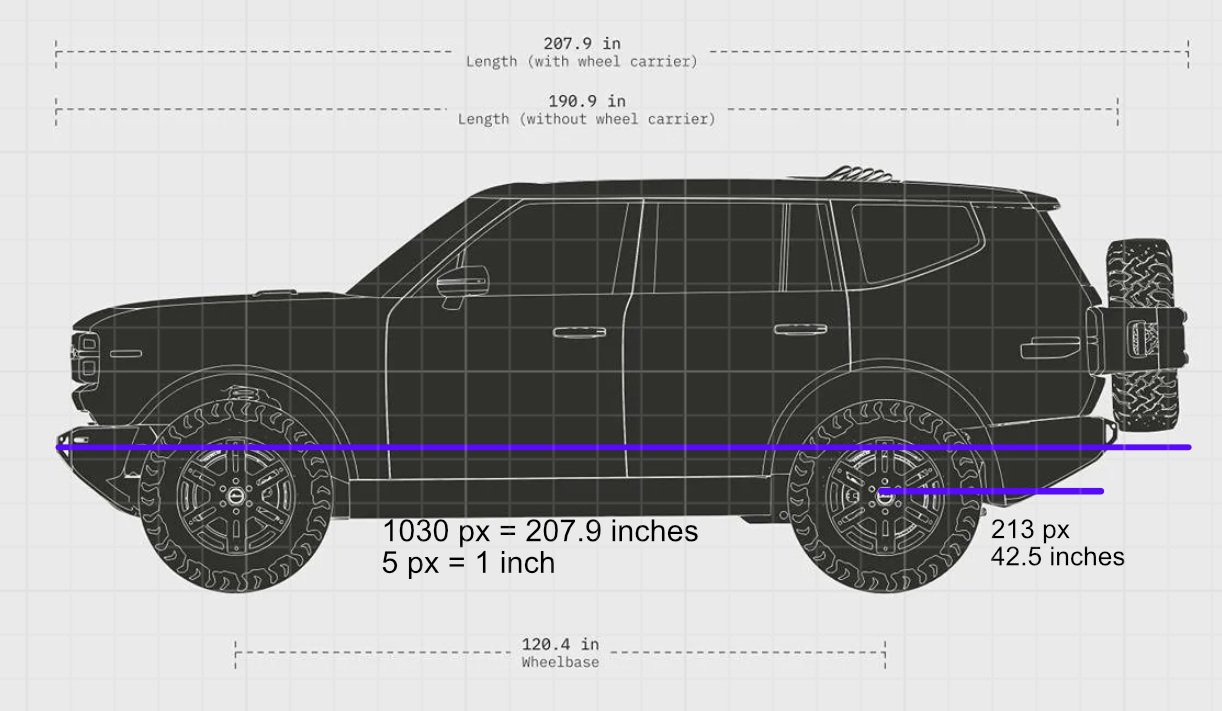
I did some basic scaling analysis of the graphics given by Scout Motors related to the size of the vehicle.
Assumption: While the vertical to horizontal scaling may not be accurate, it’s reasonable to assume that the scale doesn’t change in one dimension. So the scale used by the drawing across the image from left to right is likely to remain the same.
If this is true, then the rear overhang of the Traveler will be around 42-43 inches.
This includes the axle width and whatever might be going on at the bumper.
A 35” diameter tire would have about 6-8 inches of clearance from the center of the rear axle to the outer edge of the bumper.
Based on that, I think there’s not likely going to be an underbody spare for the Harvester buyers who don’t get the rear tire carrier. I believe this was well-understood by most forum members already.
Even for the BEV, we lose at least four inches from the rear axle and probably at least two inches from the rear bumper. It will be very close for a 35” tire to fit.
One of the problems with a short overhang and a large departure angle is that you simply can’t fit the large diameter tires into the space between the rear axle and the rear bumper. Some compromises have to be made. One of them is likely that the under-body spare is not full-sized, is not inflated, or there is no underbody spare.
If you chose not to buy the rear tire carrier for the Traveler, I suspect you will also be choosing not to have a full-size spare from the factory.
The trend is to go to either a patch kit, inflation kit, and etc., or to allow you to purchase an uninflated spare that’s smaller than the OEM wheel/tire setup—this will be purchased from the accessories or parts department, not from the factory. One of the reasons it’s an optional purchase is because of the lack of factory-safe mounting locations for that spare tire. Federal regulations do not allow a new vehicle to be sold if it has a loose spare in the back of the vehicle. It must be attached so it doesn’t fly loose during an accident. Rivian and others sell their spares via their separate Gear Shop to enable buyers to leave with their spare, but it’s a separate purchase from the vehicle and you take responsibility for bolting it down.
It’s also simply not true that every off-road advertised SUV available in the US comes with a full-size spare for their base trim.
Assumption: While the vertical to horizontal scaling may not be accurate, it’s reasonable to assume that the scale doesn’t change in one dimension. So the scale used by the drawing across the image from left to right is likely to remain the same.
If this is true, then the rear overhang of the Traveler will be around 42-43 inches.
This includes the axle width and whatever might be going on at the bumper.
A 35” diameter tire would have about 6-8 inches of clearance from the center of the rear axle to the outer edge of the bumper.
Based on that, I think there’s not likely going to be an underbody spare for the Harvester buyers who don’t get the rear tire carrier. I believe this was well-understood by most forum members already.
Even for the BEV, we lose at least four inches from the rear axle and probably at least two inches from the rear bumper. It will be very close for a 35” tire to fit.
One of the problems with a short overhang and a large departure angle is that you simply can’t fit the large diameter tires into the space between the rear axle and the rear bumper. Some compromises have to be made. One of them is likely that the under-body spare is not full-sized, is not inflated, or there is no underbody spare.
If you chose not to buy the rear tire carrier for the Traveler, I suspect you will also be choosing not to have a full-size spare from the factory.
The trend is to go to either a patch kit, inflation kit, and etc., or to allow you to purchase an uninflated spare that’s smaller than the OEM wheel/tire setup—this will be purchased from the accessories or parts department, not from the factory. One of the reasons it’s an optional purchase is because of the lack of factory-safe mounting locations for that spare tire. Federal regulations do not allow a new vehicle to be sold if it has a loose spare in the back of the vehicle. It must be attached so it doesn’t fly loose during an accident. Rivian and others sell their spares via their separate Gear Shop to enable buyers to leave with their spare, but it’s a separate purchase from the vehicle and you take responsibility for bolting it down.
It’s also simply not true that every off-road advertised SUV available in the US comes with a full-size spare for their base trim.
- Ford Bronco: Rear-mounted spare on all full-sized Broncos.
- Jeep Wrangler: Rear-mounted spare
- Sport/Sport S have a spare steel wheel to go with the alloy OEM wheels
- Others have a full-size spare with an upgraded tire carrier
- Toyota 4Runner (underbody spare)
- SR5, TRD Sport, TRD Sport Premium (22 degrees departure angles) have temporary spare/compact space-saver spare
- Limited, Platinum (22 degrees departure angle) steel wheel with outer diameter-appropriate spare tire
- TRD Off-Road, Trailhunter, and TRD Pro (24 degrees departure angles) have full-sized spares
- Toyota Land Cruiser (22 degrees departure; 33” factory tires): Underbody full-size spare

Thanks for this detailed explanation. I always count on you for things just like this.I did some basic scaling analysis of the graphics given by Scout Motors related to the size of the vehicle.
Assumption: While the vertical to horizontal scaling may not be accurate, it’s reasonable to assume that the scale doesn’t change in one dimension. So the scale used by the drawing across the image from left to right is likely to remain the same.
If this is true, then the rear overhang of the Traveler will be around 42-43 inches.
This includes the axle width and whatever might be going on at the bumper.
A 35” diameter tire would have about 6-8 inches of clearance from the center of the rear axle to the outer edge of the bumper.
Based on that, I think there’s not likely going to be an underbody spare for the Harvester buyers who don’t get the rear tire carrier. I believe this was well-understood by most forum members already.
Even for the BEV, we lose at least four inches from the rear axle and probably at least two inches from the rear bumper. It will be very close for a 35” tire to fit.
One of the problems with a short overhang and a large departure angle is that you simply can’t fit the large diameter tires into the space between the rear axle and the rear bumper. Some compromises have to be made. One of them is likely that the under-body spare is not full-sized, is not inflated, or there is no underbody spare.
If you chose not to buy the rear tire carrier for the Traveler, I suspect you will also be choosing not to have a full-size spare from the factory.
The trend is to go to either a patch kit, inflation kit, and etc., or to allow you to purchase an uninflated spare that’s smaller than the OEM wheel/tire setup—this will be purchased from the accessories or parts department, not from the factory. One of the reasons it’s an optional purchase is because of the lack of factory-safe mounting locations for that spare tire. Federal regulations do not allow a new vehicle to be sold if it has a loose spare in the back of the vehicle. It must be attached so it doesn’t fly loose during an accident. Rivian and others sell their spares via their separate Gear Shop to enable buyers to leave with their spare, but it’s a separate purchase from the vehicle and you take responsibility for bolting it down.
View attachment 17715
It’s also simply not true that every off-road advertised SUV available in the US comes with a full-size spare for their base trim.
I think it’s obvious if you want the rear departure angle to compete with the Bronco or the Wrangler, you’re also going to get the rear-mounted full-size spare in the same spot: on a rear-mounted tire carrier. If you don’t want the tire carrier, then there’s just no place for your spare to be safely mounted from the factory.
- Ford Bronco: Rear-mounted spare on all full-sized Broncos.
- Jeep Wrangler: Rear-mounted spare
- Sport/Sport S have a spare steel wheel to go with the alloy OEM wheels
- Others have a full-size spare with an upgraded tire carrier
- Toyota 4Runner (underbody spare)
- SR5, TRD Sport, TRD Sport Premium (22 degrees departure angles) have temporary spare/compact space-saver spare
- Limited, Platinum (22 degrees departure angle) steel wheel with outer diameter-appropriate spare tire
- TRD Off-Road, Trailhunter, and TRD Pro (24 degrees departure angles) have full-sized spares
- Toyota Land Cruiser (22 degrees departure; 33” factory tires): Underbody full-size spare
This one didn’t have as much MATH so I appreciate it!
Right.I did some basic scaling analysis of the graphics given by Scout Motors related to the size of the vehicle.
Assumption: While the vertical to horizontal scaling may not be accurate, it’s reasonable to assume that the scale doesn’t change in one dimension. So the scale used by the drawing across the image from left to right is likely to remain the same.
If this is true, then the rear overhang of the Traveler will be around 42-43 inches.
This includes the axle width and whatever might be going on at the bumper.
A 35” diameter tire would have about 6-8 inches of clearance from the center of the rear axle to the outer edge of the bumper.
Based on that, I think there’s not likely going to be an underbody spare for the Harvester buyers who don’t get the rear tire carrier. I believe this was well-understood by most forum members already.
Even for the BEV, we lose at least four inches from the rear axle and probably at least two inches from the rear bumper. It will be very close for a 35” tire to fit.
One of the problems with a short overhang and a large departure angle is that you simply can’t fit the large diameter tires into the space between the rear axle and the rear bumper. Some compromises have to be made. One of them is likely that the under-body spare is not full-sized, is not inflated, or there is no underbody spare.
If you chose not to buy the rear tire carrier for the Traveler, I suspect you will also be choosing not to have a full-size spare from the factory.
The trend is to go to either a patch kit, inflation kit, and etc., or to allow you to purchase an uninflated spare that’s smaller than the OEM wheel/tire setup—this will be purchased from the accessories or parts department, not from the factory. One of the reasons it’s an optional purchase is because of the lack of factory-safe mounting locations for that spare tire. Federal regulations do not allow a new vehicle to be sold if it has a loose spare in the back of the vehicle. It must be attached so it doesn’t fly loose during an accident. Rivian and others sell their spares via their separate Gear Shop to enable buyers to leave with their spare, but it’s a separate purchase from the vehicle and you take responsibility for bolting it down.
View attachment 17715
It’s also simply not true that every off-road advertised SUV available in the US comes with a full-size spare for their base trim.
I think it’s obvious if you want the rear departure angle to compete with the Bronco or the Wrangler, you’re also going to get the rear-mounted full-size spare in the same spot: on a rear-mounted tire carrier. If you don’t want the tire carrier, then there’s just no place for your spare to be safely mounted from the factory.
- Ford Bronco: Rear-mounted spare on all full-sized Broncos.
- Jeep Wrangler: Rear-mounted spare
- Sport/Sport S have a spare steel wheel to go with the alloy OEM wheels
- Others have a full-size spare with an upgraded tire carrier
- Toyota 4Runner (underbody spare)
- SR5, TRD Sport, TRD Sport Premium (22 degrees departure angles) have temporary spare/compact space-saver spare
- Limited, Platinum (22 degrees departure angle) steel wheel with outer diameter-appropriate spare tire
- TRD Off-Road, Trailhunter, and TRD Pro (24 degrees departure angles) have full-sized spares
- Toyota Land Cruiser (22 degrees departure; 33” factory tires): Underbody full-size spare
Not disagreeing with any point you made. All the cars mentioned do in fact come with a spare as standard equipment (donut or full size).
And I don’t think anyone would expect a 37 inch tire to fit under the hood. Or hang from underneath so the backpack seems to be the only viable option. But smaller sized tires, if engineered right, might have a fighting chance.
Again…it’s just an odd choice.
Also….I did get a picture of underbelly. Nice and slippery! This is going to be incredible off road.I did some basic scaling analysis of the graphics given by Scout Motors related to the size of the vehicle.
Assumption: While the vertical to horizontal scaling may not be accurate, it’s reasonable to assume that the scale doesn’t change in one dimension. So the scale used by the drawing across the image from left to right is likely to remain the same.
If this is true, then the rear overhang of the Traveler will be around 42-43 inches.
This includes the axle width and whatever might be going on at the bumper.
A 35” diameter tire would have about 6-8 inches of clearance from the center of the rear axle to the outer edge of the bumper.
Based on that, I think there’s not likely going to be an underbody spare for the Harvester buyers who don’t get the rear tire carrier. I believe this was well-understood by most forum members already.
Even for the BEV, we lose at least four inches from the rear axle and probably at least two inches from the rear bumper. It will be very close for a 35” tire to fit.
One of the problems with a short overhang and a large departure angle is that you simply can’t fit the large diameter tires into the space between the rear axle and the rear bumper. Some compromises have to be made. One of them is likely that the under-body spare is not full-sized, is not inflated, or there is no underbody spare.
If you chose not to buy the rear tire carrier for the Traveler, I suspect you will also be choosing not to have a full-size spare from the factory.
The trend is to go to either a patch kit, inflation kit, and etc., or to allow you to purchase an uninflated spare that’s smaller than the OEM wheel/tire setup—this will be purchased from the accessories or parts department, not from the factory. One of the reasons it’s an optional purchase is because of the lack of factory-safe mounting locations for that spare tire. Federal regulations do not allow a new vehicle to be sold if it has a loose spare in the back of the vehicle. It must be attached so it doesn’t fly loose during an accident. Rivian and others sell their spares via their separate Gear Shop to enable buyers to leave with their spare, but it’s a separate purchase from the vehicle and you take responsibility for bolting it down.
View attachment 17715
It’s also simply not true that every off-road advertised SUV available in the US comes with a full-size spare for their base trim.
I think it’s obvious if you want the rear departure angle to compete with the Bronco or the Wrangler, you’re also going to get the rear-mounted full-size spare in the same spot: on a rear-mounted tire carrier. If you don’t want the tire carrier, then there’s just no place for your spare to be safely mounted from the factory.
- Ford Bronco: Rear-mounted spare on all full-sized Broncos.
- Jeep Wrangler: Rear-mounted spare
- Sport/Sport S have a spare steel wheel to go with the alloy OEM wheels
- Others have a full-size spare with an upgraded tire carrier
- Toyota 4Runner (underbody spare)
- SR5, TRD Sport, TRD Sport Premium (22 degrees departure angles) have temporary spare/compact space-saver spare
- Limited, Platinum (22 degrees departure angle) steel wheel with outer diameter-appropriate spare tire
- TRD Off-Road, Trailhunter, and TRD Pro (24 degrees departure angles) have full-sized spares
- Toyota Land Cruiser (22 degrees departure; 33” factory tires): Underbody full-size spare
Attachments
I also wonder if there is battery change/enhancements coming where they potentially decided to kill the under spare to gain a bit more battery space. Obviously things can change through development. At the reveal it was pretty much implied the standard tire would fit under for Terra and hope was to get it under traveler but not guaranteedI did some basic scaling analysis of the graphics given by Scout Motors related to the size of the vehicle.
Assumption: While the vertical to horizontal scaling may not be accurate, it’s reasonable to assume that the scale doesn’t change in one dimension. So the scale used by the drawing across the image from left to right is likely to remain the same.
If this is true, then the rear overhang of the Traveler will be around 42-43 inches.
This includes the axle width and whatever might be going on at the bumper.
A 35” diameter tire would have about 6-8 inches of clearance from the center of the rear axle to the outer edge of the bumper.
Based on that, I think there’s not likely going to be an underbody spare for the Harvester buyers who don’t get the rear tire carrier. I believe this was well-understood by most forum members already.
Even for the BEV, we lose at least four inches from the rear axle and probably at least two inches from the rear bumper. It will be very close for a 35” tire to fit.
One of the problems with a short overhang and a large departure angle is that you simply can’t fit the large diameter tires into the space between the rear axle and the rear bumper. Some compromises have to be made. One of them is likely that the under-body spare is not full-sized, is not inflated, or there is no underbody spare.
If you chose not to buy the rear tire carrier for the Traveler, I suspect you will also be choosing not to have a full-size spare from the factory.
The trend is to go to either a patch kit, inflation kit, and etc., or to allow you to purchase an uninflated spare that’s smaller than the OEM wheel/tire setup—this will be purchased from the accessories or parts department, not from the factory. One of the reasons it’s an optional purchase is because of the lack of factory-safe mounting locations for that spare tire. Federal regulations do not allow a new vehicle to be sold if it has a loose spare in the back of the vehicle. It must be attached so it doesn’t fly loose during an accident. Rivian and others sell their spares via their separate Gear Shop to enable buyers to leave with their spare, but it’s a separate purchase from the vehicle and you take responsibility for bolting it down.
View attachment 17715
It’s also simply not true that every off-road advertised SUV available in the US comes with a full-size spare for their base trim.
I think it’s obvious if you want the rear departure angle to compete with the Bronco or the Wrangler, you’re also going to get the rear-mounted full-size spare in the same spot: on a rear-mounted tire carrier. If you don’t want the tire carrier, then there’s just no place for your spare to be safely mounted from the factory.
- Ford Bronco: Rear-mounted spare on all full-sized Broncos.
- Jeep Wrangler: Rear-mounted spare
- Sport/Sport S have a spare steel wheel to go with the alloy OEM wheels
- Others have a full-size spare with an upgraded tire carrier
- Toyota 4Runner (underbody spare)
- SR5, TRD Sport, TRD Sport Premium (22 degrees departure angles) have temporary spare/compact space-saver spare
- Limited, Platinum (22 degrees departure angle) steel wheel with outer diameter-appropriate spare tire
- TRD Off-Road, Trailhunter, and TRD Pro (24 degrees departure angles) have full-sized spares
- Toyota Land Cruiser (22 degrees departure; 33” factory tires): Underbody full-size spare
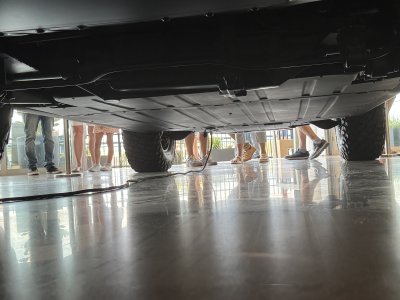
Just to be fair so it’s clear, that underbody is strictly there to hide the current battery/drive system as they don’t want all of us seeing what is currently under there. I suspect it will look very similar but early on we were told the underbody isn’t the final. Just an FYI. Newer folks might not realize that so wanted to note it. However if someone higher up at SM told you differently than I digress.Also….I did get a picture of underbelly. Nice and slippery! This is going to be incredible off road.
I didn't think it's that odd.Right.
Not disagreeing with any point you made. All the cars mentioned do in fact come with a spare as standard equipment (donut or full size).
And I don’t think anyone would expect a 37 inch tire to fit under the hood. Or hang from underneath so the backpack seems to be the only viable option. But smaller sized tires, if engineered right, might have a fighting chance.
Again…it’s just an odd choice.
If my guesses are correct, their options are basically:
- Make the tire carrier + spare tire + jack kit a deletable option in the configurator and have it selected by default for all trims.
- Make the tire carrier + spare tire + jack kit an add-on option in the configurator and have it off by default for all trims.
- Make the tire carrier + spare + jack kit default to on for certain higher-level trims and an add-on option for more base trims.
- Only allow the tire carrier + spare + jack kit for certain trims.
Which one is “best” is entirely up to the person purchasing the vehicle. If the option is worth $X thousands, do people want it to be on by default or to be off by default? Do people not want to know the cost?
There’s no vehicle manufacturer that doesn’t include the cost of these things in their vehicle. It’s just a matter of whether you see that cost explicitly or not.
Also, I think it’s very unlikely that a 37” tire will be available from the factory. And it’s even unlikely that one will be able to fit a 37” spare in the tire carrier.
Borrowing some photos from @cyure...
Here’s a photo of a 35” tire in the carrier. There’s not a ton of space on either side.
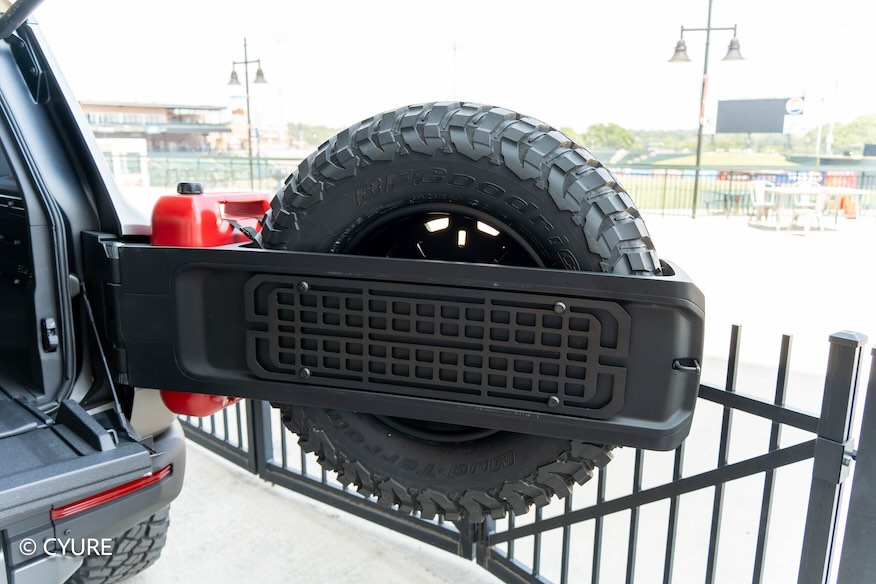
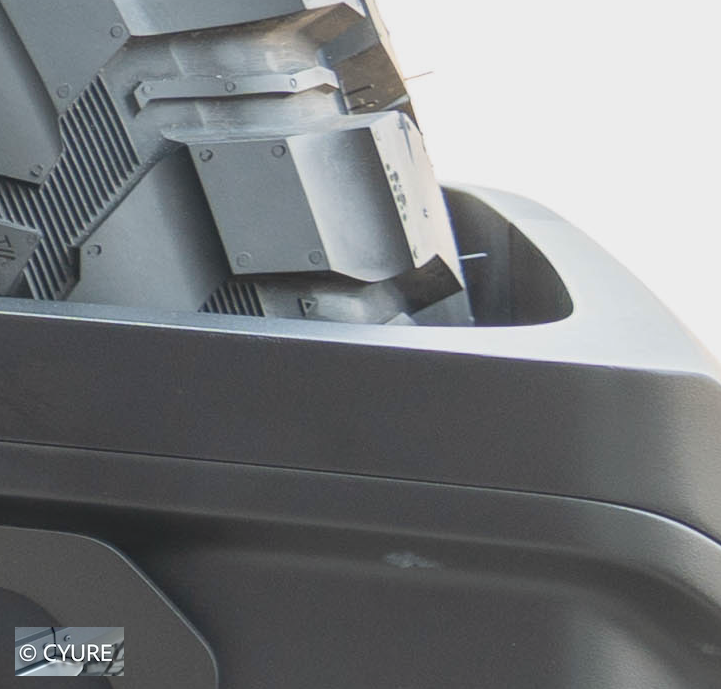
Here’s a zoom in on the right-hand side. Now, I can’t be sure what’s going on past this part of the carrier, but I’d be super surprised if there’s enough space in there for another inch of tread.
Borrowing some photos from @cyure...
Here’s a photo of a 35” tire in the carrier. There’s not a ton of space on either side.
Here’s a zoom in on the right-hand side. Now, I can’t be sure what’s going on past this part of the carrier, but I’d be super surprised if there’s enough space in there for another inch of tread.
You are welcome to borrow anytime @SpaceEVDriverAlso, I think it’s very unlikely that a 37” tire will be available from the factory. And it’s even unlikely that one will be able to fit a 37” spare in the tire carrier.
Borrowing some photos from @cyure...
Here’s a photo of a 35” tire in the carrier. There’s not a ton of space on either side.
View attachment 17718
Here’s a zoom in on the right-hand side. Now, I can’t be sure what’s going on past this part of the carrier, but I’d be super surprised if there’s enough space in there for another inch of tread.
View attachment 17720
I feel like maybe reveal there was talk. It was a while ago and truth be told some of my memories of it are blurring a bit but I seem to recall a comment that maybe there was going to be an extension mod or an ability to mount the tire a hair higher in the carrier to allow it. Not sure how or if that comes to fruition but maybe I dreamt it too?Also, I think it’s very unlikely that a 37” tire will be available from the factory. And it’s even unlikely that one will be able to fit a 37” spare in the tire carrier.
Borrowing some photos from @cyure...
Here’s a photo of a 35” tire in the carrier. There’s not a ton of space on either side.
View attachment 17718
Here’s a zoom in on the right-hand side. Now, I can’t be sure what’s going on past this part of the carrier, but I’d be super surprised if there’s enough space in there for another inch of tread.
View attachment 17720
I feel like maybe reveal there was talk. It was a while ago and truth be told some of my memories of it are blurring a bit but I seem to recall a comment that maybe there was going to be an extension mod or an ability to mount the tire a hair higher in the carrier to allow it. Not sure how or if that comes to fruition but maybe I dreamt it too?
Fair enough. I’m basing this on the concepts, which we know are not 100% true to the final product.
To add to the goalpost motion…
If I remember correctly, the 37” tires on the Terra in Scottsdale were BFGOODRICH ALL-TERRAIN T/A KO3, 37X12.5R18LT. That tire is 75+ pounds, just the tire. The wheels to support it would be around 30 pounds or more. That’s 100-110 pounds of tire that someone needs to lift up to the height of the tire carrier. If the clearances are so high, it’s going to be quite a feat for many people to fit it into the carrier.
For the Traveler, I'd love to see the spare tire carrier have an option to help raise and lower the spare. I don't care if it's slow and rudimentary, like the cable systems under the bed of many trucks, but there are plenty of people that can't easily lift a 90-lb+ spare onto the carrier.
A 37” tire, even if it fits the carrier, is going to be a literal pain for many people to use as a spare. Even a 35” tire is a pain.
Taking that all in I’m thinking I may be helping the AAA tech if I get in a bind. My shoulders are hurting just thinking about thisFair enough. I’m basing this on the concepts, which we know are not 100% true to the final product.
To add to the goalpost motion…
If I remember correctly, the 37” tires on the Terra in Scottsdale were BFGOODRICH ALL-TERRAIN T/A KO3, 37X12.5R18LT. That tire is 75+ pounds, just the tire. The wheels to support it would be around 30 pounds or more. That’s 100-110 pounds of tire that someone needs to lift up to the height of the tire carrier. If the clearances are so high, it’s going to be quite a feat for many people to fit it into the carrier.
A 37” tire, even if it fits the carrier, is going to be a literal pain for many people to use as a spare. Even a 35” tire is a pain.

Rivian sold me a full-sized spare with my R1T directly with my purchase for $800Rivian and others sell their spares via their separate Gear Shop to enable buyers to leave with their spare, but it’s a separate purchase from the vehicle and you take responsibility for bolting it down.
Here is the line item from my configuration.
This was a good deal at the time!
Rivian sold me a full-sized spare with my R1T directly with my purchase for $800
Here is the line item from my configuration.
This was a good deal at the time!
View attachment 17721
That’s a great deal.
They sold it to you through the Gear Shop, though, right? They allowed you to include it in your order, lease/loan, etc., and it looked like it was part of the order, but you had to go into the accessories to purchase it—it wasn’t part of the vehicle purchase in what might be considered the normal options/packages sense?
At least that’s how they’re doing it today—the accessories window that pops up when configuring a new vehicle purchase is a dialog box linking to the Rivian Gear Shop’s offerings (with various parameters passed between).
Similar threads
- Replies
- 94
- Views
- 11K


- Replies
- 40
- Views
- 4K

- Suggestion
- Replies
- 108
- Views
- 7K

- Suggestion
- Replies
- 31
- Views
- 4K

- Replies
- 123
- Views
- 7K
