Is there anything SM could offer to get you to switch from EREV to BEV?

  • From all of us at Scout Motors, welcome to the Scout Community! We created this community to provide Scout vehicle owners, enthusiasts, and curiosity seekers with a place to engage in discussion, suggestions, stories, and connections. Supportive communities are sometimes hard to find, but we're determined to turn this into one.

    Additionally, Scout Motors wants to hear your feedback and speak directly to the rabid community of owners as unique as America. We'll use the Scout Community to deliver news and information on events and launch updates directly to the group. Although the start of production is anticipated in 2026, many new developments and milestones will occur in the interim. We plan to share them with you on this site and look for your feedback and suggestions.

    How will the Scout Community be run? Think of it this way: this place is your favorite local hangout. We want you to enjoy the atmosphere, talk to people who share similar interests, request and receive advice, and generally have an enjoyable time. The Scout Community should be a highlight of your day. We want you to tell stories, share photos, spread your knowledge, and tell us how Scout can deliver great products and experiences. Along the way, Scout Motors will share our journey to production with you.

    Scout is all about respect. We respect our heritage. We respect the land and outdoors. We respect each other. Every person should feel safe, included, and welcomed in the Scout Community. Being kind and courteous to the other forum members is non-negotiable. Friendly debates are welcomed and often produce great outcomes, but we don't want things to get too rowdy. Please take a moment to consider what you post, especially if you think it may insult others. We'll do our best to encourage friendly discourse and to keep the discussions flowing.

    So, welcome to the Scout Community! We encourage you to check back regularly as we plan to engage our members, share teasers, and participate in discussions. The world needs Scouts™. Let's get going.


    We are Scout Motors.

I am sure plenty of people will be amazed by 29.8. But, that sucks by comparison to the BEV.
Was thinking the same thing. I’d be trading my accord and I get 44 avg annually so I’d actually be going backwards 30% going to the Scout. Which-hey, my wife’s Pilot get about 21-22 so still double her SUV but for me it would be reverse.
 
The EREV... Assuming a 15 gallon tank and a similar electric efficiency as the BEV, the mpge could be as low as 29-30 mpge.

150 miles at 84.3 mpge = 1.8 gallons
350 miles at 23.3 mph = 15 gallons
500 miles ÷ (1.8 gallons + 15 gallons) = 29.8 mpge
How does efficiency vary between the NMC BEV pack and the LFP EREV pack in a general sense? Similar overall?

Semi-related, but I haven't paid attention to this if it's been mentioned in the past- I assume the LFP discharge rate is lower than NMC, hence the slower 0-60 times for the EREV model?
 
  • Like
Reactions: maynard
How does efficiency vary between the NMC BEV pack and the LFP EREV pack in a general sense? Similar overall?

Semi-related, but I haven't paid attention to this if it's been mentioned in the past- I assume the LFP discharge rate is lower than NMC, hence the slower 0-60 times for the EREV model?
LFP isn't going to dramatically change the range/efficiency for the same battery capacity in most normal driving. Temperature can have a different impact on the two different chemistries.

NMC will perform better for both range and acceleration in the very cold (-20 ⁰C or colder).

LFP generally has more cycles in its lifetime.

NMC and LFP can both charge at about the same rate (1C plus or minus). LFP is a little better at higher discharge rates.

BUT the cycle lifetime that battery manufacturers talk about is so high (30+years, 750k+ miles) that you could probably double the charge rate without meaningfully impacting the vehicle lifetime if the vehicle manufacturers build good active thermal management.
 
I am sure plenty of people will be amazed by 29.8. But, that sucks by comparison to the BEV.
That alone is enough for me to keep with BEV, not even counting the extra maintenance on the Harvester. I'm probably going to be doing 20k miles a year when I get mine so that will add up to some decent cost savings.
 
Mpge is sort of a messy metric IMO, and actually is more confusing to most people that I talk with, than it is helping. I avoid it at all times. Its really trying to show how efficient electric vehicles are, but its also sort of comparing apples to oranges.

Here is what I mean:

We're used to burning a gallon of gas, and measuring how far we can go on that gallon (mpg). But electric cars don't have "gallons of gas" as their unit (the apples), instead they have KWh (the oranges). So they tried to mix the unit types to convey how efficient electric vehicles are, by converting them between each other, and getting a mathematically correct answer... that sort of makes no sense in the way its applied (since an EV doesn't burn gas).
  • On a EV's sticker at the dealership lot, you can see how many MPGe it gets (or on fueleconomy.gov).
    • But, they DON"T tell you what SIZE "TANK" (battery) you have in the same way.
  • My Ioniq 9 is rated for 98 MPGe.
    • Which means its battery is only ~3.18 "Gallons equivalent" (107kwh useable / 33.7kwh per gallon).
      • I think we'd all agree that listing it this way, doesn't make any sense.
    • Or even funnier, think of the reverse situation. You pull up to a dealership and look at the spec sheet for a pickup truck and see it has a "876kwh equivalent" fuel tank size (26gallon).
      • I think we'd all agree this isn't super helpful (although super hilarious), because a gas car doesn't use kwh of electricity to move.

Miles per gallon for a gas vehicle is the same idea as Miles per KWh for an electric vehicle:

What I like about these, is that both are easy to convert to "how much you pay", because you're billed by the "thing" (gallons, or KWh). So its literally just mpg x gas price per gallon, or miles per kwh x price per kwh.

A 300 mile trip for each is easy to calculate the price for:
  • (300 miles / 20mpg) x (fuel price per gallon) == total price of the trip
  • (300 miles / 2.5 miles per kwh) x (electricity price per kwh) == total price of the trip
 
Mpge is sort of a messy metric IMO, and actually is more confusing to most people that I talk with, than it is helping. I avoid it at all times. Its really trying to show how efficient electric vehicles are, but its also sort of comparing apples to oranges.

Here is what I mean:

We're used to burning a gallon of gas, and measuring how far we can go on that gallon (mpg). But electric cars don't have "gallons of gas" as their unit (the apples), instead they have KWh (the oranges). So they tried to mix the unit types to convey how efficient electric vehicles are, by converting them between each other, and getting a mathematically correct answer... that sort of makes no sense in the way its applied (since an EV doesn't burn gas).
  • On a EV's sticker at the dealership lot, you can see how many MPGe it gets (or on fueleconomy.gov).
    • But, they DON"T tell you what SIZE "TANK" (battery) you have in the same way.
  • My Ioniq 9 is rated for 98 MPGe.
    • Which means its battery is only ~3.18 "Gallons equivalent" (107kwh useable / 33.7kwh per gallon).
      • I think we'd all agree that listing it this way, doesn't make any sense.
    • Or even funnier, think of the reverse situation. You pull up to a dealership and look at the spec sheet for a pickup truck and see it has a "876kwh equivalent" fuel tank size (26gallon).
      • I think we'd all agree this isn't super helpful (although super hilarious), because a gas car doesn't use kwh of electricity to move.

Miles per gallon for a gas vehicle is the same idea as Miles per KWh for an electric vehicle:

What I like about these, is that both are easy to convert to "how much you pay", because you're billed by the "thing" (gallons, or KWh). So its literally just mpg x gas price per gallon, or miles per kwh x price per kwh.

A 300 mile trip for each is easy to calculate the price for:
  • (300 miles / 20mpg) x (fuel price per gallon) == total price of the trip
  • (300 miles / 2.5 miles per kwh) x (electricity price per kwh) == total price of the trip
I knew this was coming. Take whatever metric you want, the BEV will still be significantly more efficient and cheaper to operate.

Now, for those that want or need the Harvester, great! Get one! It will still be more efficient that most any other vehicle its size or capability.
 
I knew this was coming. Take whatever metric you want, the BEV will still be significantly more efficient and cheaper to operate.

Now, for those that want or need the Harvester, great! Get one! It will still be more efficient that most any other vehicle its size or capability.
Sure, just my once quarterly rant on MPGe :P.

FWIW, the MPGe of the harvester should be fairly equivalent to the BEV, while its in EV mode. But in combined mode, yeah, it will be much less efficient. And thats really the draw right?

I don't know what the EPA test cycle is for PHEV's and EREVs'. But I think my Tucson PHEV has 78mpge. Its got 33 miles of EV range, and gets ~30-35mpg on the road. In our best 10k mile trip meter we had an avg mpg of ~206. Our lowest 10k trip meter average was ~58mpg.
 
I knew this was coming. Take whatever metric you want, the BEV will still be significantly more efficient and cheaper to operate.

Now, for those that want or need the Harvester, great! Get one! It will still be more efficient that most any other vehicle its size or capability.
Well stated and yes. While not Accord hybrid mileage is it still great compared to any midsized SUV
 
I suspect the Harvester gas mileage will be ok. It is lugging a heavy vehicle, it will be changing chemical energy to thermal, thermal to kinetic, kinetic to electrical, then electrical back to kinetic. But it should be fairly efficient at doing that, and Scout is apparently going for efficiency rather than towing numbers with their generator choice. I would suspect that the much larger engine on the Dodge EREV will not be doing as well.

Still, if they can hit 30mpg with a heavy vehicle, that will be an accomplishment. But as a plug in EV, you should not be worrying about gas mpg all that often.
 
  • Like
Reactions: maynard
I love the idea that a simple 4-gallon RotopaX could give me another 120 miles of range when needed. That's huge when you're way out in the boonies. Part of me wants a tank larger than 15 gallons while another part recognizes that's a lot more old fuel to burn off if I don't use it.
 
If scout can come up with a battery that gets 350-400 or more real world miles I’ll switch to BEV. We love our RWD Mach-e that we bought a year and a half ago with the extended range battery (320 mile) but using it real world we’re lucky to get 250-270 miles on the highway. I absolutely love the car, acceleration is zippy and it drives dreamy-smooth, and I love the low maintenance. 10,000 mile maintenance was around $35 for an inspection and tire rotation. Not only that, but we have solar so if I use the portable slow charger the car came with, daytime home charging is completely free.

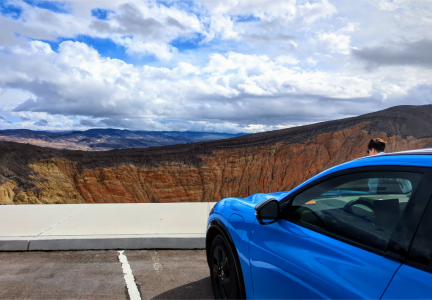
For shorter trips it’s great, but we recently had to cancel a trip to Death Valley because of the range. Baker, CA (where there are fast chargers) to north end of Death Valley (furnace creek) is about 115 miles each way. There are a few free slow chargers in the park, like 4 I think, and a rivian charger in Shoshone that I’m unsure is compatible with non-Rivians, so if the park is crowded as it is during a superbloom, charging anywhere closer than Baker seems unrealistic. So I’m looking at 230 miles, which is starting to get close to the max 270 real world mile range. That’s just up and back, no exploring, and forget going to Ubehebe or Scotty’s Castle. Then add in 10-15% range loss on a 95-105° day… it’s just cutting it too close for my taste.

The closest we’ve ever cut it was driving from Simi Valley, CA to Primm, NV on a single 100% charge. There are significant mountains and hills between here and there, and significant elevation difference with Simi at 1,000 ft and Primm around 2,600. Did the same thing coming home, single 100% charge. It’s only 240 miles each way and the battery was down to like 5% at the end of each trip.

So, if Scout can come up with a battery that hits minimum 350-400 real world miles I’m all in on BEV. Or heck, ‘portable’ 50 mile battery packs that you can buy as an accessory. Probably would be too large/heavy to be realistic, but if they were a possibility I’d consider it. Otherwise, I’m sticking to EREV because there are many remote places I want to go where the nearest charger will be too far away.
 
Last edited:
If scout can come up with a battery that gets 350-400 or more real world miles I’ll switch to BEV. We love our Mach-e that we bought a year and a half ago with the extended range battery (320 mile) but using it real world we’re lucky to get 250-270 miles on the highway. I absolutely love the car, acceleration is zippy and it drives dreamy-smooth, and I love the low maintenance. 10,000 mile maintenance was around $35 for an inspection and tire rotation. Not only that, but we have solar so if I use the portable slow charger the car came with, daytime home charging is completely free.

For shorter trips it’s great, but we recently had to cancel a trip to Death Valley because of the range. Baker, CA (where there are fast chargers) to north end of Death Valley (furnace creek) is about 115 miles each way. There are a few free slow chargers in the park, like 4 I think, and a rivian charger in Shoshone that I’m unsure is compatible with non-Rivians, so if the park is crowded as it is during a superbloom, charging anywhere closer than Baker seems unrealistic. So I’m looking at 230 miles, which is starting to get close to the max 270 real world mile range. That’s just up and back, no exploring, and forget going to Ubehebe or Scotty’s Castle. Then add in 10-15% range loss on a 95-105° day… it’s just cutting it too close for my taste.

The closest we’ve ever cut it was driving from Simi Valley, CA to Primm, NV on a single 100% charge. There are significant mountains and hills between here and there, and significant elevation difference with Simi at 1,000 ft and Primm around 2,600. Did the same thing coming home, single 100% charge. It’s only 240 miles each way and the battery was down to like 5% at the end of each trip.

So, if Scout can come up with a battery that hits minimum 350-400 real world miles I’m all in on BEV. Or heck, ‘portable’ 50 mile battery packs that you can buy as an accessory. Probably would be too large/heavy to be realistic, but if they were a possibility I’d consider it. Otherwise, I’m sticking to EREV because there are many remote places I want to go where the nearest charger will be too far away.
We did Death Valley a few years ago just fine in our 312 mile Mustang Mach-E from northern AZ through Las Vegas. Las Vegas was the last DCFC we were able to use. We had a 140 mile one-way drive from LV to DV. This was during the wet season when the Badwater Basin had a lake. It was busy. But most of the EV drivers were cooperative and helpful to each other. There are more even more chargers now than there were when we were. I don't think there are any DCFCs, though.

1000014188.png
1000014186-png.14683

1000014189.png
 

Attachments

  • 1000014186.png
    1000014186.png
    1.9 MB · Views: 105
I will never buy a ICE car again. My S 60 has 250k miles on it original battery 195 90% charge. Slow super charger.
Scout needs a 500 mile real range option, with solid state batteries will be possible.
In 2 years solid state will be the norm.
 
I will never buy a ICE car again. My S 60 has 250k miles on it original battery 195 90% charge. Slow super charger.
Scout needs a 500 mile real range option, with solid state batteries will be possible.
In 2 years solid state will be the norm.
I think realistically 2030 at best will be the regular, early adoption in any/all EVs and likely companies like Mercedes and BMW who can afford to absorb/demand the premium price. On everyday EV’s I’d guess 2032-2035 at least for the U.S. vehicles. China may figure it out but I won’t be an early adopter to solid state cars til fully vetted withLOtS of real world mileage to back it all up. That said, I hope I’m wrong and it happens much sooner
 
Last edited:
The EREV... Assuming a 15 gallon tank and a similar electric efficiency as the BEV, the mpge could be as low as 29-30 mpge.

150 miles at 84.3 mpge = 1.8 gallons
350 miles at 23.3 mph = 15 gallons
500 miles ÷ (1.8 gallons + 15 gallons) = 29.8 mpge
500 miles is an optimistic guess in ideal situations. Start going over mountain passes and averaging 70+ mph and I’d guess range drops closer to 400 miles per charge/fill up. Where the Harvester shines is it’s a gas and go setup that can be used as an EV for the shorter daily commute without the stress of longer charge times and range anxiety on longer trips. Nobody argued the Harvester had better e-range or whatever you call the “fuel economy” of an EV. It simply combines both worlds.
 
  • Like
Reactions: BeerParty
Mpge is sort of a messy metric IMO, and actually is more confusing to most people that I talk with, than it is helping. I avoid it at all times. Its really trying to show how efficient electric vehicles are, but its also sort of comparing apples to oranges.

Here is what I mean:

We're used to burning a gallon of gas, and measuring how far we can go on that gallon (mpg). But electric cars don't have "gallons of gas" as their unit (the apples), instead they have KWh (the oranges). So they tried to mix the unit types to convey how efficient electric vehicles are, by converting them between each other, and getting a mathematically correct answer... that sort of makes no sense in the way its applied (since an EV doesn't burn gas).
  • On a EV's sticker at the dealership lot, you can see how many MPGe it gets (or on fueleconomy.gov).
    • But, they DON"T tell you what SIZE "TANK" (battery) you have in the same way.
  • My Ioniq 9 is rated for 98 MPGe.
    • Which means its battery is only ~3.18 "Gallons equivalent" (107kwh useable / 33.7kwh per gallon).
      • I think we'd all agree that listing it this way, doesn't make any sense.
    • Or even funnier, think of the reverse situation. You pull up to a dealership and look at the spec sheet for a pickup truck and see it has a "876kwh equivalent" fuel tank size (26gallon).
      • I think we'd all agree this isn't super helpful (although super hilarious), because a gas car doesn't use kwh of electricity to move.

Miles per gallon for a gas vehicle is the same idea as Miles per KWh for an electric vehicle:

What I like about these, is that both are easy to convert to "how much you pay", because you're billed by the "thing" (gallons, or KWh). So its literally just mpg x gas price per gallon, or miles per kwh x price per kwh.

A 300 mile trip for each is easy to calculate the price for:
  • (300 miles / 20mpg) x (fuel price per gallon) == total price of the trip
  • (300 miles / 2.5 miles per kwh) x (electricity price per kwh) == total price of the trip
Most new EV buyers look at two things:
- Distance per full charge
- Length of time to charge to full

I simply want to know if the range is 350 miles, how long to charge when near empty to get back to full power. This is important when looking at longer road trips. If I’m going 500 miles and I stop at 300 miles for a “top off” I want to know how long is it going to take? Is this a 20 minute stop, or a 45 minute stop?

Your math isn’t wrong. It’s just that most new EV shoppers like myself look at it in much simpler terms.
 
  • Like
Reactions: SrfnFly227
I think realistically 2030 at best will be the regular, early adoption in any/all EVs and likely companies like Mercedes and BMW who can afford to absorb/demand the premium price. On everyday RV’s I’d guess 2032-2035 at least for the U.S. vehicles. China may figure it out but I won’t be an early adopter to solid state cars til fully vetted withLOtS of real world mileage to back it all up. That said, I hope I’m wrong and it happens much sooner
I suspect Scout already has a small team of engineers working in a “skunkwerks” program to look at their second generation models.

Ford had at least eight different possible battery configurations pre-programmed into their main computer module in the Lightning. They only made use of two (maybe 3 if they ever did release the third battery before canceling the truck—I lost track of that battery). The Mustang also had space for eight in their programming.
 
With all I have learned on this forum, looking at my driving use cases, and the fact that EVs are a lot less maintenance I have officially switched my reservation to a BEV. I’m on the EV bandwagon!

Now there’s been lots of discussion about which will come first, EREV or BEV. Let’s say the BEV comes out first could Scout offer something to entice EREV reservation holders to take the leap and buy a BEV.

What would it take to get you EREV reservation holders to purchase the BEV? A free home charger? Money towards the installation? Buy a BEV and get moved to the front of the line for an EREV (Rivian was doing that. If you leased an R1 it got you moved to the front of the line for an R2. They told me that when I test drove one last year).

What do you all think? You fence sitters what would push you over the edge??
While on vacation on San Juan Island in Washington I saw this. If I lived here full time, I’d be tempted to switch.

IMG_7425.jpeg