Regenerative braking

  • From all of us at Scout Motors, welcome to the Scout Community! We created this community to provide Scout vehicle owners, enthusiasts, and curiosity seekers with a place to engage in discussion, suggestions, stories, and connections. Supportive communities are sometimes hard to find, but we're determined to turn this into one.

    Additionally, Scout Motors wants to hear your feedback and speak directly to the rabid community of owners as unique as America. We'll use the Scout Community to deliver news and information on events and launch updates directly to the group. Although the start of production is anticipated in 2026, many new developments and milestones will occur in the interim. We plan to share them with you on this site and look for your feedback and suggestions.

    How will the Scout Community be run? Think of it this way: this place is your favorite local hangout. We want you to enjoy the atmosphere, talk to people who share similar interests, request and receive advice, and generally have an enjoyable time. The Scout Community should be a highlight of your day. We want you to tell stories, share photos, spread your knowledge, and tell us how Scout can deliver great products and experiences. Along the way, Scout Motors will share our journey to production with you.

    Scout is all about respect. We respect our heritage. We respect the land and outdoors. We respect each other. Every person should feel safe, included, and welcomed in the Scout Community. Being kind and courteous to the other forum members is non-negotiable. Friendly debates are welcomed and often produce great outcomes, but we don't want things to get too rowdy. Please take a moment to consider what you post, especially if you think it may insult others. We'll do our best to encourage friendly discourse and to keep the discussions flowing.

    So, welcome to the Scout Community! We encourage you to check back regularly as we plan to engage our members, share teasers, and participate in discussions. The world needs Scouts™. Let's get going.


    We are Scout Motors.

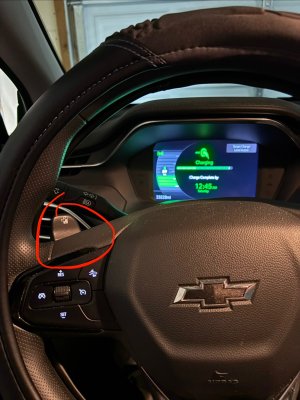
Not sure if anyone needs to be this example, but just in case it might be of use to someone not familiar with EVs I took three photos
1. One Pedal on, accelerating
View attachment 13346
2. One Pedal Off, still accelerating
View attachment 133473. One Pedal Off, foot of the accelerator coasting, no breaks but active regenView attachment 13348
With one pedal off region still does its thing, but it does not apply any level of braking. I doubt the majorityof people in this forum need this, but you never know. 🙂
I may try to have my wife photograph some of this on ours sometime.

For my Ioniq 9, regen level 0 provides 3kw or so of energy.

Level 1 is something like a max of 15-20kw.

And off the top of my head I want to say one pedal (level 4) provided as much as 75-90kw of braking.

(For context 750w = = 1horsepower, so 90kw of regen is the equivalent of 120HP of acceleration, backwards)
 
I may try to have my wife photograph some of this on ours sometime.

For my Ioniq 9, regen level 0 provides 3kw or so of energy.

Level 1 is something like a max of 15-20kw.

And off the top of my head I want to say one pedal (level 4) provided as much as 75-90kw of braking.

(For context 750w = = 1horsepower, so 90kw of regen is the equivalent of 120HP of acceleration, backwards)
The highest level of regen I’ve seen in my car has been 107 but that was while going down an incredibly steep offramp using both the brake pedal and Regen on demand in one pedal drive, so it only stayed that high for a couple of seconds because the exit kind of snuck up on me. My highest regen in normal cases is in the mid 20s low 30s. If I take my foot fully off the pedal in one pedal drive if I slowly lift my foot off and allow the car to slow in one pedal it kind of tops out around 16-19
 
Stumbled into this thread and am now really interested by it.

How widespread is "car sickness" with drivers with this kind of braking?

I have a really difficult time with motion sickness unless I am the one driving (its super fun on planes and trains), but admittedly don't have any tangible EV experience to see how it would impact me.
 
  • Like
Reactions: maynard and cyure
Stumbled into this thread and am now really interested by it.

How widespread is "car sickness" with drivers with this kind of braking?

I have a really difficult time with motion sickness unless I am the one driving (its super fun on planes and trains), but admittedly don't have any tangible EV experience to see how it would impact me.
I think it really is as I stated above it varies on driving style. I’ve never made someone that I know has motion sickness feel sick in my car because generally, I’m smooth in my release of the accelerator in one pedal and even if I take my foot fully off the car has a decent decline in speed. It doesn’t lurch or jerk. While on the other hand the first time I let my mother drive my car with one pedal on she made me feel a little motion sick. Had a rough start because she was unfamiliar with that kind of driving and it was very jerky for pretty much the entire drive. I told her she could take one pedal off and it would feel more normal to her, but she wanted to try it.
 
  • Like
Reactions: maynard
Stumbled into this thread and am now really interested by it.

How widespread is "car sickness" with drivers with this kind of braking?

I have a really difficult time with motion sickness unless I am the one driving (its super fun on planes and trains), but admittedly don't have any tangible EV experience to see how it would impact me.
EV Car sickness feeling is really down to two separate things.

1) In an EV, it is quieter. And the normal audible cues we have to be able to tell if we're trying to accelerate or slow down (engine noise rising/disappearing) are typically gone. Imagine closing your eyes as a passenger, and going for a drive. With a gas car, you'll probably be able to tell if the driver is going to be accelerating, or not.

Believe it or not there is actually research on this. And EV brands are trying to find ways to add cues to the inside of the car (as an adjustable setting), to help combat this.

2) Heavy regen on throttle liftoff is a common feature of EV cars (called "one pedal driving"). This is where you lift off the throttle, and the car will start decelerating, and come to a full stop (and won't creep forward). Because this deceleration is strong, and the throttle response of an EV is quicker than the average gas car, if you have "herky jerky" throttle control, you can make your passenger feel carsick.

This herky jerky driving style is somewhat of a response to how a gas vehicle with an automatic transmission will "coast" (with light deceleration), allowing you to sort of "stab the throttle" and then lift off. So people have been somewhat trained in some cases to drive with less optimal throttle control. And people like that, are more likely to cause their passengers to get sick.

Personally, this is why I find the regen level adjustment to be nice. There are situations where heavy throttle based braking/regen is helpful (anytime you're dancing between brake pedal and throttle constantly, like at the airport dropoff in traffic that is constantly changing). But I also find that on relatively open road/highway, I prefer a much lighter regen level, so you can feather off the accelerator without impact easier. But of course its all personal preference.
 
  • Like
Reactions: maynard and cyure
Stumbled into this thread and am now really interested by it.

How widespread is "car sickness" with drivers with this kind of braking?

I have a really difficult time with motion sickness unless I am the one driving (its super fun on planes and trains), but admittedly don't have any tangible EV experience to see how it would impact me.
Never had a complaint in the 7 years of EV ownership.
 
  • Like
Reactions: maynard and cyure
I hope Scout follows GM's path. NO PADDLES! Just blend regen on the brake pedal and also have a toggle for one pedal driving. Go drive a new Equinox or Blazer EV. They nailed it IMO (this coming from a 16-year Tesla owner). IMO paddles are a gimmick to live out someone's F1 fantasies. Yes, if you do not use OPD and are on a long downhill you will "ride" the brakes but this will just be regen and will not smoke your brakes. It would be helpful if there was some visual indication of when you hit max regen so you know if you're into friction brakes or not.

If we absolutely must have paddles, make them buttons on the rear of the steering or somehow out of my line of sight (or have a simple screw so I can remove them without taking the entire steering column apart). 😇

Tesla's method stems from the original Roadster. The cars were built by Lotus (they were modified Elise chassis). To save money and time they used Lotus' DOT approvals for things like the brakes so they could not modify them. When it came time for the Model S, they kept it the same - motors on the right pedal, friction brakes on the left. You clearly knew at all times which system you were using. To be fair, back in the early 2010s, brake regen on hybrids was TERRIBLE. As you would press on the brake it would regen, regen more, then BAM the friction brakes would grab. Modern cars have fixed this but the die had been cast with Tesla so they have left it this way.

Regarding car sickness and EVs, it is a combination of much higher torque (at zero rpm) than ICE vehicles and regen. In an EV you have 100% torque available at all times. Unlike an ICE if you move your foot a little the car will move a lot. The more powerful the EV the worse this is which would explain @cyure's experience (Rivian's are quite powerful). In my Model X Plaid the accelerator goes from 0 to 1,050 ftlbs in one stroke so the increase in ftlbs per inch is quite high! OPD definitely takes a little practice - you can't just jump off the accelerator like you can in an automatic. But very quickly you will learn to just modulate your foot to get exactly the power you need. It is really intuitive once you give it a try. My foot almost never moves off of the accelerator.
 
Last edited:
I hope Scout follows GM's path. NO PADDLES! Just blend regen on the brake pedal and also have a toggle for one pedal driving. Go drive a new Equinox or Blazer EV. They nailed it IMO (this coming from a 16-year Tesla owner). IMO paddles are a gimmick to live out someone's F1 fantasies. Yes, if you do not use OPD and are on a long downhill you will "ride" the brakes but this will just be regen and will not smoke your brakes. It would be helpful if there was some visual indication of when you hit max regen so you know if you're into friction brakes or not.

If we absolutely must have paddles, make them buttons on the rear of the steering or somehow out of my line of sight (or have a simple screw so I can remove them without taking the entire steering column apart). 😇

Tesla's method stems from the original Roadster. The cars were built by Lotus (they were modified Elise chassis). To save money and time they used Lotus' DOT approvals for things like the brakes so they could not modify them. When it came time for the Model S, they kept it the same - motors on the right pedal, friction brakes on the left. You clearly knew at all times which system you were using. To be fair, back in the early 2010s, brake regen on hybrids was TERRIBLE. As you would press on the brake it would regen, regen more, then BAM the friction brakes would grab. Modern cars have fixed this but the die had been cast with Tesla so they have left it this way.

Regarding car sickness and EVs, it is a combination of much higher torque (at zero rpm) than ICE vehicles and regen. In an EV you have 100% torque available at all times. Unlike an ICE if you move your foot a little the car will move a lot. The more powerful the EV the worse this is which would explain @cyure's experience (Rivian's are quite powerful). In my Model X Plaid the accelerator goes from 0 to 1,050 ftlbs in one stroke so the increase in ftlbs per inch is quite high! OPD definitely takes a little practice - you can't just jump off the accelerator like you can in an automatic. But very quickly you will learn to just modulate your foot to get exactly the power you need. It is really intuitive once you give it a try. My foot almost never moves off of the accelerator.
NO PADDLES!!!!
 
I hope Scout follows GM's path. NO PADDLES! Just blend regen on the brake pedal and also have a toggle for one pedal driving. Go drive a new Equinox or Blazer EV. They nailed it IMO (this coming from a 16-year Tesla owner). IMO paddles are a gimmick to live out someone's F1 fantasies. Yes, if you do not use OPD and are on a long downhill you will "ride" the brakes but this will just be regen and will not smoke your brakes. It would be helpful if there was some visual indication of when you hit max regen so you know if you're into friction brakes or not.

If we absolutely must have paddles, make them buttons on the rear of the steering or somehow out of my line of sight (or have a simple screw so I can remove them without taking the entire steering column apart). 😇

Tesla's method stems from the original Roadster. The cars were built by Lotus (they were modified Elise chassis). To save money and time they used Lotus' DOT approvals for things like the brakes so they could not modify them. When it came time for the Model S, they kept it the same - motors on the right pedal, friction brakes on the left. You clearly knew at all times which system you were using. To be fair, back in the early 2010s, brake regen on hybrids was TERRIBLE. As you would press on the brake it would regen, regen more, then BAM the friction brakes would grab. Modern cars have fixed this but the die had been cast with Tesla so they have left it this way.

Regarding car sickness and EVs, it is a combination of much higher torque (at zero rpm) than ICE vehicles and regen. In an EV you have 100% torque available at all times. Unlike an ICE if you move your foot a little the car will move a lot. The more powerful the EV the worse this is which would explain @cyure's experience (Rivian's are quite powerful). In my Model X Plaid the accelerator goes from 0 to 1,050 ftlbs in one stroke so the increase in ftlbs per inch is quite high! OPD definitely takes a little practice - you can't just jump off the accelerator like you can in an automatic. But very quickly you will learn to just modulate your foot to get exactly the power you need. It is really intuitive once you give it a try. My foot almost never moves off of the accelerator.

This is very useful. Mine does something like this, although its more of a "shows you a bar that fills with regen". I assume that when you are braking, and the regen bar is all the way filled, that it blends into friction brakes. But AFAIK there isn't an actual "hey, you're riding your brakes" light.

I'm actually on team paddles myself. I change between the 5 regen settings I have somewhat frequently, depending on the situation. If that adjustment was hidden away in some menu somewhere, that would make that more difficult. Its not a deal breaker if they don't exist, but I do like them.

The situations are sort of specific, and generally I do leave it in one setting. But I'd say I change it a few times on any given drive. One of the situations is driving from my house, to the nearby town. Its nearly all downhill (500ft elevation difference). With regen set to level 0, we can basically freewheel most of the difference, without riding the brakes, or applying throttle. Heck, I even manually downshift on my automatic vehicles on grades, so adjusting the regen to help with the grade you're dealing with, feels pretty normal to me.

In congested traffic with lots of lane changes (where adaptive cruise control doesn't work well, like airport pickup/dropoff lines), I actually like 1 pedal.

Do I have to adjust it so much? No, I'm sure I don't. But, TBH, even if all it does is make it more engaging to drive/like I'm doing something (sorry, used to drive a manual :D), I'm ok with that.