The One-Ton Problem with Scout’s Harvester Range Extender

  • From all of us at Scout Motors, welcome to the Scout Community! We created this community to provide Scout vehicle owners, enthusiasts, and curiosity seekers with a place to engage in discussion, suggestions, stories, and connections. Supportive communities are sometimes hard to find, but we're determined to turn this into one.

    Additionally, Scout Motors wants to hear your feedback and speak directly to the rabid community of owners as unique as America. We'll use the Scout Community to deliver news and information on events and launch updates directly to the group. Although the start of production is anticipated in 2026, many new developments and milestones will occur in the interim. We plan to share them with you on this site and look for your feedback and suggestions.

    How will the Scout Community be run? Think of it this way: this place is your favorite local hangout. We want you to enjoy the atmosphere, talk to people who share similar interests, request and receive advice, and generally have an enjoyable time. The Scout Community should be a highlight of your day. We want you to tell stories, share photos, spread your knowledge, and tell us how Scout can deliver great products and experiences. Along the way, Scout Motors will share our journey to production with you.

    Scout is all about respect. We respect our heritage. We respect the land and outdoors. We respect each other. Every person should feel safe, included, and welcomed in the Scout Community. Being kind and courteous to the other forum members is non-negotiable. Friendly debates are welcomed and often produce great outcomes, but we don't want things to get too rowdy. Please take a moment to consider what you post, especially if you think it may insult others. We'll do our best to encourage friendly discourse and to keep the discussions flowing.

    So, welcome to the Scout Community! We encourage you to check back regularly as we plan to engage our members, share teasers, and participate in discussions. The world needs Scouts™. Let's get going.


    We are Scout Motors.
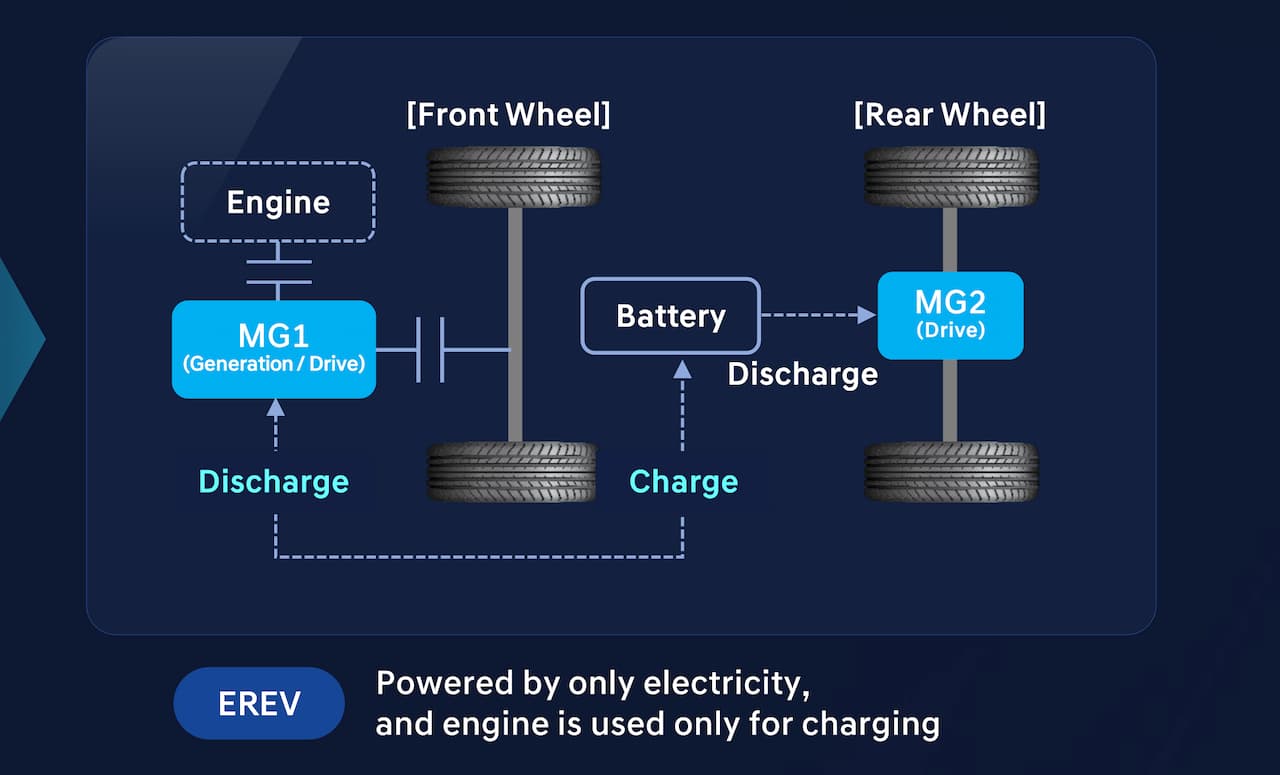
Just to introduce more fun to the thread - this is from Hyundai's recent EREV presentation. Can't wait to learn how about the Santa Fe since its expected in the next 6 months.
And as to some of the above, perhaps i was careless when using the term max, which was meant to indicate harvester running at it's max -whatever Scout tunes that to, not max charging rate
34396.jpg
 
It looked like Ford tried to squeeze as much F-150 into the Lightening as possible, and it certainly didn't appear that Ford was building the Lightening on an entirely new platform from the ground up. That was something Rivian used very specifically to their advantage (and touted heavily). The story about F-150 buyers wanting the same truck (but electric) seemed very "convenient" to me. I understand that traditional buyers didn't want a Cybertruck (I get that), but my impression was that Ford tried to rush the Lightening to market - partially due to pressure from Rivian, and that they whiffed a little in the process.

One look underneath a Lightning (compared to a completely flat Rivian skateboard) is very revealing.

Whether or not what Ford said to the media at the time was true, might be up for debate.
Go visit and tour. You'll get the story from Ford directly. They know their F150 buyers and what they want. The Lightning was definitely *not* a powertrain swap. The frame is entirely different to accommodate the battery pack as a structural element with the frame. It has 4 wheel independent suspension. What they kept from the F-150 was the look and feel of the interior as a recognizable F150, the overall shape and payload capacity. A flat underbody would not have saved the Lightning.

What killed the Lightning was that even though they sold okay, they couldn't make money on them, even with the federal incentives, and especially once the incentives were taken away. This is because they had to invest in an entirely new and separate production line down to stamping the body panels and forming, bonding, and welding the frame elements from raw steel and aluminum. Everything they had to do from engineering up was brand new, and they invested billions into that plant. The federal and state incentives were always price support for automakers to turn the corner on unit profitability faster, which when you have to amortize the investment in the plant as well as the non-recurring engineering for the vehicle itself, is not going to happen quickly if your market doesn't want to pay 2x what they could pay to just get an updated version of what they've been driving for years. And when those incentives get yanked... there's pretty much no chance when you're starting with your volume leading product line.

Jim Farley has several interviews on this topic, feel free to google them.
 
This EREV stuff is all coming back to me now (slowly) and I need a refresher myself... Since the Harvester doesn't directly power the wheels, I was thinking that the harvester would send all the power it generated straight into the battery (then the battery would just use what it needs at the motors). But in actuality and while driving, the power from the generator could just be coupled with the power coming from the battery, as it is routed to the motors through a "shared power bus". Meaning, if the motor needs more energy and the EREV is running, the Harvester is used to "supplement" the energy that is flowing through the bus from the battery (and will reduce the amount of power coming out of the battery to help preserve SOC). Of course if you are towing up a big hill, that reduction goes out the window. *** Have we seen an architectural diagram of this power flow from Scout yet? Maybe not.

The paragraph below is from my own research, which really helps explain (and helped me understand) how the EREV might work (while you're driving / expending battery energy). Instead of thinking of the Harvester as charging while driving, this describes a system whereby the EREV simply reduces the amount of energy required from the battery. I'm a BEV reservations holder, so not as familiar with the EREV's on the market today. I will admit that I am just starting to really understand this EREV thing. Of course, if the EREV is running while the truck is parked, all the energy generated can simply be routed directly to the battery (in this "parked" / not driving mode).

Here's what I found that helped set me straight (I think):
A split design, where the generator fills some "open" modules while others feed the motors, would require separate DC-DC converters for each module group and switching to rotate groups in and out. That means added cost, weight, heat, and conversion losses, all to recreate what a "shared bus" already does for free. Nothing Scout has disclosed points to a separated, DC-DC design. Known details are: a smaller lithium-iron-phosphate pack on the EREV, VW Group's 800-volt expertise and Rivian's zonal electrical architecture, and at least three driving modes, including one that maximizes battery use and one that behaves like a traditional hybrid. Those modes are software choices about when to run the generator and what state of charge to hold, not physical partitioning of the pack.

Precisely.

If they decide to split modules into separate batteries, they’re going to add cost, complexity, and inefficiency to the system and shorten battery lifetime for no valuable reason.

Using the Rivian 140 kWh Large+ battery pack as an example. It has 9 modules. So the vehicle has to run an AC-DC converter to convert from the genset AC power to DC power, then it needs to have 9 separate DC-DC converters; it needs 9 so the modules can all be balanced properly.

So, now it will have an entirely new system, which means added R&D costs, added weight, added complexity, added high-voltage (large, heavy) wiring, and increased likelihood of failure. More importantly, the vehicle loses power because it can’t pull from all the modules at the same time if it's charging some modules and discharging others.

If it's charging four modules and running off of five, it has only a maximum 78 kWh of battery energy it can use. Assuming it's using the standard maximum discharge power of about 3C to tow, it would be pulling about 230 kW (5/9 of 140 times 3) from the battery and the genset would have to generate 370 kW of power to both charge 4/9 of the battery and replace the missing 4/9 that is unavailable from the battery—this is what “charging and discharging at the same time” would imply. A 370 kW genset is not a 3- or 4-cylinder engine. That’s a 5+ liter V8 engine.

In the worst case scenario where all of the modules are at 0% state of charge, the battery would not be able to provide any power and the genset would have to provide both 100% to charge the battery and 100% to make up the missing power. At a 3C discharge/charge rate, that would mean the genset would have to provide 3 * 18/9 of 140 kW = 840 kW, or 1127 HP. Formula 1 engines produce up to about 1,000 HP.

As you mentioned, @R1TVT, the genset is likely going to send power to a common bus. If the motors are pulling power, the genset will power them as much as it can. If it’s generating more than the motors need, it’ll charge the battery. If it’s not generating enough, the battery will be discharging.

Either way, the battery is not the heat generator; the engine is. The battery is close to 95-97% round trip efficient. The motors are close to 99% efficient. The wiring is about 98% efficient. The genset internal combustion engine is close to 25% efficient. The ICE is far, far less efficient than everything else, and all of its inefficiency is output as waste heat.

One way to think about it is:
To charge up an empty 140 kWh battery, the genset will need to provide about 5-10% extra due to the wiring, conversion, and battery inefficiency (we’re up to 154 kWh) and then it will need 4x that to account for losses due to heat. That’s 462 kWh of waste heat. That’s about 1.58 million BTU. That heat needs to be extracted from under the cabin. Some of it will leave via the exhaust (about 40-50%), but the other ~50-60% will need to be moved via thermal transfer like forced convection of air moving past it and also a heat pump and radiator. If the exhaust pipe is short enough, it won’t cause any meaningful heat transfer into the cabin. Double the power necessary and the waste heat generated if the vehicle must also be driven by the genset at maximum power while charging at maximum power.

Assuming the Harvester engine ranges between 110 HP and 250 HP, it’ll produce around 0.52 (110 HP engine low end) to 1.9 million BTU/hr (250 HP engine high end) of waste heat.
At maximum power, the 762 HP American Axle motor on one axle will produce 0.081 to 0.215 million BTU/hour of waste heat.
At maximum power draw from the motors, the battery will be producing another 0.1 to 0.215 million BTU/hour of waste heat.
Note that in the above three considerations, the battery and motor are drawing power at 3-7x the power coming from the genset. In other words, if the vehicle is pulling a trailer up a hill flat out, the battery will drain quite a bit quicker than the genset could recharge it, even if the genset’s power wasn’t being used to power the motor as well.
This is their thermal problem. They need to move 520 thousand to 2.3 million BTU/hr out from under the vehicle. Double the waste heat generated if the vehicle must also be driven by the genset at maximum power while charging at maximum power.

A standard large truck/SUV AC unit moves about 20,000 to 40,000 BTU/hour. A second heat pump with about the same power is good enough to cool and usually good enough to heat a truck-sized battery, under normal driving conditions, but not while towing at high speeds, especially up a hill.

They need a solution that’s about 10-100x more powerful to cool the engine on the genset when they’re on the move. Some of that will be accomplished by moving a lot more thermal mass in the movement of large volumes of coolant. That’ll have to move fast and have a powerful heat pump transferring the heat out. Then they’ll need a large radiator in the front of the vehicle to have the heat dumped into the passing air. My guess is that their problem is likely very similar in overall heat removal requirements as with a V8 at the front of an ICE vehicle because of the location of the waste heat and because they’ll likely want to have an underbody that’s not open to the air for range reasons.
Sometime like a year or more ago I recall something being noted by Scott that they have a creative solution for cooling but I am unsure what that is as it was not disclosed. Will be fun to see how this all develops
 
@SpaceEVDriver we need to pin your guesses to the fridge so we can see how close you came. Given your analytical approach to things… you may be much closer than any of us thinks.

I’m happy to have my predictions compared with the reality when the time comes. The worst that happens is that I learn something.

This one is a little bit more of a gamble because there’s a cost element to this. They need the motor power and the cooling power to meet it, and both of those could push the cost up.

The axles I think they’re going to use are rated for up to 18,000 pounds towing. And they’ll have the power (762 HP), especially if they use two of them. However, I expect they’ll run IFS rather than solids in the front. The GAWR of the front will probably be slightly lower than the GAWR of the rear, as is typical of trucks, but it could be the same. In other words, the axles are probably not the limiting link.

The tires they’ll run will probably be 115T or 116T. That’s up to 2756 pounds per tire, or 5512 pounds per axle load rating. The tires will not be the limiting link.

The GVWR will probably be 8,900 to 10,000 pounds. This leaves some 1200 to 2000 pounds load capacity as well as some safety margin for the axles and tires. It also keeps the vehicles below the Class 3 rating.

A GCWR of 19,000 to 22,000 pounds is a competent, top-end half-ton truck.

Because the genset is going to be over the rear axle, it shouldn’t cause more than a 1:1 reduction to the load weight, so it may only reduce the load capacity, not significantly reduce the towing capacity. This is different from what I have said in the past because in the past the illustrations showed that the genset would be behind/aft of the rear axle. We’ve since been told the genset will be over the rear axle. That decision has limited its impact on the tongue weight.

The Silverado EV 5WT with Max battery pack and max tow package has a 12,500 towing capacity with a cargo capacity of 1,800 pounds. It has a 21,400 lbs GCWR and puts out 510 HP and 580 ft-lb torque with 424 miles range. I’m guessing this will be the to-beat target for the Terra BEV. IMO, Scout shouldn't muck around with looking at lower-rated vehicles; they should beat this. The 424 miles range will not be easy, but I think they can get to 375 if they offer a bigger-but-not-as-big battery. The only way to get to 400+ miles range on the BEV is with a big battery.

The Ford EREV claim is 700 miles. Their EcoBoost V6 can reach a maximum of 13,500 pounds towing with an axle and cooling system upgrade. The question is whether they’ll try to combine the two. I think they will, but I think they’ll top out at 12,500 for the EREV, at best. If they do, Scout needs to get to 10,000+ towing capacity with their Harvester. And I think they’ll need to bump up the range, probably by adding gasoline volume and maybe also by increasing the size of the battery.

For the pickups:
I think a Harvester with a max of 10k pound towing and 500-600 miles range will fit in well enough.
I think a BEV with 12.5k pound towing and 350 mile range (not while towing) will fit in well enough.
I think both are achievable, with some compromises—most likely on price and on mass.
 
Precisely.

If they decide to split modules into separate batteries, they’re going to add cost, complexity, and inefficiency to the system and shorten battery lifetime for no valuable reason.

Using the Rivian 140 kWh Large+ battery pack as an example. It has 9 modules. So the vehicle has to run an AC-DC converter to convert from the genset AC power to DC power, then it needs to have 9 separate DC-DC converters; it needs 9 so the modules can all be balanced properly.

So, now it will have an entirely new system, which means added R&D costs, added weight, added complexity, added high-voltage (large, heavy) wiring, and increased likelihood of failure. More importantly, the vehicle loses power because it can’t pull from all the modules at the same time if it's charging some modules and discharging others.

If it's charging four modules and running off of five, it has only a maximum 78 kWh of battery energy it can use. Assuming it's using the standard maximum discharge power of about 3C to tow, it would be pulling about 230 kW (5/9 of 140 times 3) from the battery and the genset would have to generate 370 kW of power to both charge 4/9 of the battery and replace the missing 4/9 that is unavailable from the battery—this is what “charging and discharging at the same time” would imply. A 370 kW genset is not a 3- or 4-cylinder engine. That’s a 5+ liter V8 engine.

In the worst case scenario where all of the modules are at 0% state of charge, the battery would not be able to provide any power and the genset would have to provide both 100% to charge the battery and 100% to make up the missing power. At a 3C discharge/charge rate, that would mean the genset would have to provide 3 * 18/9 of 140 kW = 840 kW, or 1127 HP. Formula 1 engines produce up to about 1,000 HP.

As you mentioned, @R1TVT, the genset is likely going to send power to a common bus. If the motors are pulling power, the genset will power them as much as it can. If it’s generating more than the motors need, it’ll charge the battery. If it’s not generating enough, the battery will be discharging.

Either way, the battery is not the heat generator; the engine is. The battery is close to 95-97% round trip efficient. The motors are close to 99% efficient. The wiring is about 98% efficient. The genset internal combustion engine is close to 25% efficient. The ICE is far, far less efficient than everything else, and all of its inefficiency is output as waste heat.

One way to think about it is:
To charge up an empty 140 kWh battery, the genset will need to provide about 5-10% extra due to the wiring, conversion, and battery inefficiency (we’re up to 154 kWh) and then it will need 4x that to account for losses due to heat. That’s 462 kWh of waste heat. That’s about 1.58 million BTU. That heat needs to be extracted from under the cabin. Some of it will leave via the exhaust (about 40-50%), but the other ~50-60% will need to be moved via thermal transfer like forced convection of air moving past it and also a heat pump and radiator. If the exhaust pipe is short enough, it won’t cause any meaningful heat transfer into the cabin. Double the power necessary and the waste heat generated if the vehicle must also be driven by the genset at maximum power while charging at maximum power.

Assuming the Harvester engine ranges between 110 HP and 250 HP, it’ll produce around 0.52 (110 HP engine low end) to 1.9 million BTU/hr (250 HP engine high end) of waste heat.
At maximum power, the 762 HP American Axle motor on one axle will produce 0.081 to 0.215 million BTU/hour of waste heat.
At maximum power draw from the motors, the battery will be producing another 0.1 to 0.215 million BTU/hour of waste heat.
Note that in the above three considerations, the battery and motor are drawing power at 3-7x the power coming from the genset. In other words, if the vehicle is pulling a trailer up a hill flat out, the battery will drain quite a bit quicker than the genset could recharge it, even if the genset’s power wasn’t being used to power the motor as well.
This is their thermal problem. They need to move 520 thousand to 2.3 million BTU/hr out from under the vehicle. Double the waste heat generated if the vehicle must also be driven by the genset at maximum power while charging at maximum power.

A standard large truck/SUV AC unit moves about 20,000 to 40,000 BTU/hour. A second heat pump with about the same power is good enough to cool and usually good enough to heat a truck-sized battery, under normal driving conditions, but not while towing at high speeds, especially up a hill.

They need a solution that’s about 10-100x more powerful to cool the engine on the genset when they’re on the move. Some of that will be accomplished by moving a lot more thermal mass in the movement of large volumes of coolant. That’ll have to move fast and have a powerful heat pump transferring the heat out. Then they’ll need a large radiator in the front of the vehicle to have the heat dumped into the passing air. My guess is that their problem is likely very similar in overall heat removal requirements as with a V8 at the front of an ICE vehicle because of the location of the waste heat and because they’ll likely want to have an underbody that’s not open to the air for range reasons.
Not an engineer but…could they instal
I’m happy to have my predictions compared with the reality when the time comes. The worst that happens is that I learn something.

This one is a little bit more of a gamble because there’s a cost element to this. They need the motor power and the cooling power to meet it, and both of those could push the cost up.

The axles I think they’re going to use are rated for up to 18,000 pounds towing. And they’ll have the power (762 HP), especially if they use two of them. However, I expect they’ll run IFS rather than solids in the front. The GAWR of the front will probably be slightly lower than the GAWR of the rear, as is typical of trucks, but it could be the same. In other words, the axles are probably not the limiting link.

The tires they’ll run will probably be 115T or 116T. That’s up to 2756 pounds per tire, or 5512 pounds per axle load rating. The tires will not be the limiting link.

The GVWR will probably be 8,900 to 10,000 pounds. This leaves some 1200 to 2000 pounds load capacity as well as some safety margin for the axles and tires. It also keeps the vehicles below the Class 3 rating.

A GCWR of 19,000 to 22,000 pounds is a competent, top-end half-ton truck.

Because the genset is going to be over the rear axle, it shouldn’t cause more than a 1:1 reduction to the load weight, so it may only reduce the load capacity, not significantly reduce the towing capacity. This is different from what I have said in the past because in the past the illustrations showed that the genset would be behind/aft of the rear axle. We’ve since been told the genset will be over the rear axle. That decision has limited its impact on the tongue weight.

The Silverado EV 5WT with Max battery pack and max tow package has a 12,500 towing capacity with a cargo capacity of 1,800 pounds. It has a 21,400 lbs GCWR and puts out 510 HP and 580 ft-lb torque with 424 miles range. I’m guessing this will be the to-beat target for the Terra BEV. IMO, Scout shouldn't muck around with looking at lower-rated vehicles; they should beat this. The 424 miles range will not be easy, but I think they can get to 375 if they offer a bigger-but-not-as-big battery. The only way to get to 400+ miles range on the BEV is with a big battery.

The Ford EREV claim is 700 miles. Their EcoBoost V6 can reach a maximum of 13,500 pounds towing with an axle and cooling system upgrade. The question is whether they’ll try to combine the two. I think they will, but I think they’ll top out at 12,500 for the EREV, at best. If they do, Scout needs to get to 10,000+ towing capacity with their Harvester. And I think they’ll need to bump up the range, probably by adding gasoline volume and maybe also by increasing the size of the battery.

For the pickups:
I think a Harvester with a max of 10k pound towing and 500-600 miles range will fit in well enough.
I think a BEV with 12.5k pound towing and 350 mile range (not while towing) will fit in well enough.
I think both are achievable, with some compromises—most likely on price and on mass.
Given that the rear erev area is modular, couldn’t they “just” offer a larger engine/more cooling power for a future max tow version? I think with their launch versions the focus needs to be on price. Not everyone wants to tow 10k, but for those that do, they pay a premium to get to that 13k or whatever benchmark.
 
  • Like
Reactions: Broverlander
Sometime like a year or more ago I recall something being noted by Scott that they have a creative solution for cooling but I am unsure what that is as it was not disclosed. Will be fun to see how this all develops

They have some creative cooling called out in their battery pack patent. I don’t know if they’ll use that, but I hope they do. I haven’t looked at any recent patents they might have filed.

They have to have come up with some creative cooling to solve the internal combustion issue while keeping the system robust. Running coolant through 24 to 30 feet of 2.5” ID cooling hose doesn’t lend itself to robustness. I suspect they’ll run a 2-phase refrigerant through or very near the engine block rather than single-phase liquid coolant. Vaporizing the refrigerant will absorb a lot more heat. If they have a heat exchanger in or near the engine block, they won’t need liquid or they won’t need to pump the liquid very far before it loses its heat to vaporizing the refrigerant.
 
Not an engineer but…could they instal

Given that the rear erev area is modular, couldn’t they “just” offer a larger engine/more cooling power for a future max tow version? I think with their launch versions the focus needs to be on price. Not everyone wants to tow 10k, but for those that do, they pay a premium to get to that 13k or whatever benchmark.

I think they’re struggling to physically fit a 4-cylinder into the space. For anything larger they would also have to bump up the cooling substantially. I don’t know if they can accomplish the cooling they need with a 6-cylinder engine.

And I agree that their launch should be a vehicle that as many people will buy as possible. This is slightly different from other launches recently—many of those have been top-price vehicles with cheaper ones coming later. I think Scout’s success will depend at least in part on their sales numbers, even if the total revenue/vehicle isn’t as high.
 
I took @J Alynn’s question as an opportunity to look at more of Scout Motor’s patents.

I don’t know if the following approach might negate my concerns about two batteries, but I’m going to “think out loud” here. I may owe @Hedges1 and forum a mea culpa if the math works out.

Scout Motors have a really fun patent about deciding how and when to charge the battery in an EREV. There are a bunch of scenarios played out in the patent, including using knowledge of upcoming terrain. As is always the case with patent applications, they try to cover way more than they’ve imagined, just in case they come up with some new idea or solution in the near future.

One of the things they do mention is the possibility that there will be multiple batteries in the “battery block” of their system.

There have been other conversations out there about “hybrid battery” solutions for EVs. The idea in one approach is to have a main battery and a smaller, very, very fast charging (“boosting”) battery that can slowly discharge alongside the main battery. The idea is that you go to a fast charger with, say 20% in your main battery, boost up to 80% on the boost battery and charge the main battery at a more normal rate. So, maybe you only spend 5 minutes charging, adding 10% to the main battery and 80% to the boost battery. You then keep driving. You use some of the main battery and most of the boost battery to get to your next stop. But when you’re commuting, you don’t need a fast charger, so you slow charge both using L2 charging. This doesn’t really solve the range anxiety for road tripping, but it helps with the time anxiety some people have while charging on a road trip. It also preserves the life of the main battery a bit more. I, personally, don’t think it’s necessary. For me charge times and lifetime of the main battery is great for how I drive.

In the Scout Motors patent, they talk about how they might have multiple batteries in the “battery” box. This means they could be charging one battery while discharging the other. Using two of the same batteries means they would still face the issue of losing power and the Harvester having to output much more extra power to meet the demands of the missing battery...

Unless...

Scout Motors use a boost battery with a chemistry and the right power connectors and controls that allow a higher charge and discharge rate (say 5C instead of the preferred 0.25C to 0.5C for the main battery).

Maybe the Harvester tow package has 80 kWh of total battery, a main and a boost battery, that discharge at the same rate during normal driving. But maybe the main battery is 60 kWh and the boost battery is 20 kWh. Normally when you're driving along, the vehicle is pulling from both the main and boost battery at some predefined rate so both batteries reach the same voltage under normal operating conditions. It will also need a higher-power genset engine than the non-tow package, 120 kW (160 hp) instead of the normal 82 kW (110 hp).

Now let’s say you’re on a road trip towing your travel trailer. The truck gets down to 50% or 40 kWh remaining. Because you’re towing, the truck strategically used the boost battery to get you up to speed, meaning 0% in the boost battery and 40 kWh in the main battery.

You are coming up on a 5% grade going at 65 mph. Let’s say you’re 13 miles (12 minutes) out when the Harvester kicks in to start charging. At 12 minutes, it needs to charge the boost battery at 5C, which means 100 kW of output. But it also decides it needs to produce enough to keep the vehicle going at 65 mph. To maintain speed and charge the boost battery, the vehicle needs the genset engine to produce 182 kW of power. It’s only capable of 120 kW. So it starts drawing 62 kW from the main battery. That’s slightly over 1C, which is safe enough.

By the time you get to the base of the mountain you’re going to climb, the boost battery is fully charged, but the main battery has expended another 12.4 kWh, so it’s down to 27.6 kWh.

At 65 mph climbing a 5% grade, you need 230 kW of power to maintain speed. Because the Harvester charged the Boost Battery, you have 20 kWh more energy available to make it up the hill, for a total of 47.6 kWh. Because the route planner knows you’re climbing all the way up the mountain, 13 miles, the algorithm knows you need 230 kW of power for another 12 minutes.

That’s 46 kWh of energy.
But you only have 47.6 kWh remaining, meaning you would be down to 2% charge. That’s well below the 20% buffer the vehicle prefers you to have going up a climb.

The vehicle’s algorithm decides that it needs to keep the Harvester running at 120 kW power output. To get to 230 kW to maintain your speed, you need 110 kW more of power. The boost battery can discharge at 5C, and if it does that, it’ll be empty in 12 minutes. The boost battery can give you 100 kW. The main battery has 27.6 kWh of energy remaining. You need 10 kW over 12 minutes, which is only 2 kWh. You’ll have 25.6 kWh at the top of the climb, which is about 32% state of charge.

So the vehicle decides it can make it without reducing power by pulling max output from the Harvester, max output from the boost battery and the rest from the main battery.

It draws 120 kW from the Harvester for 12 minutes total = 24 kWh of energy output. This will generate 72 kWh of waste heat. That will require ~60% extraction of that heat via the cooling system, or about 43 kWh and the rest will be exhausted or radiated away. If the heat is all extracted in 12 minutes, that requires 215 kW of thermal power removal by the radiator. That’s within the capability of a large (F-150) truck radiator. After some back-of-the-envelope calculations, a vapor-cycle cooling system as I described earlier is probably not the right approach—the size of tube on the the vapor side of the loop would need to be huge. A huge, long line is prone to problematic condensation of the vapor, among other issues.

Generating 96 kWh of motive energy and waste heat will burn about 5 gallons of gasoline. Add that to the gas it burned earlier to recharge the boost battery, you’ll be down by about 6 gallons. If you hadn’t used the gasoline engine any time before this, you’d be down to about 60% of a tank.

The vehicle draws 100 kW from the Boost Battery for 12 minutes total = 20 kWh => 0% / 0 kWh remaining.
The vehicle draws 10 kW from the main battery for 12 minutes total = 5 kWh => 22.6 kWh remaining.

120 + 100 + 10 = 230 kW. That’s about the right amount of power needed to maintain 65 mph up a 5% grade. But over the 13 mile climb, you spend about 6 gallons, all of your boost battery, and a bit of your main battery. You have about 32% state of charge and about 60% fuel remaining. If there are crosswinds, you’ll have trouble. But overall, if the heat can be extracted from under the vehicle cab, this could work.

If they do it this way, I would assume that Boost Battery might be considered a consumable and part of the towing package rather than part of the powertrain, so it probably wouldn’t get the 100,000 mile, 8 year warranty.
Wow - thanks for this! Do you have a price guess for the boost battery?
 
  • Like
Reactions: SpaceEVDriver
I took @J Alynn’s question as an opportunity to look at more of Scout Motor’s patents.

I don’t know if the following approach might negate my concerns about two batteries, but I’m going to “think out loud” here. I may owe @Hedges1 and forum a mea culpa if the math works out.

Scout Motors have a really fun patent about deciding how and when to charge the battery in an EREV. There are a bunch of scenarios played out in the patent, including using knowledge of upcoming terrain. As is always the case with patent applications, they try to cover way more than they’ve imagined, just in case they come up with some new idea or solution in the near future.

One of the things they do mention is the possibility that there will be multiple batteries in the “battery block” of their system.

There have been other conversations out there about “hybrid battery” solutions for EVs. The idea in one approach is to have a main battery and a smaller, very, very fast charging (“boosting”) battery that can slowly discharge alongside the main battery. The idea is that you go to a fast charger with, say 20% in your main battery, boost up to 80% on the boost battery and charge the main battery at a more normal rate. So, maybe you only spend 5 minutes charging, adding 10% to the main battery and 80% to the boost battery. You then keep driving. You use some of the main battery and most of the boost battery to get to your next stop. But when you’re commuting, you don’t need a fast charger, so you slow charge both using L2 charging. This doesn’t really solve the range anxiety for road tripping, but it helps with the time anxiety some people have while charging on a road trip. It also preserves the life of the main battery a bit more. I, personally, don’t think it’s necessary. For me charge times and lifetime of the main battery is great for how I drive.

In the Scout Motors patent, they talk about how they might have multiple batteries in the “battery” box. This means they could be charging one battery while discharging the other. Using two of the same batteries means they would still face the issue of losing power and the Harvester having to output much more extra power to meet the demands of the missing battery...

Unless...

Scout Motors use a boost battery with a chemistry and the right power connectors and controls that allow a higher charge and discharge rate (say 5C instead of the preferred 0.25C to 0.5C for the main battery).

Maybe the Harvester tow package has 80 kWh of total battery, a main and a boost battery, that discharge at the same rate during normal driving. But maybe the main battery is 60 kWh and the boost battery is 20 kWh. Normally when you're driving along, the vehicle is pulling from both the main and boost battery at some predefined rate so both batteries reach the same voltage under normal operating conditions. It will also need a higher-power genset engine than the non-tow package, 120 kW (160 hp) instead of the normal 82 kW (110 hp).

Now let’s say you’re on a road trip towing your travel trailer. The truck gets down to 50% or 40 kWh remaining. Because you’re towing, the truck strategically used the boost battery to get you up to speed, meaning 0% in the boost battery and 40 kWh in the main battery.

You are coming up on a 5% grade going at 65 mph. Let’s say you’re 13 miles (12 minutes) out when the Harvester kicks in to start charging. At 12 minutes, it needs to charge the boost battery at 5C, which means 100 kW of output. But it also decides it needs to produce enough to keep the vehicle going at 65 mph. To maintain speed and charge the boost battery, the vehicle needs the genset engine to produce 182 kW of power. It’s only capable of 120 kW. So it starts drawing 62 kW from the main battery. That’s slightly over 1C, which is safe enough.

By the time you get to the base of the mountain you’re going to climb, the boost battery is fully charged, but the main battery has expended another 12.4 kWh, so it’s down to 27.6 kWh.

At 65 mph climbing a 5% grade, you need 230 kW of power to maintain speed. Because the Harvester charged the Boost Battery, you have 20 kWh more energy available to make it up the hill, for a total of 47.6 kWh. Because the route planner knows you’re climbing all the way up the mountain, 13 miles, the algorithm knows you need 230 kW of power for another 12 minutes.

That’s 46 kWh of energy.
But you only have 47.6 kWh remaining, meaning you would be down to 2% charge. That’s well below the 20% buffer the vehicle prefers you to have going up a climb.

The vehicle’s algorithm decides that it needs to keep the Harvester running at 120 kW power output. To get to 230 kW to maintain your speed, you need 110 kW more of power. The boost battery can discharge at 5C, and if it does that, it’ll be empty in 12 minutes. The boost battery can give you 100 kW. The main battery has 27.6 kWh of energy remaining. You need 10 kW over 12 minutes, which is only 2 kWh. You’ll have 25.6 kWh at the top of the climb, which is about 32% state of charge.

So the vehicle decides it can make it without reducing power by pulling max output from the Harvester, max output from the boost battery and the rest from the main battery.

It draws 120 kW from the Harvester for 12 minutes total = 24 kWh of energy output. This will generate 72 kWh of waste heat. That will require ~60% extraction of that heat via the cooling system, or about 43 kWh and the rest will be exhausted or radiated away. If the heat is all extracted in 12 minutes, that requires 215 kW of thermal power removal by the radiator. That’s within the capability of a large (F-150) truck radiator. After some back-of-the-envelope calculations, a vapor-cycle cooling system as I described earlier is probably not the right approach—the size of tube on the the vapor side of the loop would need to be huge. A huge, long line is prone to problematic condensation of the vapor, among other issues.

Generating 96 kWh of motive energy and waste heat will burn about 5 gallons of gasoline. Add that to the gas it burned earlier to recharge the boost battery, you’ll be down by about 6 gallons. If you hadn’t used the gasoline engine any time before this, you’d be down to about 60% of a tank.

The vehicle draws 100 kW from the Boost Battery for 12 minutes total = 20 kWh => 0% / 0 kWh remaining.
The vehicle draws 10 kW from the main battery for 12 minutes total = 5 kWh => 22.6 kWh remaining.

120 + 100 + 10 = 230 kW. That’s about the right amount of power needed to maintain 65 mph up a 5% grade. But over the 13 mile climb, you spend about 6 gallons, all of your boost battery, and a bit of your main battery. You have about 32% state of charge and about 60% fuel remaining. If there are crosswinds, you’ll have trouble. But overall, if the heat can be extracted from under the vehicle cab, this could work.

If they do it this way, I would assume that Boost Battery might be considered a consumable and part of the towing package rather than part of the powertrain, so it probably wouldn’t get the 100,000 mile, 8 year warranty.

Wow. Thanks for looking into all of that.
 
  • Like
Reactions: Indy and maynard
Just to introduce more fun to the thread - this is from Hyundai's recent EREV presentation. Can't wait to learn how about the Santa Fe since its expected in the next 6 months.
And as to some of the above, perhaps i was careless when using the term max, which was meant to indicate harvester running at it's max -whatever Scout tunes that to, not max charging rateView attachment 20283
The charge and discharge single line above is confusing - particularly if this vehicle were in motion. The architectural difference is likely much more nuanced, for each drive mode, so ideally we would have multiple diagrams for the different drive modes would help to represent how the Harvester is working (both when it is parked and straight charging, and while in motion with varying power requirements).

Someone (an electrician probably) needs to take something like this and run a proper power overlay on top of this. I'm sure that the lines to and from the bus can be shortened for efficiency, but this is getting closer to a proper architecture for the Harvester. In terms of scale, AI drew this, so no clue about actual dimensions of any system or subsystem here. This was meant more to show how the power from the Harvester can be combined with power coming directly from the battery, then sent to each motor (front and back) and how these systems might come together.

The cooling piece for the Harvester does appear to be one of the bigger challenges here, not only due to space constraints at the rear axle, but perhaps also because of its location at the rear. There is complexity to work out for sure:

Screenshot 2026-11-23 at 7.29.05 AM.png
 
  • Like
Reactions: SpaceEVDriver
To charge up an empty 140 kWh battery, the genset will need to provide about 5-10% extra due to the wiring, conversion, and battery inefficiency (we’re up to 154 kWh) and then it will need 4x that to account for losses due to heat. That’s 462 kWh of waste heat. That’s about 1.58 million BTU. That heat needs to be extracted from under the cabin. Some of it will leave via the exhaust (about 40-50%), but the other ~50-60% will need to be moved via thermal transfer like forced convection of air moving past it and also a heat pump and radiator. If the exhaust pipe is short enough, it won’t cause any meaningful heat transfer into the cabin. Double the power necessary and the waste heat generated if the vehicle must also be driven by the genset at maximum power while charging at maximum power.
^^Quick correction on the battery size to be charged since the EREV has a smaller battery.

Otherwise, with a relatively small genset, I don't think genset heat is the limiting factor here when towing. That genset will struggle with heat more when running at 100% when parked/charging with no external airflow than it will running at 100% when towing up a hill with airflow. Much like a normal ICE vehicle, airflow helps keep things cool. I have to assume they're designing the cooling system to handle parked charging at 100% in a 140+ degree parking lot with no wind as I think that'd be the most demanding situation the system will encounter. The genset shouldn't care where the electrical load is going when output is at 100%. As such, I do question what the limiting factor is. Since it's towing, there will be more current running between the AC genset and the drive motors instead of the DC battery and drive motors, so I'm wondering if the heat generated in whatever inverter/switching mechanism they're using to redirect power was the issue.
 
I'm very curious where all the air flow is coming from, and how it might be discharged (while still maintaining protection from a 3 foot proposed wading depth? That to me seems a bit like another engineering challenge, but I know nothing of the requirements for cooling a completely enclosed generator in such a tight space.
 
I'm very curious where all the air flow is coming from, and how it might be discharged (while still maintaining protection from a 3 foot proposed wading depth? That to me seems a bit like another engineering challenge, but I know nothing of the requirements for cooling a completely enclosed generator in such a tight space.
So far, all of the drawings I've seen have shown three electric cooling fans with a radiator just above/behind the rear bumper. I'm thinking they might be routing some of the under-body air into this space for airflow and using the fans more when stationary. Maybe the wading-depth will be electric-only? Even if the engine was running, the radiator would then be acting like a water-to-water intercooler, so the engine should be just fine and stay even cooler, but the cooling fans would definitely be a problem.
 
I think both models with be north of 7k when it's all said and done with. We've seen it speculated that the harvester placement was the constraint, but it sounds like it's been thermal management all along with the battery. Our phones get HOT when charging, right? The battery is doing serious work and being charged at MAX during the extreme conditions in the SAE towing test, so it's been referenced a few times that we should expect a chemistry change in the harvester battery to increase tow rating. Folks at Scout just keep saying "stay tuned"
As not a very science-y or math-y person, I'm wondering if you could explain a bit about thermal issues. I mean, I understand batteries get hot when charged, but don't all EVs have this problem? Or is it more of a problem with the Harvester because it's charging as you drive, meaning it's getting hot as you drive? Also, when you say it's been said we should expect a chemistry change in harvester battery, do you believe that's a reference to a switch from LFP to NMC? Or something else?
 
^^Quick correction on the battery size to be charged since the EREV has a smaller battery.

Otherwise, with a relatively small genset, I don't think genset heat is the limiting factor here when towing. That genset will struggle with heat more when running at 100% when parked/charging with no external airflow than it will running at 100% when towing up a hill with airflow. Much like a normal ICE vehicle, airflow helps keep things cool. I have to assume they're designing the cooling system to handle parked charging at 100% in a 140+ degree parking lot with no wind as I think that'd be the most demanding situation the system will encounter. The genset shouldn't care where the electrical load is going when output is at 100%. As such, I do question what the limiting factor is. Since it's towing, there will be more current running between the AC genset and the drive motors instead of the DC battery and drive motors, so I'm wondering if the heat generated in whatever inverter/switching mechanism they're using to redirect power was the issue.

Yeah, I was just playing with some numbers I already had at-hand.

Even an 80 kWh battery would need the genset engine to put out ~240 kW of waste heat if it’s charging at 1C. If you’re towing, you’re generally discharging at higher than 1C, usually around 2C-3C, maybe more, depending on the slope and acceleration. If the genset is capable of generating 2C for an 80 kWh battery, that’s 160 kW of electrical power with ~480 kW of waste heat power (plus/minus for efficiency different from 25%). If they don’t quickly move that heat away from the cabin, it’s going to overheat the system, both the electronics and the passengers.

To compare, that much waste heat is more than what the battery and electronics would experience during DC Fast Charging. And if it’s just hanging out there, it’ll very obviously cause electronics and cabin overheating. The question is what is Scout’s solution.

I’m sure Scout will have some strategic airflow directed through the engine space, much like the VW Beetle did in the 1960s. But I highly doubt that the space around the rear axle will be left entirely open. That would increase drag considerably and I don’t think it would improve cooling enough to justify. They might be using some vapor cycling close to the engine, but they would still need high mass of air flowing over the condenser to remove the heat.

To be clear: I’m certain they will find or have already found a solution to the engine’s waste heat. I’m just speculating as to what the solution might be.