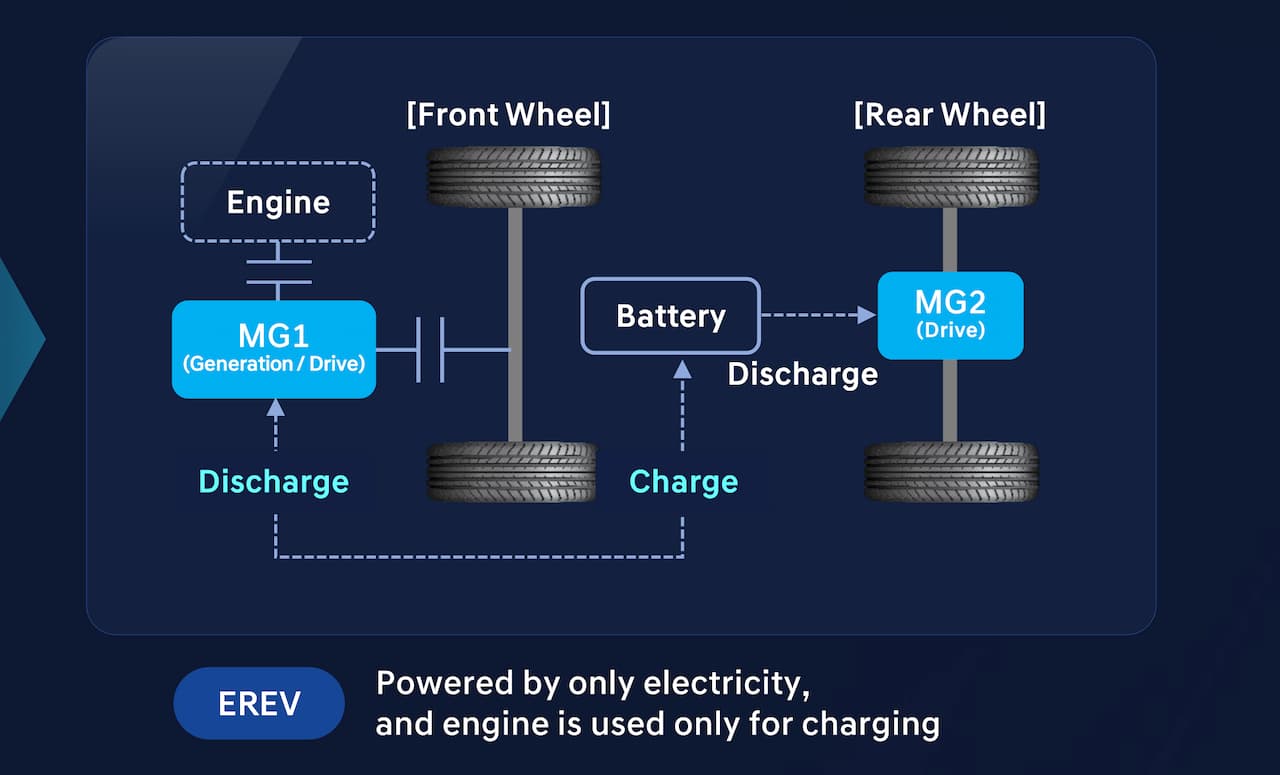
I took @J Alynn’s question as an opportunity to look at more of Scout Motor’s patents.
I don’t know if the following approach might negate my concerns about two batteries, but I’m going to “think out loud” here. I may owe
@Hedges1 and forum a mea culpa if the math works out.
Scout Motors have a really fun patent about deciding how and when to charge the battery in an EREV. There are a bunch of scenarios played out in the patent, including using knowledge of upcoming terrain. As is always the case with patent applications, they try to cover way more than they’ve imagined, just in case they come up with some new idea or solution in the near future.
One of the things they do mention is the possibility that there will be multiple batteries in the “battery block” of their system.
There have been other conversations out there about “hybrid battery” solutions for EVs. The idea in one approach is to have a main battery and a smaller, very, very fast charging (“boosting”) battery that can slowly discharge alongside the main battery. The idea is that you go to a fast charger with, say 20% in your main battery, boost up to 80% on the boost battery and charge the main battery at a more normal rate. So, maybe you only spend 5 minutes charging, adding 10% to the main battery and 80% to the boost battery. You then keep driving. You use some of the main battery and most of the boost battery to get to your next stop. But when you’re commuting, you don’t need a fast charger, so you slow charge both using L2 charging. This doesn’t really solve the range anxiety for road tripping, but it helps with the time anxiety some people have while charging on a road trip. It also preserves the life of the main battery a bit more. I, personally, don’t think it’s necessary. For me charge times and lifetime of the main battery is great for how I drive.
In the Scout Motors patent, they talk about how they might have multiple batteries in the “battery” box. This means they could be charging one battery while discharging the other. Using two of the same batteries means they would still face the issue of losing power and the Harvester having to output much more extra power to meet the demands of the missing battery...
Unless...
Scout Motors use a boost battery with a chemistry and the right power connectors and controls that allow a higher charge and discharge rate (say 5C instead of the preferred 0.25C to 0.5C for the main battery).
Maybe the Harvester tow package has 80 kWh of total battery, a main and a boost battery, that discharge at the same rate during normal driving. But maybe the main battery is 60 kWh and the boost battery is 20 kWh. Normally when you're driving along, the vehicle is pulling from both the main and boost battery at some predefined rate so both batteries reach the same voltage under normal operating conditions. It will also need a higher-power genset engine than the non-tow package, 120 kW (160 hp) instead of the normal 82 kW (110 hp).
Now let’s say you’re on a road trip towing your travel trailer. The truck gets down to 50% or 40 kWh remaining. Because you’re towing, the truck strategically used the boost battery to get you up to speed, meaning 0% in the boost battery and 40 kWh in the main battery.
You are coming up on a 5% grade going at 65 mph. Let’s say you’re 13 miles (12 minutes) out when the Harvester kicks in to start charging. At 12 minutes, it needs to charge the boost battery at 5C, which means 100 kW of output. But it also decides it needs to produce enough to keep the vehicle going at 65 mph. To maintain speed and charge the boost battery, the vehicle needs the genset engine to produce 182 kW of power. It’s only capable of 120 kW. So it starts drawing 62 kW from the main battery. That’s slightly over 1C, which is safe enough.
By the time you get to the base of the mountain you’re going to climb, the boost battery is fully charged, but the main battery has expended another 12.4 kWh, so it’s down to 27.6 kWh.
At 65 mph climbing a 5% grade, you need 230 kW of power to maintain speed. Because the Harvester charged the Boost Battery, you have 20 kWh more energy available to make it up the hill, for a total of 47.6 kWh. Because the route planner knows you’re climbing all the way up the mountain, 13 miles, the algorithm knows you need 230 kW of power for another 12 minutes.
That’s 46 kWh of energy.
But you only have 47.6 kWh remaining, meaning you would be down to 2% charge. That’s well below the 20% buffer the vehicle prefers you to have going up a climb.
The vehicle’s algorithm decides that it needs to keep the Harvester running at 120 kW power output. To get to 230 kW to maintain your speed, you need 110 kW more of power. The boost battery can discharge at 5C, and if it does that, it’ll be empty in 12 minutes. The boost battery can give you 100 kW. The main battery has 27.6 kWh of energy remaining. You need 10 kW over 12 minutes, which is only 2 kWh. You’ll have 25.6 kWh at the top of the climb, which is about 32% state of charge.
So the vehicle decides it can make it without reducing power by pulling max output from the Harvester, max output from the boost battery and the rest from the main battery.
It draws 120 kW from the Harvester for 12 minutes total = 24 kWh of energy output. This will generate 72 kWh of waste heat. That will require ~60% extraction of that heat via the cooling system, or about 43 kWh and the rest will be exhausted or radiated away. If the heat is all extracted in 12 minutes, that requires 215 kW of thermal power removal by the radiator. That’s within the capability of a large (F-150) truck radiator. After some back-of-the-envelope calculations, a vapor-cycle cooling system as I described earlier is probably not the right approach—the size of tube on the the vapor side of the loop would need to be huge. A huge, long line is prone to problematic condensation of the vapor, among other issues.
Generating 96 kWh of motive energy and waste heat will burn about 5 gallons of gasoline. Add that to the gas it burned earlier to recharge the boost battery, you’ll be down by about 6 gallons. If you hadn’t used the gasoline engine any time before this, you’d be down to about 60% of a tank.
The vehicle draws 100 kW from the Boost Battery for 12 minutes total = 20 kWh => 0% / 0 kWh remaining.
The vehicle draws 10 kW from the main battery for 12 minutes total = 5 kWh => 22.6 kWh remaining.
120 + 100 + 10 = 230 kW. That’s about the right amount of power needed to maintain 65 mph up a 5% grade. But over the 13 mile climb, you spend about 6 gallons, all of your boost battery, and a bit of your main battery. You have about 32% state of charge and about 60% fuel remaining. If there are crosswinds, you’ll have trouble. But overall, if the heat can be extracted from under the vehicle cab, this could work.
If they do it this way, I would assume that Boost Battery might be considered a consumable and part of the towing package rather than part of the powertrain, so it probably wouldn’t get the 100,000 mile, 8 year warranty.