



The Garage (What did you work on today?)

  • From all of us at Scout Motors, welcome to the Scout Community! We created this community to provide Scout vehicle owners, enthusiasts, and curiosity seekers with a place to engage in discussion, suggestions, stories, and connections. Supportive communities are sometimes hard to find, but we're determined to turn this into one.

    Additionally, Scout Motors wants to hear your feedback and speak directly to the rabid community of owners as unique as America. We'll use the Scout Community to deliver news and information on events and launch updates directly to the group. Although the start of production is anticipated in 2026, many new developments and milestones will occur in the interim. We plan to share them with you on this site and look for your feedback and suggestions.

    How will the Scout Community be run? Think of it this way: this place is your favorite local hangout. We want you to enjoy the atmosphere, talk to people who share similar interests, request and receive advice, and generally have an enjoyable time. The Scout Community should be a highlight of your day. We want you to tell stories, share photos, spread your knowledge, and tell us how Scout can deliver great products and experiences. Along the way, Scout Motors will share our journey to production with you.

    Scout is all about respect. We respect our heritage. We respect the land and outdoors. We respect each other. Every person should feel safe, included, and welcomed in the Scout Community. Being kind and courteous to the other forum members is non-negotiable. Friendly debates are welcomed and often produce great outcomes, but we don't want things to get too rowdy. Please take a moment to consider what you post, especially if you think it may insult others. We'll do our best to encourage friendly discourse and to keep the discussions flowing.

    So, welcome to the Scout Community! We encourage you to check back regularly as we plan to engage our members, share teasers, and participate in discussions. The world needs Scouts™. Let's get going.


    We are Scout Motors.
I’ve been doing solar and battery “backup” for about 40 years. It started on our entirely off-grid ranch with 12V Pb-A car batteries running a couple of lights, some fans, a scavenged car radio, and a 12V TV.

Currently we have 14 kW of solar and 64 kWh of generic in-home battery, 24 kWh of battery I need to re-connect (but am waiting to get another 5 kW of solar set up so I can have it as a secondary backup on the “generator” port), 15 kWh of battery in our trailer (which can be connected to the house if necessary), and the 212 kWh of the truck’s battery.

For people without a system, I generally recommend battery backup over solar if the budget doesn’t allow both. I don’t recommend standalone power stations unless there’s no other option, the energy need is very small (5 kWh or less), or there are specific goals in mind that the standalone power station helps address. Power stations are very expensive compared with a battery+inverter setup, and they’re not as “plug-and-play” as they pretend to be. A good inverter will allow grid peak shaving to reduce costs, will do automatic, unnoticed power switchover, and have a generator input, which means a decent 240V 30A output from an EV can provide silent power backup. The biggest issue I’ve run into is that most certified, qualified electricians have a few very specific battery companies they will work with. If you can’t DIY, you want to find someone who isn’t locked into particular vendors.

If you can DIY or if your electrician is willing to work with generic components, the cost for 15kWh of generic LFP (which are the same cells in almost all expensive power stations or branded battery boxes) is about $1500. A high-quality inverter is not cheap, but you can get a good 6kW for about $2k. That can cover a critical loads, including AC/heat pump.

All good input.

Locally we have fixed utility rates, so no peak shaving to be done. And most of our power outages locally are in the winter, overnight. So solar is less of a consideration for me at the moment. PNW winter time is very dark/rainy, so I'm not convinced that even relatively large solar setups would provide meaningful charge when we actually needed it. Although, in the summer time we get lots of sun (long days, clear skies), so it could potentially offset some costs for the critical loads panel if I implemented it that way. But so far, I've only been considering the battery + inverter.

The reason that a power station was considered, was simply because it could be used as a temporary solution for the home, and then as a longer term camping solution if needed. But I'm definitely not set on it.

I've looked at some of the more generic stuff (mostly stuff I see through Will Prowses youtube channel, and the forums there). And the first rough plan I was considering was either server rack batteries, or some floorstanding/wall mount batteries (total of 5-15kw of total storage, probably in 1 battery), with a 5-10kw inverter. And even without building your own batteries, you can find deals on 16kwh batteries down into the $1600-1800 range fairly often, or the 5kwh server rack batteries in the $700-850 range (UL listed).

I know just enough about this stuff to find it interesting, but just "not enough" to feel apprehensive about doing it myself, at that scale/$$ for the first time. Which is where things like the Anker E10 come into play, as its a bit more plug and play.

Still in the learning phase.
 
I’ve been doing solar and battery “backup” for about 40 years. It started on our entirely off-grid ranch with 12V Pb-A car batteries running a couple of lights, some fans, a scavenged car radio, and a 12V TV.

Currently we have 14 kW of solar and 64 kWh of generic in-home battery, 24 kWh of battery I need to re-connect (but am waiting to get another 5 kW of solar set up so I can have it as a secondary backup on the “generator” port), 15 kWh of battery in our trailer (which can be connected to the house if necessary), and the 212 kWh of the truck’s battery.

For people without a system, I generally recommend battery backup over solar if the budget doesn’t allow both. I don’t recommend standalone power stations unless there’s no other option, the energy need is very small (5 kWh or less), or there are specific goals in mind that the standalone power station helps address. Power stations are very expensive compared with a battery+inverter setup, and they’re not as “plug-and-play” as they pretend to be. A good inverter will allow grid peak shaving to reduce costs, will do automatic, unnoticed power switchover, and have a generator input, which means a decent 240V 30A output from an EV can provide silent power backup. The biggest issue I’ve run into is that most certified, qualified electricians have a few very specific battery companies they will work with. If you can’t DIY, you want to find someone who isn’t locked into particular vendors.

If you can DIY or if your electrician is willing to work with generic components, the cost for 15kWh of generic LFP (which are the same cells in almost all expensive power stations or branded battery boxes) is about $1500. A high-quality inverter is not cheap, but you can get a good 6kW for about $2k. That can cover a critical loads, including AC/heat pump.
Excellent to hear you say all of that since it pretty much mirrors what I've found as I've been researching. I'm now on a time-of-use plan as it made financial sense for us over the fixed rate plan, so the battery system makes even more financial sense, even if I'm using it to discharge during peak hours and charge during discount hours. Even DIY, the numbers don't make a lot of fiscal sense, but I do want to start playing with batteries/solar, so I can probably write it off as a hobby cost in my head. :LOL:
 
In my ideal world, I'd love to see a 240v, 30A V2L plug on the Scout. That's about what my current generator is and that covers enough of the basics, though no heat or AC.
The Terra has already been shown with a 14-30 so you are covered there. The Traveller has only been shown with 120V plugs so that's an open question. The hope is that they build an adapter cable to go from the NACS port to a 14-30. I have to believe the inverters and such can be (are) common so it's just a wiring/space issue.
 
The Terra has already been shown with a 14-30 so you are covered there. The Traveller has only been shown with 120V plugs so that's an open question. The hope is that they build an adapter cable to go from the NACS port to a 14-30. I have to believe the inverters and such can be (are) common so it's just a wiring/space issue.
Jamie's pretty much told me to stop reading too much into some of the pictures and such, so I'm hopeful they're making it work. Butter lady says "patience". :ROFLMAO:
 
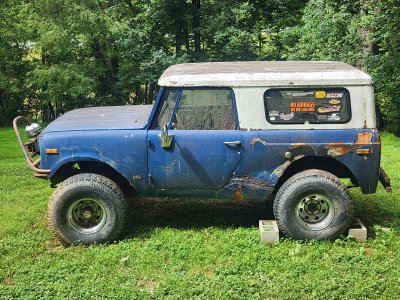
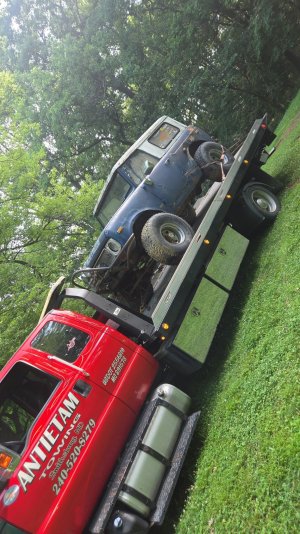
After a strong storm that resulted in many trees down in the area persuaded me to stop neglecting this project. Having it taken to a local shop today for engine work, replace the gas tank, and brakes to let the tear down of the cab begin. Plan is to just get it running and enjoy it for its purpose.
 

Attachments

  • 20260708_153705.jpg
    20260708_153705.jpg
    3.3 MB · Views: 3
The reason that a power station was considered, was simply because it could be used as a temporary solution for the home, and then as a longer term camping solution if needed. But I'm definitely not set on it.

I have a mostly portable power station for exactly this. The Delta Pro 3 is too heavy to call it "easily portable", but it has wheels and a handle to help with mobility. I had to get something the size of the Delta Pro 3 specifically because I needed 240V for my house's well. The 240V output of the DP3 plugs into the transfer switch to power the critical loads in my house in case of a power outage. I have tested it, and it handles the well, gas heat and hot water systems, freezer, fridge, and some smaller loads. I have also tested that it can continue to power the house while being recharged from the V2L of my Ioniq 5. I have only had to use it once for backup power to the house, but it worked without issue.

Thanks to the design, it is easy to move around until you have lift it. Then you had better have a strong back or a friend.
 
I have a mostly portable power station for exactly this. The Delta Pro 3 is too heavy to call it "easily portable", but it has wheels and a handle to help with mobility. I had to get something the size of the Delta Pro 3 specifically because I needed 240V for my house's well. The 240V output of the DP3 plugs into the transfer switch to power the critical loads in my house in case of a power outage. I have tested it, and it handles the well, gas heat and hot water systems, freezer, fridge, and some smaller loads. I have also tested that it can continue to power the house while being recharged from the V2L of my Ioniq 5. I have only had to use it once for backup power to the house, but it worked without issue.

Thanks to the design, it is easy to move around until you have lift it. Then you had better have a strong back or a friend.

Great input.

I'm a bit lucky in this case, in the sense that I really can only feasibly run 120v loads in my home, and have no truly essential 240v loads.

We have propane fireplace and cooktop, heat pump for cooling/heat, and a yuuuuge 80amp backup resistive heater for when its too cold for the heat pump.

So instead of trying to power the heat pump + the backup resistive heater with a giant generator, I've instead gone the other way, and realized that most 120v stuff in our home can be powered with something relatively small. So we have a ~3500w generator.

And a portable power station that can output ~2.5 - 4.5kw via 120v, isn't all that hard to find (or expensive). And I have a TT-30 - L14-30R adapter, so I can plug that 120v x 30 amp output into the home transfer switch.

So that means I could take a ~2-3kwh system, which can weigh in the order of 40-65lbs, which is a lot more feasible to use as a portable device in the future if needed.

I just don't even know if that is "needed", when I already have a v2L adapter that does 80% of this, and then still have my generator on top of that. I suppose if I sold the generator, it might make sense. But even then, the Scout coming out and doing 240v... maybe I don't even need to worry.

The main thing that any of these DIY/critical load panel setups buy me, is UPS functionality for things like fridge and freezer. But... is that worth $4-10k? Apparently not to me, not yet. That would take money from my scout fund :P.
 
After a strong storm that resulted in many trees down in the area persuaded me to stop neglecting this project. Having it taken to a local shop today for engine work, replace the gas tank, and brakes to let the tear down of the cab begin. Plan is to just get it running and enjoy it for its purpose.
Then she's off...
 

Attachments

  • IMG_20260709_091959.jpg
    IMG_20260709_091959.jpg
    648.5 KB · Views: 1
  • Love
Reactions: cyure
Look at her go! How long is she expected to be at the shop?
I asked to have back by October just so I can use to plow. When it returns I plan to strip the interior and add sound deadening with carpeting and add a bench seat with a pendelton style design and replace all the window seals and do a wiring harness.
 
  • Love
Reactions: cyure