



All terrain tires
- Thread starter Xlargetophat
- Start date
-
 From all of us at Scout Motors, welcome to the Scout Community! We created this community to provide Scout vehicle owners, enthusiasts, and curiosity seekers with a place to engage in discussion, suggestions, stories, and connections. Supportive communities are sometimes hard to find, but we're determined to turn this into one.
Additionally, Scout Motors wants to hear your feedback and speak directly to the rabid community of owners as unique as America. We'll use the Scout Community to deliver news and information on events and launch updates directly to the group. Although the start of production is anticipated in 2026, many new developments and milestones will occur in the interim. We plan to share them with you on this site and look for your feedback and suggestions.
How will the Scout Community be run? Think of it this way: this place is your favorite local hangout. We want you to enjoy the atmosphere, talk to people who share similar interests, request and receive advice, and generally have an enjoyable time. The Scout Community should be a highlight of your day. We want you to tell stories, share photos, spread your knowledge, and tell us how Scout can deliver great products and experiences. Along the way, Scout Motors will share our journey to production with you.
Scout is all about respect. We respect our heritage. We respect the land and outdoors. We respect each other. Every person should feel safe, included, and welcomed in the Scout Community. Being kind and courteous to the other forum members is non-negotiable. Friendly debates are welcomed and often produce great outcomes, but we don't want things to get too rowdy. Please take a moment to consider what you post, especially if you think it may insult others. We'll do our best to encourage friendly discourse and to keep the discussions flowing.
So, welcome to the Scout Community! We encourage you to check back regularly as we plan to engage our members, share teasers, and participate in discussions. The world needs Scouts™. Let's get going.
We are Scout Motors.
You are using an out of date browser. It may not display this or other websites correctly.
You should upgrade or use an alternative browser.
You should upgrade or use an alternative browser.


I just can’t imagine that we wouldn’t. You can get them on Wranglers and such. Good question.Will we be able to get all terrain tires for highway driving on delivery ?
Ty

The Scout Concepts I’ve seen are all riding on BFG KO3’s. They are a great A/T with good highway manners.Will we be able to get all terrain tires for highway driving on delivery ?
Ty

A offroad tire like the K03 would likely only be available on the Offroad packages. Not sure yet what our standard tires will be. Probably varies by the wheel size.
Thanks for that info Jamie. Looks like in addition to advocating for PBY, I also need to advocate for an offroad appearance package. K03 on an 18”, tire carrier, compass, without an air compressor because I’m never going to air down my tires, and I don’t need to lock my diff. If I need those to lock I think I’ve got big problems.A offroad tire like the K03 would likely only be available on the Offroad packages. Not sure yet what our standard tires will be. Probably varies by the wheel size.


It’s better to have lockers and not need them, then to need them and not have them.Thanks for that info Jamie. Looks like in addition to advocating for PBY, I also need to advocate for an offroad appearance package. K03 on an 18”, tire carrier, compass, without an air compressor because I’m never going to air down my tires, and I don’t need to lock my diff. If I need those to lock I think I’ve got big problems.


I am 99% sure the BFG AT is a done deal. I am hoping for a rugged all season highway tire for efficiency.Will we be able to get all terrain tires for highway driving on delivery ?
Ty
I’m terrible, who cares about efficiency, I’m all for looks! And the Traveler just looks so good on those K03s, efficiency be damned!I am 99% sure the BFG AT is a done deal. I am hoping for a rugged all season highway tire for efficiency.

@cyure buying KO3’s for everybody. She’s like Oprah-you get KO3’s, and you get …..I’m terrible, who cares about efficiency, I’m all for looks! And the Traveler just looks so good on those K03s, efficiency be damned!
I find myself the opposite. I am constantly trying to get 4.0 mi/kWh and look good doing it.I’m terrible, who cares about efficiency, I’m all for looks! And the Traveler just looks so good on those K03s, efficiency be damned!
Okay when you find that post a picture. I would love to see what that kind of tire looks like.I find myself the opposite. I am constantly trying to get 4.0 mi/kWh and look good doing it.
Oh, I think the Michelin Defender Platinum shows promise.Okay when you find that post a picture. I would love to see what that kind of tire looks like.
Now that I think I could get behind!Oh, I think the Michelin Defender Platinum shows promise. View attachment 13695
I'm just hoping someone starts making some lighter mud-terrains. Those heavy beasts are really hard on range, but ATs just don't do it for my use case.

I dont get hung up on factory tires because manufacturers usually spec a different tire than you get off the shelf.
They tend to ride smoother and quieter to help sell the car on a test drive, but wear out much faster than the normal retail tires do because they use softer compounds to accommodate for NVH requirements. And yes, I mean the same size and same "model" tires will wear and ride much differently.
I just drive them until they are down the wear bars and install what I want after that.
I also think it's stilly when people talk about Offroad packages like the TRD Pro and Pro 4X packages.
If you are really offroading, all the factory lifted suspension components get ripped out almost right away to make way for beefier aftermarket struts, springs and shocks. Same usually goes for the upgraded wheels those packages come with because they tend to be too narrow for larger offroad tires with 12" widths.
The only thing you typically gain from those are a rear locker and a few offroad specific software modes.
They tend to ride smoother and quieter to help sell the car on a test drive, but wear out much faster than the normal retail tires do because they use softer compounds to accommodate for NVH requirements. And yes, I mean the same size and same "model" tires will wear and ride much differently.
I just drive them until they are down the wear bars and install what I want after that.
I also think it's stilly when people talk about Offroad packages like the TRD Pro and Pro 4X packages.
If you are really offroading, all the factory lifted suspension components get ripped out almost right away to make way for beefier aftermarket struts, springs and shocks. Same usually goes for the upgraded wheels those packages come with because they tend to be too narrow for larger offroad tires with 12" widths.
The only thing you typically gain from those are a rear locker and a few offroad specific software modes.
I’m honestly not that worried about what tires SM are offering either. I will pick the closest to what I like and if there’s really nothing my tire guy will buy the tires on it if they don’t have too many miles on them. It’s not a lot of money he pay for them but it’s something.I dont get hung up on factory tires because manufacturers usually spec a different tire than you get off the shelf.
They tend to ride smoother and quieter to help sell the car on a test drive, but wear out much faster than the normal retail tires do because they use softer compounds to accommodate for NVH requirements. And yes, I mean the same size and same "model" tires will wear and ride much differently.
I just drive them until they are down the wear bars and install what I want after that.
I also think it's stilly when people talk about Offroad packages like the TRD Pro and Pro 4X packages.
If you are really offroading, all the factory lifted suspension components get ripped out almost right away to make way for beefier aftermarket struts, springs and shocks. Same usually goes for the upgraded wheels those packages come with because they tend to be too narrow for larger offroad tires with 12" widths.
The only thing you typically gain from those are a rear locker and a few offroad specific software modes.
The Supra came with summer performance and those aren’t practical out here so we immediately swapped for an all season tire.
I would normally agree, but the BFG KO3’s are a solid choice for Scout. I had the KO2’s on my Raptor and liked them. My brother ran two sets of KO2’s on his Chevy Colorado and got 60,000 miles out of each set before getting KO3’s this last time (his Colorado has over 170,000 miles in it). My TRX came with the Goodyear Wrangler Territory A/T that was speed rated for 118mph, and it performed well until I replaced them at 36,000 miles (the more miles I put on, the louder they got).I dont get hung up on factory tires because manufacturers usually spec a different tire than you get off the shelf.
They tend to ride smoother and quieter to help sell the car on a test drive, but wear out much faster than the normal retail tires do because they use softer compounds to accommodate for NVH requirements. And yes, I mean the same size and same "model" tires will wear and ride much differently.
I just drive them until they are down the wear bars and install what I want after that.
I also think it's stilly when people talk about Offroad packages like the TRD Pro and Pro 4X packages.
If you are really offroading, all the factory lifted suspension components get ripped out almost right away to make way for beefier aftermarket struts, springs and shocks. Same usually goes for the upgraded wheels those packages come with because they tend to be too narrow for larger offroad tires with 12" widths.
The only thing you typically gain from those are a rear locker and a few offroad specific software modes.
I’m glad to see Scout offering a legit A/T tire!

I'll run whatver the stock A/Ts on the Scout for 6 months.
Then Swap to these for the other 6 months (Hakka LT3)
Nokian Hakka is 100% the best severe service winter truck tire there is, and the LT3 should be just about perfect on a Scout.


Then Swap to these for the other 6 months (Hakka LT3)
Nokian Hakka is 100% the best severe service winter truck tire there is, and the LT3 should be just about perfect on a Scout.
I think you missed the part about them usually having softer compounds.I would normally agree, but the BFG KO3’s are a solid choice for Scout. I had the KO2’s on my Raptor and liked them. My brother ran two sets of KO2’s on his Chevy Colorado and got 60,000 miles out of each set before getting KO3’s this last time (his Colorado has over 170,000 miles in it). My TRX came with the Goodyear Wrangler Territory A/T that was speed rated for 118mph, and it performed well until I replaced them at 36,000 miles (the more miles I put on, the louder they got).
I’m glad to see Scout offering a legit A/T tire!
The K03 Scout will install will likely not be the same K03 you buy at a tire shop.
Most people dont realize they are different tires despite being the same size and model.
Car manufacturers typically get multiple versions of the same tires sent by the tire manufacturers. Then pick one based on their goals and handling characteristics for the new vehicle.
While you may be familiar with the K03 tire, there is a chance the ones on the Scouts will behave different in snow, wet, muddy, uneven, hot, or rocky conditions than the ones you had in the past.
This is also why factory tires tend to wear out quickly on most vehicles.
This article describes part of that tire selection process.
Sticking With Your OEM Tires, Some Notes About Wheel Sizes
"Well, Pieter, I too find the choice of 20” wheels across the board odd, but there could be a very good reason for this. I can’t look into the minds of the engineers and product planners at Renault but one reason to have a single tire size is that tire development is expensive and time consuming. If you can release a new vehicle with the same tire on all trim levels it saves a lot of time and money during development. A lot of effort is put into making sure the tires a car is sold with perform at the high levels a manufacturer specifies. This process can take over a year to complete and requires the tire manufacturer to make several “submissions” to the car company.In each submission, the tire company will provide several hundred tires with different types of construction and rubber compounds. The constructions may vary in the way the steel and nylon belts are oriented, or what rubber compounds are used in the tread blocks. Each design will behave differently and the vehicle development engineers will then spend several weeks testing each of the tires to see which one works the best in the car. They will test each tire for cornering, stopping, and acceleration performance in dry and wet conditions. They will test the amount of noise a tire makes over various types of road surfaces. They will see how well the tire communicates road conditions through the steering system. Does the tire wander over minor road imperfections? Is it sensitive to ruts in the road? They may also test it on special machines to get an estimate of tire life.
Stick With OEM Rubber
All this can take several months to complete and it will usually happen about three times, with each successive submission refining the tire construction until hopefully by the third submission there is at least one construction that meets the targets set by the company for that particular vehicle. These targets, as well as many other vehicle targets, like cost, weight, fuel economy, vehicle size, etc. are set very early in a vehicle program to meet the expectations of the expected customer. The overall vehicle targets then get broken down into targets for each individual system, including the suspension and tires. Often the targets are based on vehicles made by the company’s competition, and also by doing a bit of guesswork on how the competition’s future products might improve — a process called “futuring.” You have to make some assumptions about how everyone else’s products are going to get better in the years it takes to bring a new car to market and make sure your product is as good or better than that. You don’t want to get into a situation where your new car is just as good as what your competition had four years earlier.Once the engineers find a tire submission that meets (or even exceeds) the vehicle targets, that submission will be released for production. Since so much work has gone into choosing the right tire construction for a particular car, it is almost always advisable to replace your car’s tires with the same ones it came with. Round and black is not sufficient. All tires are absolutely NOT the same and choosing a non-OEM specified tire can have significant effects on the ride and handling of your car. It can also have a very strong effect on steering feel.
The tuning of the tire and the tuning of the steering system go hand-in-hand, as the rubber plays a big role in communicating the steering feel the manufacturer wants. That great steering feel and handling confidence your BMW 3 Series has can quickly disappear if you put some generic aftermarket tire on it. More importantly though, if the replacement tires don’t have the same amount of traction as the OEM tires, you could increase your stopping distances and hurt braking performance. Replace your car’s tires with the same brand and model it came with and you will likely be much happier in the long run."
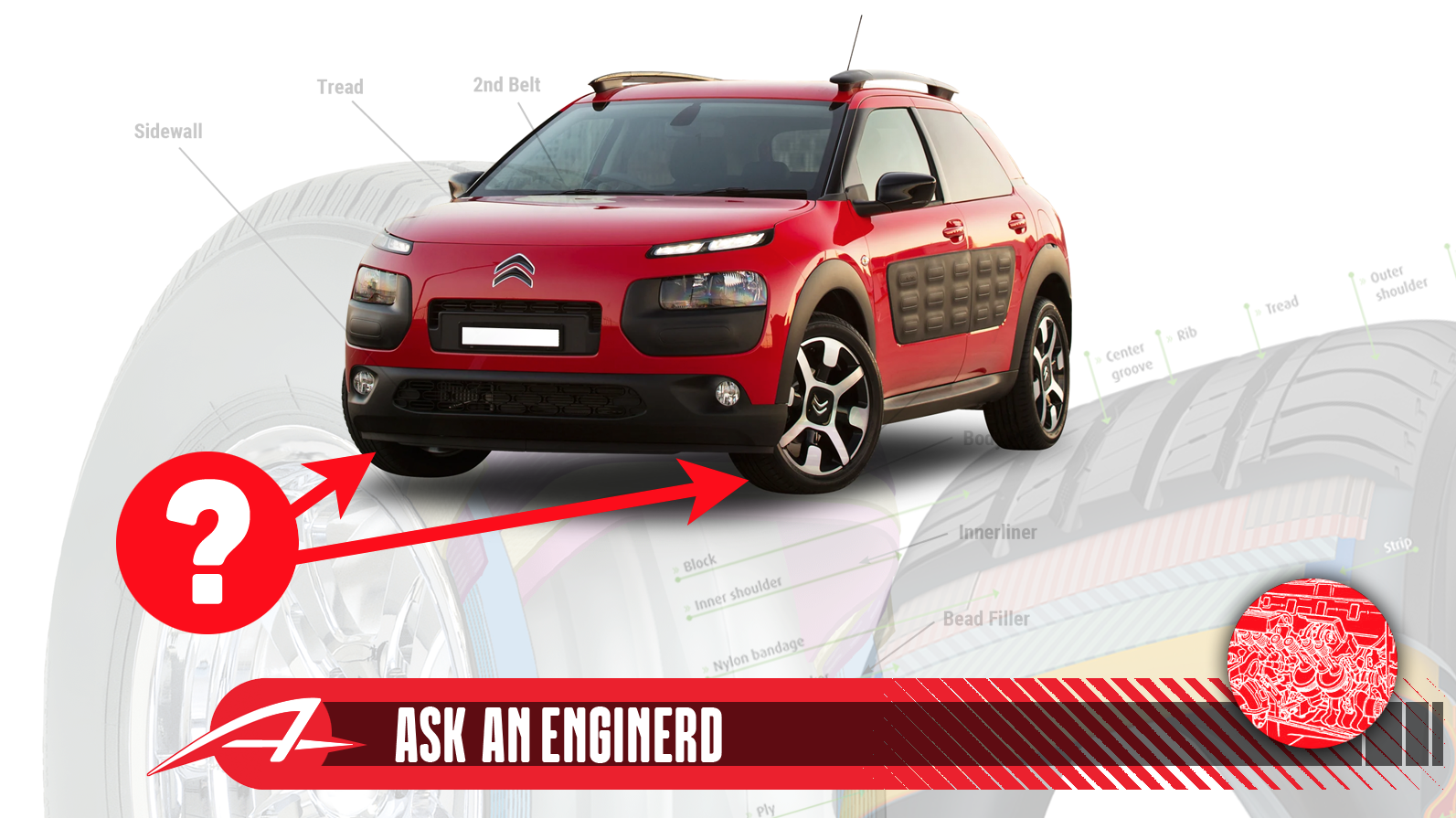
Why You Should Replace Your Tires With The Ones It Came With Originally: Ask An Engineer - The Autopian
Should you replace your worn-out tires with the same make and model of tire that came on your car when it was new? An engineer makes the case.
 www.theautopian.com
Similar threads

- Replies
- 23
- Views
- 1K


- Replies
- 4
- Views
- 383


- Replies
- 26
- Views
- 794


- Replies
- 32
- Views
- 1K
