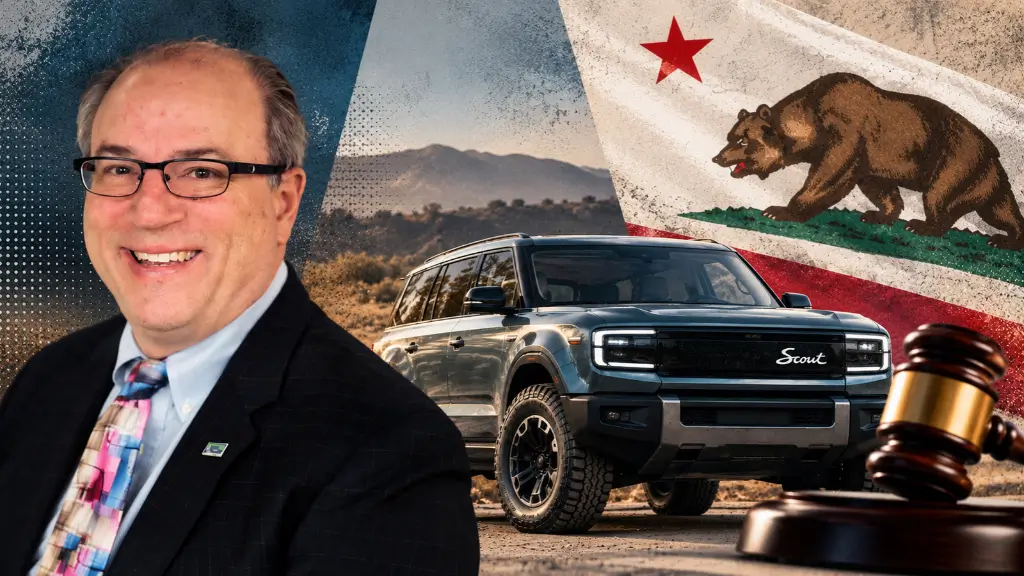
Scout's lawsuits regarding direct to consumer Sales

  • From all of us at Scout Motors, welcome to the Scout Community! We created this community to provide Scout vehicle owners, enthusiasts, and curiosity seekers with a place to engage in discussion, suggestions, stories, and connections. Supportive communities are sometimes hard to find, but we're determined to turn this into one.

    Additionally, Scout Motors wants to hear your feedback and speak directly to the rabid community of owners as unique as America. We'll use the Scout Community to deliver news and information on events and launch updates directly to the group. Although the start of production is anticipated in 2026, many new developments and milestones will occur in the interim. We plan to share them with you on this site and look for your feedback and suggestions.

    How will the Scout Community be run? Think of it this way: this place is your favorite local hangout. We want you to enjoy the atmosphere, talk to people who share similar interests, request and receive advice, and generally have an enjoyable time. The Scout Community should be a highlight of your day. We want you to tell stories, share photos, spread your knowledge, and tell us how Scout can deliver great products and experiences. Along the way, Scout Motors will share our journey to production with you.

    Scout is all about respect. We respect our heritage. We respect the land and outdoors. We respect each other. Every person should feel safe, included, and welcomed in the Scout Community. Being kind and courteous to the other forum members is non-negotiable. Friendly debates are welcomed and often produce great outcomes, but we don't want things to get too rowdy. Please take a moment to consider what you post, especially if you think it may insult others. We'll do our best to encourage friendly discourse and to keep the discussions flowing.

    So, welcome to the Scout Community! We encourage you to check back regularly as we plan to engage our members, share teasers, and participate in discussions. The world needs Scouts™. Let's get going.


    We are Scout Motors.

Broverlander

Scout Community Veteran
Oct 28, 2024
288
1,018
St. Paul, MN
For those of you who may not know, I'm a lawyer and have been for the past 22 years. I was in private practice with a law firm for 15 of those years but for the last seven, have been employed by a municipality in an in-house capacity (much less stressful!). During those 22 years, I practiced mainly in Minnesota (I live in Minneapolis/St. Paul). In addition to being licensed in Minnesota, I was also licensed in Wisconsin and Iowa. On top of that, I've handled cases around the Country (when you're not licensed in a state, you can get admitted on a case-by-case basis). To this day, I have two specialties. First, I advise employers on human resources issues. Second, I defend civil lawsuits for corporations and now, a municipality. I'm also a new vehicle addict, love off-road vehicles (even though I rarely take them off road, thus my user handle), and have a reservation in for both the Traveler and the Terra. To say I'm all-in on Scout would be an understatement (ask my wife. She'll tell you).

A lot of forum members seem to have lots of questions about the civil lawsuits that some car dealers have started against Scout in some states (California, Washington, Colorado, and somewhere on the East Coast). I plan on using this thread to explain what's going on and why the dealers' associations are doing this (that will be my first post). Then, at some point, I plan to gather most of the legal documents that have been filed publicly and give you my thoughts and opinions on them. This thread is in no way, shape, or form intended to be, or should be constructed as, legal advice. Rather, it's my chance to try to help the forum members understand what's going on and let them know what I think--in my own opinion--the legal landscape looks like for Scout.

I also don't want this to be just me spouting my thoughts. Everyone who wants to give an opinion or thought should. Honestly? Some of the best ideas I've gotten over the years have been because of comments or questions I got from my clients. I literally won a trial about a year ago because of a question a client asked me that I hadn't' thought of.
 
What’s the gist of these lawsuits?

Scout Motors (I’ll refer to it as “Scout”) is wholly owned and fully funded by Volkswagen Aktiengesellschaft, also known as the Volkswagen Group (I’ll refer to this company as “VW”). This is the VW you all know and love (maybe? Maybe not?). In addition to owning and funding Scout, VW owns and funds a lot of other companies. One of them is called Volkswagen Group of America (I’ll refer to this company as “VGA”). VGA is the company that sells VW automobiles in the United States.

To sell VW automobiles in the U.S., VW uses a “dealer” model. What this means is that there are brick-and-motor stores where you can go buy a VW. Those VW stores aren’t owned by VW. Rather, they are owned by what we call “franchisees.” So basically, a person (I’ll use that phrase because it’s easier to understand) enters into an agreement with VW that gives the person the legal right to sell VW automobiles, they build the brick-and-motor stores and then sell the cars. There are a lot of VW dealers. What most franchisors do is sell territories. They’ll sell the right to sell cars in a certain area in a city to one dealer and sell the right for another part of that city to another.

It’s because of this that every state has a set of laws called “franchise laws.” These laws regulate the relationship between the franchisee (the person selling the cars) and the franchisor (VW). They are intended to protect the franchisee (the car dealer) from the franchisor (VW) because the franchisor typically is much bigger, has more power and money, and has way more leverage. These laws are not designed to help the consumer.

The dealer model isn’t specific to VW. Frankly, with the exception of Tesla and Rivian, and maybe a few others, almost all cars are sold through this model. This model has been around for a long time. The car companies make money because they sell cars and the dealers make money because they increase the cost of the car slightly and when they sell them, they pocket the cost (called markup). In truth though, most of the profits for dealers come from used cars, accessories, parts, and service. The markup on new cars these days is pretty small though not insubstantial. That markup has the tendency to increase the cost of the car. And the dealer has the tendency to increase the complexity of purchasing a car (not the mention the hassle).

For this reason, some new auto manufacturers are selling direct to consumer (I call this “DTC”). Telsa and Rivian are two examples. DTC allows consumers to purchase vehicles through the website or their Scout Service centers or whatever they’ll call them. Having purchased a Rivian that way, it’s way, way, way better.

Scout does not intend to use the dealer model and instead, intends on DTC sales. To engage in the business of selling cars in a state, however, Scout needs a license in each state in which it intends to sell them (presumably all). Scout is in the process of applying for those licenses.

The various VW dealers around the Country are upset. They’re upset because Scout intends to use the DTC model, which cuts them out of the picture, and doesn’t let them profit from Scout sales. Some have been so mad that they’ve objected to Scout’s seeking of licenses and have filed civil lawsuits against Scout. In these lawsuits, the VW dealers have alleged that Scout cannot sell DTC because it violates certain states’ franchise laws. They argue that because VW owns Scout. They argue that they have agreements with VGA to sell cars. They argue that because VW owns both Scout and VGA, their agreements with VGA require VW to use them to sell Scouts.

I’ve not dug into the merits of the argument, but I’m skeptical to say the least. VGA is separate from VW. Dealers have an agreement with VGA. VW owns Scout. Dealers don’t have an agreement with VW. I’ll start digging into the filings to see what they say.

In my opinion, these lawsuits are about nothing but money. These car dealers want the right to sell Scouts so they can profit, (mostly) to the detriment of the consumer.
Thanks for all your time digging into this and explaining it. Appreciate it.
 
For those of you who may not know, I'm a lawyer and have been for the past 22 years. I was in private practice with a law firm for 15 of those years but for the last seven, have been employed by a municipality in an in-house capacity (much less stressful!). During those 22 years, I practiced mainly in Minnesota (I live in Minneapolis/St. Paul). In addition to being licensed in Minnesota, I was also licensed in Wisconsin and Iowa. On top of that, I've handled cases around the Country (when you're not licensed in a state, you can get admitted on a case-by-case basis). To this day, I have two specialties. First, I advise employers on human resources issues. Second, I defend civil lawsuits for corporations and now, a municipality. I'm also a new vehicle addict, love off-road vehicles (even though I rarely take them off road, thus my user handle), and have a reservation in for both the Traveler and the Terra. To say I'm all-in on Scout would be an understatement (ask my wife. She'll tell you).

A lot of forum members seem to have lots of questions about the civil lawsuits that some car dealers have started against Scout in some states (California, Washington, Colorado, and somewhere on the East Coast). I plan on using this thread to explain what's going on and why the dealers' associations are doing this (that will be my first post). Then, at some point, I plan to gather most of the legal documents that have been filed publicly and give you my thoughts and opinions on them. This thread is in no way, shape, or form intended to be, or should be constructed as, legal advice. Rather, it's my chance to try to help the forum members understand what's going on and let them know what I think--in my own opinion--the legal landscape looks like for Scout.

I also don't want this to be just me spouting my thoughts. Everyone who wants to give an opinion or thought should. Honestly? Some of the best ideas I've gotten over the years have been because of comments or questions I got from my clients. I literally won a trial about a year ago because of a question a client asked me that I hadn't' thought of.
Appreciate your efforts on this. Love when experts share what they know
 
It’s because of this that every state has a set of laws called “franchise laws.” These laws regulate the relationship between the franchisee (the person selling the cars) and the franchisor (VW). They are intended to protect the franchisee (the car dealer) from the franchisor (VW) because the franchisor typically is much bigger, has more power and money, and has way more leverage. These laws are not designed to help the consumer.
To clarify, is the franchisor actually VWA? If so, the dealership battle will be much tougher than if the franchisor were VW.
 
Yeah, but do the VW/Audi/whatever dealerships sign their franchise agreements with VWA or VW? That would make a big difference I'm thinking.
VWA is my understanding. That's the company that distributes VW vehicles in Minnesota.

You're right about the big difference and that's what Scout's been arguing. What I would want to know if I were the plaintiff is whether there's a real difference between VW and VWA. If all there is is a mere formality, they are the same and that's what I'd argue. We call this (not quite the right context but close enough) piercing the corporate veil. It's where one company's acts are considered the acts of another because the existence of the second company is just a shell to hide the real actions of the first. I'm guessing that's going to be a tough argument with VW.
 
Being a Volkswagen dealer doesn't entitle them to sell anything from Audi, Bentley, Lamborghini, etc, so why would they think they'd be entitled to sell Scout vehicles?
Reading over the class action, dealers signed their franchise agreements with VWA, not VWAG, so they're going to have a tougher time since VWA hasn't funded Scout. On the flip side, with franchise laws mentioning the "manufacturer", it could get trickier since the manufacturer is occasionally VWAG, as noted on this 2026 GTI:

20261110_155937.jpg


I think a lot of this will come down to the definition of manufacturer. In NC:
Manufacturer. - A person, resident or nonresident, who manufactures or assembles new motor vehicles, or who imports new motor vehicles for distribution through a distributor, including any person who acts for and is under the control of the manufacturer or assembler in connection with the distribution of the motor vehicles. Additionally, the term "manufacturer" shall include the terms "distributor" and "factory branch."

With VVA importing vehicles made by VWAG, it sounds to me like VWA would be the legal manufacturer.
 
Last edited:
  • Like
Reactions: Latrant
Being a Volkswagen dealer doesn't entitle them to sell anything from Audi, Bentley, Lamborghini, etc, so why would they think they'd be entitled to sell Scout vehicles?
Reading over the class action, dealers signed their franchise agreements with VWA, not VWAG, so they're going to have a tougher time since VWA hasn't funded Scout. On the flip side, with franchise laws mentioning the "manufacturer", it could get trickier since the manufacturer is occasionally VWAG, as noted on this 2026 GTI:

View attachment 20005


I think a lot of this will come down to the definition of manufacturer. In NC:
Manufacturer. - A person, resident or nonresident, who manufactures or assembles new motor vehicles, or who imports new motor vehicles for distribution through a distributor, including any person who acts for and is under the control of the manufacturer or assembler in connection with the distribution of the motor vehicles. Additionally, the term "manufacturer" shall include the terms "distributor" and "factory branch."

With VVA importing vehicles made by VWAG, it sounds to me like VWA would be the legal manufacturer.
Minnesota's definition is as follows:

"Manufacturer" means any person who manufactures or assembles new motor vehicles or any person, partnership, firm, association, joint venture, corporation, or trust which is controlled by the manufacturer.

Under Minnesota law, I'd make the argument that Scout Motors, not any of the Volkswagen entities, is the manufacturer. Scout is the one making the vehicles. It's clearly assembling them. Manufacturing isn't defined by the statute or case law, so the term would carry its ordinary meaning: to make or produce something, particularly by industrial processes or with machinery. That's Scout too.

But to your excellent point, this is where it gets hairy. It is where the plaintiff's attorneys will make their hay. Even a single instance of comingling who makes what will be latched onto by those attorneys to argue that the corporate distinctions are nothing but a facade and it's just one big corporation.
 
So, I'm in Ohio and customers are unable to test drive, sit in or ask questions of Rivian at the Service Center 6 miles from my house. We can 'purchase' a Rivian online but from another state, and have it delivered to the Service Center for pickup or delivered to our driveway and then pay the Ohio Sales tax when we Register it (and pay more EV fees / gas tax fees as well as license plate fees, etc) at that time. Its ridiculous.

Tesla has a full 'dealership' 20 miles from my house on the east side of Cleveland (Lyndhurst) and I've been there and can do everything anyone could want including test drive, ask questions, get a Tesla Serviced, etc.

I think Tesla Grandfathered because the Ohio NADA didn't think Tesla would be a threat. Once they were, they blocked as much as they could for Rivian, even though its an American Company with American Employees and manufactured in America. Crazy.

I worry this is what will happen to Scout in Ohio, even if they are allowed to sell vehicles DTC. There is a lawsuit on an Ohio Docket from September 2025 with Rivian as the Plaintiff and the Ohio government and the law passed to block Rivian as the defendant. I've read about it the last few days but no new info on it since September 2025 that I can find.

How long do you think this process will take with Scout? Five Years?
 
  • Like
Reactions: maynard and J Alynn
So, I'm in Ohio and customers are unable to test drive, sit in or ask questions of Rivian at the Service Center 6 miles from my house. We can 'purchase' a Rivian online but from another state, and have it delivered to the Service Center for pickup or delivered to our driveway and then pay the Ohio Sales tax when we Register it (and pay more EV fees / gas tax fees as well as license plate fees, etc) at that time. Its ridiculous.

Tesla has a full 'dealership' 20 miles from my house on the east side of Cleveland (Lyndhurst) and I've been there and can do everything anyone could want including test drive, ask questions, get a Tesla Serviced, etc.

I think Tesla Grandfathered because the Ohio NADA didn't think Tesla would be a threat. Once they were, they blocked as much as they could for Rivian, even though its an American Company with American Employees and manufactured in America. Crazy.

I worry this is what will happen to Scout in Ohio, even if they are allowed to sell vehicles DTC. There is a lawsuit on an Ohio Docket from September 2025 with Rivian as the Plaintiff and the Ohio government and the law passed to block Rivian as the defendant. I've read about it the last few days but no new info on it since September 2025 that I can find.

How long do you think this process will take with Scout? Five Years?
Has nothing to do with where the vehicles are produced, and everything to do with dealership cartels who want to control access to the product.

Until American automakers stand up and with their immense lobbying power work together for national legislation to break open direct to consumer sales, nothing will change.

Their argument is every other durable good - refrigerators, ovens, washing machines, boats, RVs... - are all sold through a network of "independent" retailers, why should they be forced "out of buisness" (they won't, they'll just be re-employed) to enable automakers to sell directly to consumers?

Additionally, since states regulate consumer sales via sales and use taxes, not the federal government, it is in dealer networks' best interests to maintain the fractured state to state legal patchwork that keeps them in business.

I was at a mobility conference this week - dealers are now employing AI agents to manage what data *your* AI agents access in order to control what deals you can get. They openly discussed ON A STAGE using AI agents to conceal and manipulate data that consumers have access to to preserve their business model.
 
I was at a mobility conference this week - dealers are now employing AI agents to manage what data *your* AI agents access in order to control what deals you can get. They openly discussed ON A STAGE using AI agents to conceal and manipulate data that consumers have access to to preserve their business model.

Can you give an example of what they were saying was possible with this scheme? Like, what specifically they wanted to manipulate?
 
  • Like
Reactions: cyure and maynard
I guess to me it seems something like this. VW dealers have a franchise to sell VW vehicles imported or manufactured by VWA. They do not have a franchise to sell any other vehicles manufactured by other brands under VWAG. That said, the owners of the VW dealers presumably could try to jump through the hoops and pay the fees and maybe purchase franchises to sell those other brands (may, because who knows the rules of the franchise license - it could include exclusive territories). They are not being given that opportunity with Scout.

So to me, it is less about VW dealers being able to sell Scouts - I don't see them having a leg to stand on. But perhaps the lawsuits can force VWAG to put Scout under VWA to get Scout to use a franchise model and open up pathways to building and buying Scout franchises.

Now a second question - if a lawsuit wins in one state, will it automatically apply to other states? All Scout really needs is one state to allow direct sales - then they should be able to use the existing loophole. Ship all vehicles to the state that allows the sales, and sell them from that state.
 
  • Like
Reactions: maynard