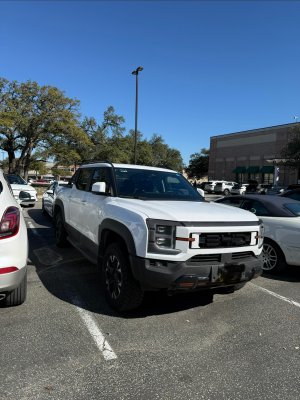


BYD Shark PHEV Outsells Toyota HiLux in Australia

  • From all of us at Scout Motors, welcome to the Scout Community! We created this community to provide Scout vehicle owners, enthusiasts, and curiosity seekers with a place to engage in discussion, suggestions, stories, and connections. Supportive communities are sometimes hard to find, but we're determined to turn this into one.

    Additionally, Scout Motors wants to hear your feedback and speak directly to the rabid community of owners as unique as America. We'll use the Scout Community to deliver news and information on events and launch updates directly to the group. Although the start of production is anticipated in 2026, many new developments and milestones will occur in the interim. We plan to share them with you on this site and look for your feedback and suggestions.

    How will the Scout Community be run? Think of it this way: this place is your favorite local hangout. We want you to enjoy the atmosphere, talk to people who share similar interests, request and receive advice, and generally have an enjoyable time. The Scout Community should be a highlight of your day. We want you to tell stories, share photos, spread your knowledge, and tell us how Scout can deliver great products and experiences. Along the way, Scout Motors will share our journey to production with you.

    Scout is all about respect. We respect our heritage. We respect the land and outdoors. We respect each other. Every person should feel safe, included, and welcomed in the Scout Community. Being kind and courteous to the other forum members is non-negotiable. Friendly debates are welcomed and often produce great outcomes, but we don't want things to get too rowdy. Please take a moment to consider what you post, especially if you think it may insult others. We'll do our best to encourage friendly discourse and to keep the discussions flowing.

    So, welcome to the Scout Community! We encourage you to check back regularly as we plan to engage our members, share teasers, and participate in discussions. The world needs Scouts™. Let's get going.


    We are Scout Motors.

04Ram2500Hemi

Scout Community Veteran
Oct 25, 2024
434
1,321
Western Montana
From Expedition Portal:
https://expeditionportal.com/byd-shark-phev-outsells-toyota-hilux-in-australia/

In a year that will be talked about for decades, 2025 marked the moment plug-in electrified vehicles truly made themselves at home in the competitive Australian ute market. In a segment long dominated by diesel-burning workhorses—where names like HiLux and Ranger have been etched into the cultural DNA of farmers, tradies, and adventure seekers alike—something remarkable happened.

The BYD Shark 6, a plug-in hybrid electric utility vehicle from Chinese automaker BYD, outsold the venerable HiLux among private car buyers in Australia for the first time. Yes, that HiLux, the symbol of rugged reliability, fell behind a hybrid ute from a brand that, until recently, was barely on most Australians’ radar.

According to the latest sales data, the BYD Shark 6 recorded 15,564 private sales in Australia in 2025, comfortably ahead of the HiLux’s 12,529 deliveries into private hands. That’s no small feat given how entrenched Toyota is in the market. This is nothing short of a stunning result in its first full year on sale and one that helped BYD become one of the fastest-growing brands in the country.

Part of the Shark’s winning formula is value. In 2025, the Shark 6 was competitively priced from around A$57,900 before on-road costs, with many buyers securing drive-away deals in the $55,000–$60,000 range—roughly in line with, or cheaper than, comparable HiLux variants. For a vehicle that pairs the practicality of a dual-cab ute with the efficiency of a plug-in hybrid and enough tech to shame many mainstream SUVs, that’s a compelling proposition.

But the numbers tell only part of the story. Australia has historically been a very tough market for electric vehicles. Long distances, sparse charging infrastructure outside major cities, and a cultural skepticism toward EVs have combined to keep pure battery EV adoption relatively slow compared to other parts of the world. Yet 2025 saw electrified vehicles—including hybrids, PHEVs, and BEVs—collectively outsell internal-combustion-engine-only cars, a watershed moment reflecting a broader shift in consumer attitudes.

The Shark’s success isn’t just about price or novelty. It signals a deeper realization among buyers that electrified powertrains now deliver real-world utility without compromising versatility—and in some respects enhance it, offering instant torque, lower running costs, and the flexibility of gasoline backup when the trip calls for range.

For manufacturers entrenched in the internal-combustion world, this is a clear inflection point. Toyota and others are already accelerating their electrification strategies, but the BYD story underscores rising competition from Chinese brands that are marrying bold pricing with cutting-edge technology.

Long-term reliability and durability remain a large question mark, as the Shark has only been in customers’ hands in Australia for a little over 12 months. How the electrical systems, chassis, axles, and driveline will hold up to tens of thousands of miles of corrugations, heat cycles, and the stress of driving at or near maximum payload capacity is a question that can’t be answered yet.

With an impressive six-year, 90,000-mile warranty and an eight-year battery warranty, maybe early adopters are thinking it doesn’t matter too much? As the sun rises on a new era of vehicle choice in Australia, the Shark’s bite may be the first sign that even the most traditional segments are ripe for electrified disruption—and that Australia’s adventurous spirits might be more ready for the plug-in revolution than anyone expected. The BYD Shark is expected to be on sale soon in Canada, thanks to greatly reduced tariffs. The US continues to maintain a 100% tariff on all Chinese EVs, effectively keeping BYD vehicles off the road for now.

IMG_0511.jpeg
IMG_0509.jpeg
IMG_0510.jpeg
 
From Expedition Portal:
https://expeditionportal.com/byd-shark-phev-outsells-toyota-hilux-in-australia/

In a year that will be talked about for decades, 2025 marked the moment plug-in electrified vehicles truly made themselves at home in the competitive Australian ute market. In a segment long dominated by diesel-burning workhorses—where names like HiLux and Ranger have been etched into the cultural DNA of farmers, tradies, and adventure seekers alike—something remarkable happened.

The BYD Shark 6, a plug-in hybrid electric utility vehicle from Chinese automaker BYD, outsold the venerable HiLux among private car buyers in Australia for the first time. Yes, that HiLux, the symbol of rugged reliability, fell behind a hybrid ute from a brand that, until recently, was barely on most Australians’ radar.

According to the latest sales data, the BYD Shark 6 recorded 15,564 private sales in Australia in 2025, comfortably ahead of the HiLux’s 12,529 deliveries into private hands. That’s no small feat given how entrenched Toyota is in the market. This is nothing short of a stunning result in its first full year on sale and one that helped BYD become one of the fastest-growing brands in the country.

Part of the Shark’s winning formula is value. In 2025, the Shark 6 was competitively priced from around A$57,900 before on-road costs, with many buyers securing drive-away deals in the $55,000–$60,000 range—roughly in line with, or cheaper than, comparable HiLux variants. For a vehicle that pairs the practicality of a dual-cab ute with the efficiency of a plug-in hybrid and enough tech to shame many mainstream SUVs, that’s a compelling proposition.

But the numbers tell only part of the story. Australia has historically been a very tough market for electric vehicles. Long distances, sparse charging infrastructure outside major cities, and a cultural skepticism toward EVs have combined to keep pure battery EV adoption relatively slow compared to other parts of the world. Yet 2025 saw electrified vehicles—including hybrids, PHEVs, and BEVs—collectively outsell internal-combustion-engine-only cars, a watershed moment reflecting a broader shift in consumer attitudes.

The Shark’s success isn’t just about price or novelty. It signals a deeper realization among buyers that electrified powertrains now deliver real-world utility without compromising versatility—and in some respects enhance it, offering instant torque, lower running costs, and the flexibility of gasoline backup when the trip calls for range.

For manufacturers entrenched in the internal-combustion world, this is a clear inflection point. Toyota and others are already accelerating their electrification strategies, but the BYD story underscores rising competition from Chinese brands that are marrying bold pricing with cutting-edge technology.

Long-term reliability and durability remain a large question mark, as the Shark has only been in customers’ hands in Australia for a little over 12 months. How the electrical systems, chassis, axles, and driveline will hold up to tens of thousands of miles of corrugations, heat cycles, and the stress of driving at or near maximum payload capacity is a question that can’t be answered yet.

With an impressive six-year, 90,000-mile warranty and an eight-year battery warranty, maybe early adopters are thinking it doesn’t matter too much? As the sun rises on a new era of vehicle choice in Australia, the Shark’s bite may be the first sign that even the most traditional segments are ripe for electrified disruption—and that Australia’s adventurous spirits might be more ready for the plug-in revolution than anyone expected. The BYD Shark is expected to be on sale soon in Canada, thanks to greatly reduced tariffs. The US continues to maintain a 100% tariff on all Chinese EVs, effectively keeping BYD vehicles off the road for now.

View attachment 13528View attachment 13529View attachment 13530
Well if there is a crucible to test their mettle it’s Australia. Those blokes will put it to the test. If it fails the Shark will not last long down under.
 
I’m really waiting to see how it goes for Chinese EVa in Canada this year. Between pricing and mileage. Hard to beat
Unless they suck and have poor support. I’ve had some customers in the past buy cheap Chinese tractors and excavators only to come back to us with horror stories. We will not work on them either. We had one about “run away” in our shop because it had a hydraulic pump leak that was sending hydraulic fluid into the combustion chambers. I had a retired Navy mechanic that acted fast, cut the intake hose and stuffed a fired extinguisher in it and that snuffed it out. Otherwise the engine would have become a grenade. I know this is not an apples to apples comparison. But, cheap and good do not often go hand in hand.
 
Not a Scout, not really interested - although, will admit it looks better than a Telsa or Rivian, and maybe even a Ford Lightning.
I own a Rivian and would still agree with you on this. I have never loved the Rivian front end, but the back is slick and clean. Fun fact, the front end was designed so it would be instantly recognizable and not look like anything else on the road. Well they succeeded at that, but at a cost. :ROFLMAO:
 
I own a Rivian and would still agree with you on this. I have never loved the Rivian front end, but the back is slick and clean. Fun fact, the front end was designed so it would be instantly recognizable and not look like anything else on the road. Well they succeeded at that, but at a cost. :ROFLMAO:
There in lies the problem. It isn’t as polarizing as a Tesla CT but it’s still odd enough a lot of people get turned off by them. I can live with it but as a designer I will say the light proportions are off and I generally don’t like it for that reason but I see a lot of other new cars and see things just as bad so the Rivian at least has great body lines-just those bug eyes headlights
 
I'll take my R1T over that BYD anyday. I saw a few in Mexico over the Holidays and their proportions are the absolute worst of any truck mentioned. The fender flares are awful.

The front end of my R1T has grown on me over time, and the profile of the truck is super clean on the front end. Scout nailed the Terra front-end design IMHO, so looking forward to switching it up if Scout can pull through on the pure BEV Terra (and get a little extra bed space, which will be really nice too). The R1T Bed is just a tad too small for my purposes, but I will miss the gear tunnel. That gets a ton of use.
 
There in lies the problem. It isn’t as polarizing as a Tesla CT but it’s still odd enough a lot of people get turned off by them. I can live with it but as a designer I will say the light proportions are off and I generally don’t like it for that reason but I see a lot of other new cars and see things just as bad so the Rivian at least has great body lines-just those bug eyes headlights
I call them race tracks. There’s an old Subaru that they call a bug eye Subaru. My son wanted one but all the ones we were finding had tons of miles and they were not cheap so he didn’t get one.

IMG_9600.png
 
I'll take my R1T over that BYD anyday. I saw a few in Mexico over the Holidays and their proportions are the absolute worst of any truck mentioned. The fender flares are awful.

The front end of my R1T has grown on me over time, and the profile of the truck is super clean on the front end. Scout nailed the Terra front-end design IMHO, so looking forward to switching it up if Scout can pull through on the pure BEV Terra (and get a little extra bed space, which will be really nice too). The R1T Bed is just a tad too small for my purposes, but I will miss the gear tunnel. That gets a ton of use.
I really like the front end actually. It’s different. Now I do have a question. I just had to replace the bulb in my tail light. Easy peasy and cheap. When the lights go out on our Scouts what happens? Do you have to replace the whole light? Is it a bulb? How long do LED lights in new cars last these days?
 
I really like the front end actually. It’s different. Now I do have a question. I just had to replace the bulb in my tail light. Easy peasy and cheap. When the lights go out on our Scouts what happens? Do you have to replace the whole light? Is it a bulb? How long do LED lights in new cars last these days?
Usually you replace the whole thing. Anything can be repaired but at what cost and time? There will inevitably be work around and DIY repairs that come out. LEDs should last 10s of thousands of hours.
 
  • Like
Reactions: J Alynn and cyure
I really like the front end actually. It’s different. Now I do have a question. I just had to replace the bulb in my tail light. Easy peasy and cheap. When the lights go out on our Scouts what happens? Do you have to replace the whole light? Is it a bulb? How long do LED lights in new cars last these days?
I'm hoping that Scout makes it at at least easy to replace the whole thing!
 
I'm hoping that Scout makes it at at least easy to replace the whole thing!
We had to replace the headlights in the Supra and they are a sealed light and they were $2000 each. Thankfully it was an insurance claim and we didn’t have to pay for it but I had no idea until then how expensive a proposition changing a light could be.
 
  • Like
Reactions: J Alynn
We had to replace the headlights in the Supra and they are a sealed light and they were $2000 each. Thankfully it was an insurance claim and we didn’t have to pay for it but I had no idea until then how expensive a proposition changing a light could be.
They’ve become ridiculously expensive in the past 5-8 years